A Daily History of Holes, Dots, Lines, Science, History, Math, Physics, Art, the Unintentional Absurd, Architecture, Maps, Data Visualization, Blank and Missing Things, and so on. |1.6 million words, 7500 images, 4.9 million hits| Press & appearances in The Times, Le Figaro, Mensa, The Economist, The Guardian, Discovery News, Slate, Le Monde, Sci American Blogs, Le Pont, and many other places… 5000+ total posts since 2008.

  • An Outstanding Issue on Relativity in NATURE, 1921

    JF Ptak Science Books  Quick Post

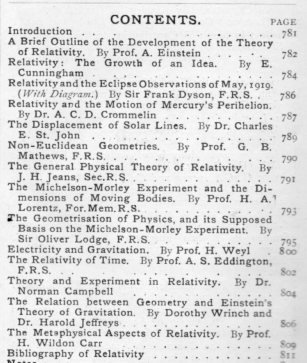
    I bumped in this issue of Nature  (volume 106, pp782–784) this evening, and as it turns out it is the “Special Number: Relativity” and published February 17, 1921–and it is packed. Somehow when I first looked at this weekly I mega-missed the Einstein entry–as is customary I work back-to-front, bottom-to-top (don’t ask) and was so taken by the collection of Big Names that Einstein’s escaped me. Einstein’s article is longish for this journal and concise, with numerous references in the influencing forces in his development of the theory of relativity (which he capitalizes).  Einstein nature 1921429
    The table of contents for this single week–though it is (roughly) a double issue of thirty pages or so–incoudes work by Cunningham, Frank Dyson, James Jeans, H.A. Lorentz, Oliver Lodge, Herman Weyl, A.S. Eddington, Norman Campbell, and Harold Jeffreys, plus a few pages of tight bibliography.  
    Einstein nature 1921430

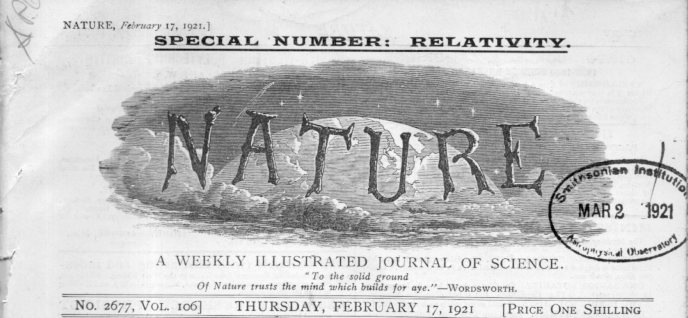
    Here’s the beginning of the Einstein article, courtesy of Nature, with the rest of it available from their website, here. My copy (formerly in the Smithsonian Institution) is too tender to open fully for the scanner, but the cover’s masthead is certainly available, and pretty. Abraham Pais notes in his Subtle is the Lord : The Science and the Life of Albert Einstein, that Einstein delayed the publication of the issue somewhat in his attempts to make a complicated issue fit in the space allot (as in the old Mark Twain adage, “If I had more time I would have written a shorter letter”).  So, the Einstein:

    A Brief Outline of the Development of the Theory of Relativity, by Prof. A. Einstein

    [Translated by Dr. Robert W. Lawson] 

    There is something attractive in presenting the evolution of a sequence of ideas in as brief a form as possible, and yet with a completeness sufficient to preserve throughout the continuity of development. We shall endeavour to do this for the Theory of Relativity, and to show that the whole ascent is composed of small, almost self-evident steps of thought.

    The entire development starts off from, and is dominated by, the idea of Faraday and Maxwell, according to which all physical processes involve a continuity of action (as opposed to action at a distance), or, in the language of mathematics, they are expressed by partial differential equations. Maxwell succeeded in doing this for electro-magnetic processes in bodies at rest by means of the conception of the magnetic effect of the vacuum-displacement-current, together with the postulate of the identity of the nature of electro-dynamic fields produced by induction, and the electro-static field.

    ·Posted by :

    ·in:

  • On Death and Mayhem in Children’s Alphabets–the New England Primer

    JF Ptak Science Books   Post 2355

    Now I lay me down to sleep, I  pray thee Lord, my soul to keep;If I should die before I wake, I pray thee, Lord, my soul to take.–New England Primer, 1784 edition

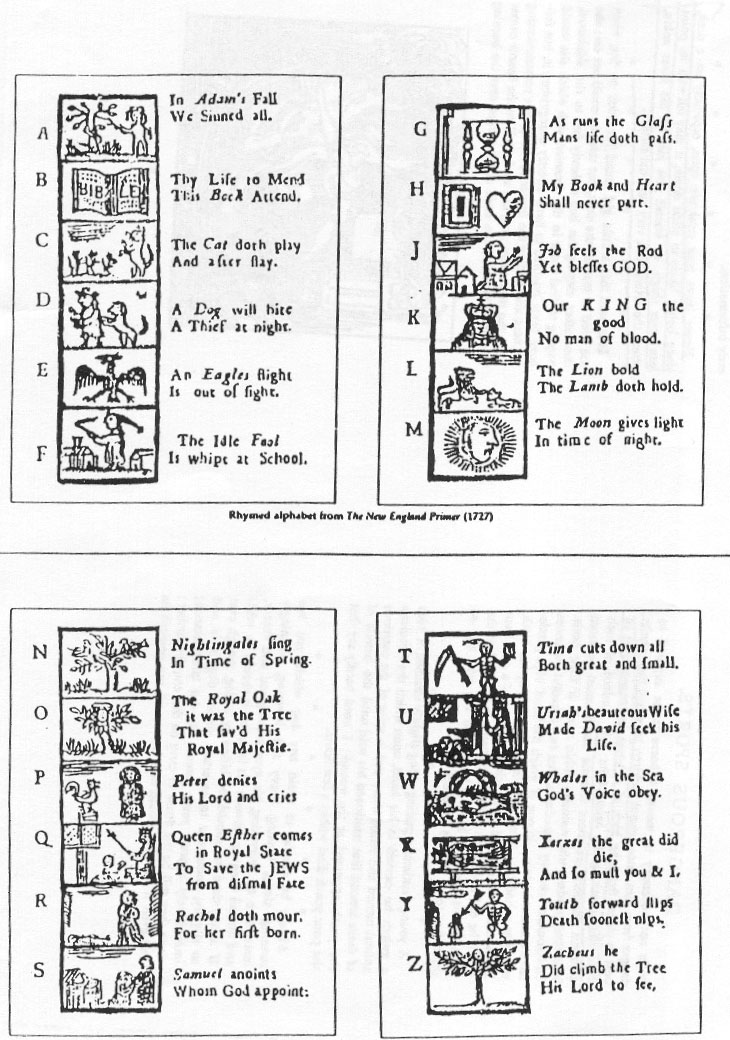
    There’s nothing scary in that is there?  The nightmare-maker may have its first introduction in the New England Primer, a book which was the backbone of North American education for many decades. as popular as it was and as much as it was used, print runs were not enormous, and most children would never actually own a copy of the book. It would be read to them for lessons, and that being the case much info was presented by vivid short rhymes , some of which are hard to forget because of the mental imagery they present.

    NEPrimer

    [Image source: Wikipedia, here.]

    For example the mnemonic devices used to help learn the alphabet is riddled with murder, mayhem, vice, death, and not all that much hope….except if you include stuff like “Job feels the rod, and praises God” as a Puritanical form of hope/salvation. Perhaps the writers were after the indelible impression as well as searing the cerebellum with the moral code. In fact, in the 24-letter alphabet presented in the   edition (“i” and “v” are not included), 12 of the letters are death- or violence-related, including the statements that we are all sinners, that cats kill things, dogs bite, fools are whipped at school, life runs out like sand in an hourglass, punishment deserves prayer, offensive things as big as armies can be swallowed up whole, a teary Rachel cries over her tiny dead child, time will kill you (again), kings will do and so will so, and youthful bits can of course kill you.  It is part-and-parcel I guess of the rearing of kids in the not-necessarily-glorious history of childhood.  Death and the possibilities of it or some close relative of it was a lot closer to reality than it is today, especially when the average life span at the time was well under 50 and infant mortality easily an order of magnitude more prevalent than it is today1.  And of course outside of the plague-of-death culture and the subjugation of kids for a better behavior there was also the screaming Calvinist theology that beat up/taught readers the abandonment of the self to the creator available to young and old.  

    This sort of indoctrination was hardly limited to the New England Primer, printed in this country as the first of its type beginning in the late 17th century (and with some familiarity several printings can be remember for famously having the “printed by B. Franklin” imprint in the 1760’s). It would be easier to name the child’s instructional that did not have this leaning (at least before 1880) though I am presently hard-pressed to think of an example off-hand).

    And lest we forget, the Grimm brothers wrote stuff for kid the vast majority of which we wouldn’t think of reading to our kids today–I didn’t.  

    Notes:

    1. Good national statistics for the U.S. before 1870 begin to get sketchy in this area, though from 1900 onward the numbers look pretty good.  Suffice to say that historians of medicine and Medieivalists and so on make pretty good educated estimates for these rates, and they’re not so good.  For example, in 1900 in America the average life span was 47 and the infant mortality at 16% (compared to about 80 or so and .7% today), though I cannot offhand find the stats for childhood survivability by age 10.  Looking back in time the numbers get really big, with some people  saying that childbirth mortality in the Medieval and Renaissance times were in the 30-50% range, and the survivability rate passed 10 was about the same.  I don’t have these rates for American colonial times, but I assume that they are closer to the Renaissance than they are to 1900 numbers.  And of course this does not apply to slaves, whose rates of survivability were smaller still.  

    ·Posted by :

    ·in:

    —
  • Help (1946)

    JF Ptak Science Books   Quick Post

    Cover--Help431

    This pamphlet was written in 1946 and is indeed a plea for help–mostly for food, and medical aid, for the displaced persons and survivors of WWII. It is a striking thing, blunt, necessary. The cover of the work does its job.  

    ·Posted by :

    ·in:

  • A Remarkable Chronology of Elusive Definition

    JF Ptak Science Books  Quick Post

     The source for this is a lovely article “Colonial School Books” by Clifton Johnson in the New England Magazine, volume 30, 1904, who sifted and read his way through a number of primers and turned out this work by “Fenning”, which urns out to be Daniel Fenning of the Universal Spelling Book, first printed in 1762.   This turns out to have been a best seller and kin to another British speller, Thomas Dilworth’s New Guide to the English Tongue (70+ editions in American before 1800!), both of which dominated the market until the first American-born speller was written by Daniel Webster in 1783.  In any event Fenning for whatever reason listed historical tidbits, one of which is this chronology, which is slight and charming and, well, a little elusive:


    [I cannot locate the reference for this–it obviously was re-set by someone in a more modern typeface; I’m sorry to say I cannot locate who. It wasn’t me. See HERE for a lexisnexis document on American Primers.]


    ·Posted by :

    ·in:

  • On Finding Pictures of 18th Century Everyday Common Life (1726)

    JF Ptak Science Books     Post 2356

    I’ve written earlier in this blog about the magnificent-ish and often described book by John Comenius called The Visible World…1, which also happens to be the first illustrated children’s book. It was also a book about virtually anything, and everything, and certainly not a book about nothing, because sooner of later Comenius would get to the topic and deal with it, right or wrong.

    The book was originally written in 1676, and translated into English in 1726; in that edition the translator states the purpose of the work:   

    To entice witty children to it, that they may not conceit a torment to be in the school, but dainty/are., For it is apparent, that children (even from their infancy almost) are delighted with Pictures, and willingly please their eyes with these fights: And it will be very well worth the pains to have once brought it to pafs, that fcare-crows may be taken away out of Wifdom’s Gardens…”

    Though much is said of other illustrations in that book (I was drawn to it for the illustration of the human soul) I don’t often see very much at all on the subject of his display of trades–for example, the barber, illustrated below. The trusting bit about these cuts is that it shows a relatively simple image of common working life, which frankly is not terribly common, or at least so with the commentary on the tools of the trade, which are listed in the text and annotated in the image.  It is interesting to see the reference to the comb used to sometimes “curl” the customer; and also the “crisping iron” which is a tong-like device that would be used to further curl the hair.  In the background we see the remnant from an older time, a barber using a “pen-knife” to “sometimes…cutteth a vein”, a practice of balancing the humours, of curing maladies from major aliments to gunshots to dandruff and ingrown toenails–anatomy and the understanding of the body may have progressed a little more quickly than figuring out disease.  This practice lasted in places until deep into the 19th century, and is still used today in  are cases where Dr. House might find something absolutely suited for this procedure, or for the application of leeches, which did much the same thing. (The Brits imported millions of these buggers from France for this purpose, even into the 19th century.) 


     There’s much much more to come in this book–just follow the link to the original at Project Gutenberg. 

    Notes:

    1.  The work itself: John Amos Comenius, Orbis Senfualium Piélus: Omnium Principalium in Mundo Rerun/ &f m Vita АШопит,  translated as Pictura et Nomenclatur, the Visible World, or A Nomenclature, and Pictures of all Chief Things that are int he World, translated into English by Charles Hoof…1726.


    ·Posted by :

    ·in:

  • An Annotated Poetry of Clouds

      JF Ptak Science Books  Quick Post

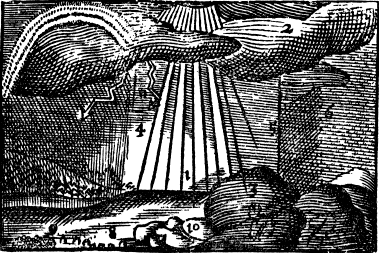
    Clouds cromenius

    [Image from John Comenius,  Orbis Senfualium Piélus: Omnium Principalium in Mundo Rerun/ Vita Аllопит,  translated as Pictura et Nomenclatur, the Visible World, or A Nomenclature, and Pictures of all Chief Things that are int he World, translated into English by Charles Hoof…1726.  See an earlier post here for more on Comenius. Image Source:  PROJECT GUTENBERG.]


    Clouds

    A Vapour, (1). ascendeth
    from the Water.

    From it a Cloud, (2).
    is made, and a white Mist, (3).
    near the Earth.

    Rain, (4).
    and a small Shower
    distilleth out of a Cloud,
    drop by drop.

    Which being frozen, is Hail, (5).
    half frozen is Snow, (6).
    being warm is Mel-dew.

    In a rainy Cloud,
    set over against the Sun
    the Rainbow, (7). appeareth.

    A drop falling into the water
    maketh a Bubble, (8).
    many Bubbles make
    froth, (9).

    Frozen Water
    is called Ice, (10).
    Dew congealed,
    (13) is called a white Frost

    Thunder is made of
    a brimstone-like vapour,
    which breaking out of a Cloud,
    with Lightning, (11).
    thundereth and
    striketh with lightning

  • Superior Cover Design: Battery Catalog, 1940

    JF Ptak Science Books   Quick Post 

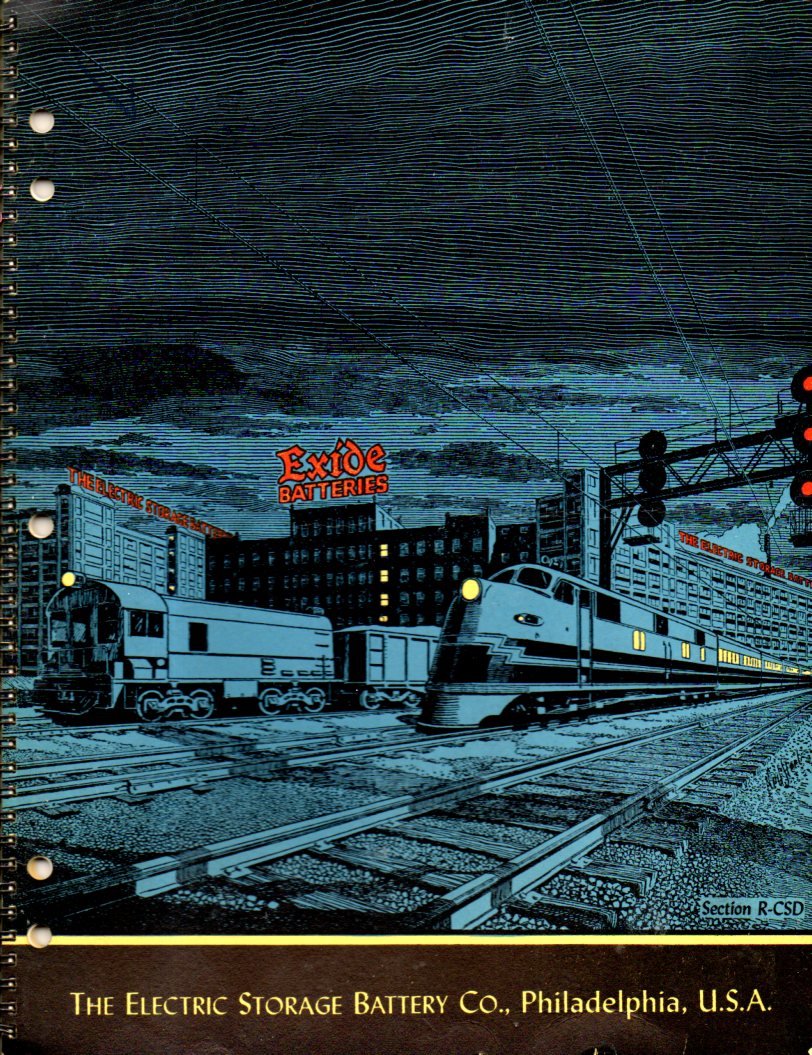
    This is another quick stop to appreciate a job-well-done, a wonderful illustration for a largish catalog (12×9 inches) for Exide Electric Storage Battery Company (Philadelphia), which was printed in 1940. It would be simple to have a plain text cover for this sort of thing, being batteries and all, but Exide went the extra step and had designed for them this wonderful cover. It seems to transfer the reliance of their battery in the dark and cold environment via the working trains, their lights working, safe and secure. It is understated and very effective.

    Cover--batteries433

    ·Posted by :

    ·in:

  • The Tall in the Short of It–the Giants of Microworlds

    JF Ptak Science Books     Post 2318

    I’ve posted a number of bits in this blog about stupendously large and enormously small things, but it is infrequent to find the story of something made exceptionally large in a reduced world.  Perhaps it is normal fare in the science fiction world, but I found the not-obvious but still-obvious making of a giant in microland to be, well, less than obvious.  

    There have been countless stories told of shrinking people, or the discovery of vastly small communities living withing a larger host community, and so on, like the following:

    http://static.flickr.com/67/202348136_833ca3249d_o.jpg

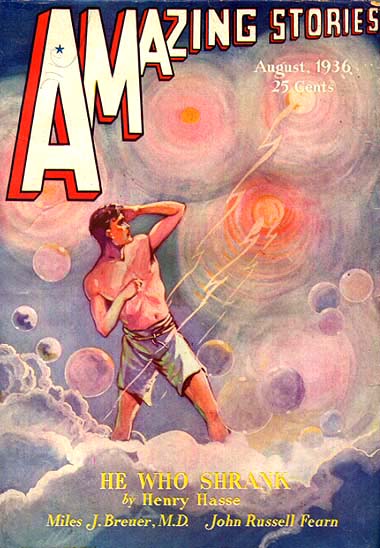
    This is a story by Henry Hasse and it involves a great scientist and the his elixir called “Shrinx” which after it has been injected into his assistant shrinks the man immeasurably, so science-fictionally small, that he has passed through the microscomos and “subuniverses” to the point where he emerges on a primitive place called Earth.  The assistant has traveled from a planet in a solar system revolving around a sun in a solar system in a galaxy in a universe to something small, something sub-atomic, landing in an electron holding within it its own universe. 

    That’s small. 

    And then there is this piece of magnificent ne plus ultra, where we remain in the microworld but where there are also micro-giants.

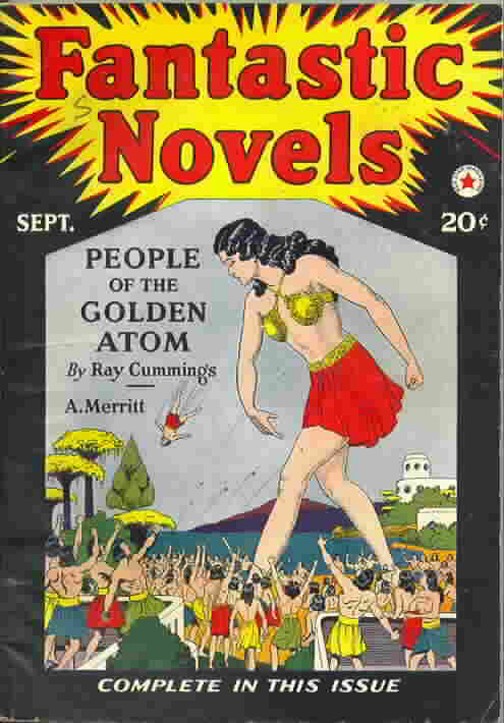
    The cover of Fantastic Novels (1921?) seems to tell a straightforward story, but as it turns out the giant is giant but one living within a world in an atom of a gold wedding ring.

    Man throwing

    Author Ray Cummings (1887-1957) found a nice writing niche for himself in his fictional discovery of a drug that could make people as small as atoms and then, once inside the microworld, could be made as immense as micro-mountains.  The Girl in the Golden Atom was one of a five-part trilogy(?)1 and so far as I can tell, Cummings used the hell out of his original idea.  The prose reads like it is punctuated with invisible periods every fifth word–evidently Cummings was so very busy writing 750 books and short stories that it  left him little time to edit or, maybe, think.

    It was a very nice surprise for me. That said, I can only imagine the giddiness and suspension of (dis-)belief when the mass market readership of Robert Hooke’s Micrographia got a look for the first time on what the small creepy crawlies that lived around them looked like under magnification.  Suddenly the blots and blotches took on real–and sometomes terrifying–forms.  These were basically unseen during their long interactions with human beings, until, suddenly, Mr., Hooke made his investigations and put a face on the unseen microworld and shared it with the General Public. 

    “It is my hope, as well as belief, that these my Labours will be no more comparable to the Productions of many other Natural Philosophers, who are now every where busie about greater things; then my little Objects are to be compar’d to the greater and more beautiful Works of Nature, A Flea, a Mite, a Gnat, to an Horse, an Elephant, or a Lyon” said Mr. Hooke at the end of his 28-page preface to Micrographia in 1665.

    https://historyofideasblog.com/a/6a00d83542d51e69e20120a5ec29c4970c-pi

    [Mr. Hooke’s drawing of his flea, in full and unexpected glory, with as much detail and armor as anything that had ever been imagined–only this thing was real, and common, and lived on you.]

    It may have been a similar shock to those seeing these images for the first time as it was for people to see Galileo’s images of the Moon, or to read him announcing that the perfect sky of Creation was actually not so, and that his telescope revealed ten-fold the number of stars that people could see with only their eyes, and which faith alone could not elaborate. 

    Yes, the incredible shrinking giant woman was a surprise but not on this order, not by a stretch–though it seems to be the world of science rather than scifi that has delivered the most shocking stories of the big and the small. 

  • Anti-Gravity Anti-Gravitas

    JF Ptak Science Books   Post 2319

    “Similitude of Substance will cause Attraction, where the Body is wholly freed from the Motion of Grauity.”– Bacon, Sylua Syluarum, 1626 

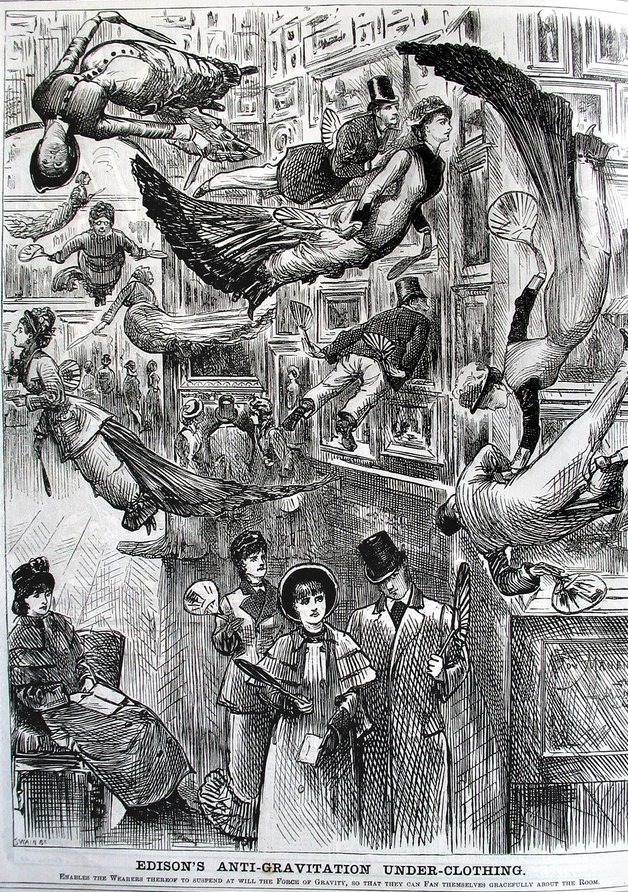
    It seems that in variations of the future that I have read that the concept of anti-gravity-something wasn’t taken so much seriously as it was a half-prank.  For example earlier in this blog I wrote about one of Edison’s least-known and most-nonexistent inventions, antigravity underpants. There was a time in the late 19th century when it was seen that Thomas Edison could do just about anything–so much so that the Brits in The London Punch gave him tongue-in-cheek credit for inventing (flying, so to speak), anti-gravity underwear.  The funny thing about this though is that the best thing that people could do with this new invention would be to go to a super-sized art gallery to look at paintings close to the ceiling. 

    Edison anti gravity b

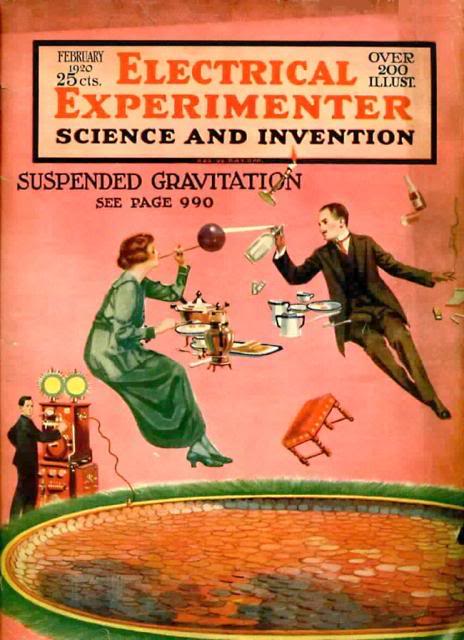
    Another example of gravity taken not-so-heavily is the scientific publication, Electrical Experimenter, where a seated couple is no longer so in the clutches of “suspended gravitation”, and again what the floating people engage in is play, the oman blowing a balloon and the man spraying selzter at it.  

    Anti-Gravity

    [Image source:  My Ear Trumpet, here.]

    The odd bit here is that “gravity” is found early on in the Oxford English Dictionary back to 1622 with G. de Malynes and N. Carpenter in 1625, and then of course with Roger Bacon a year later), though “anti-gravity” does not occur in use until 1945; and clearly the concept is on display in these three quick examples, though the phrase is not. “Anti-gravitation” however is used, though for some reason it is not included in the OED.  

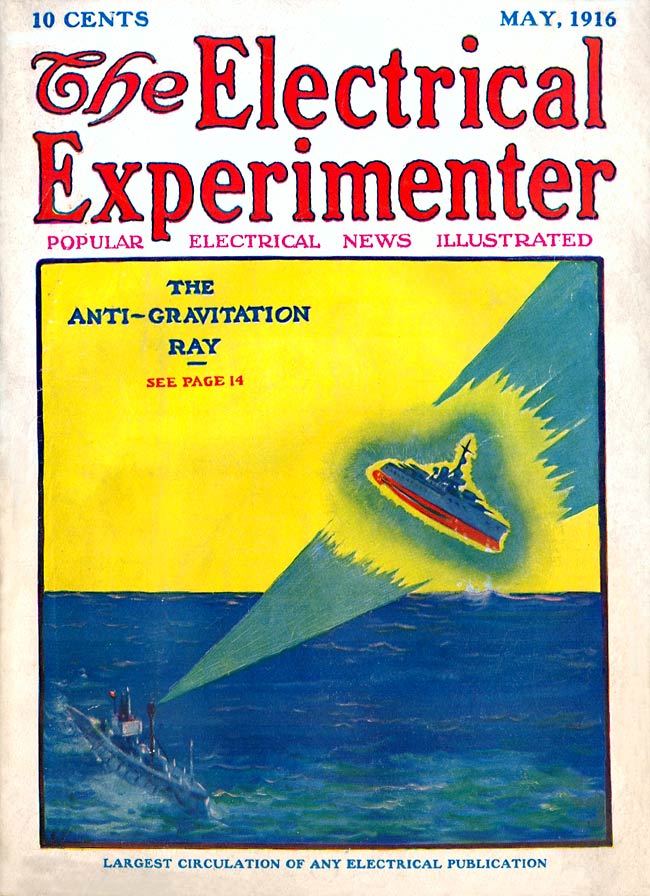
    The article, “Overoming Gravitation” by George Piggott, really did take the matter seriously, in spite of the cover illustration, as a quick read will verify.  More serious than that, though was an earlier and perhaps war-infested thinking mode was the militarily enhanceable anti-gravity ray (May, 1916).  

    Electricalexperimenter anti-gravity

     [Image source: Airminded, in a post about future weapons of the past, here.]

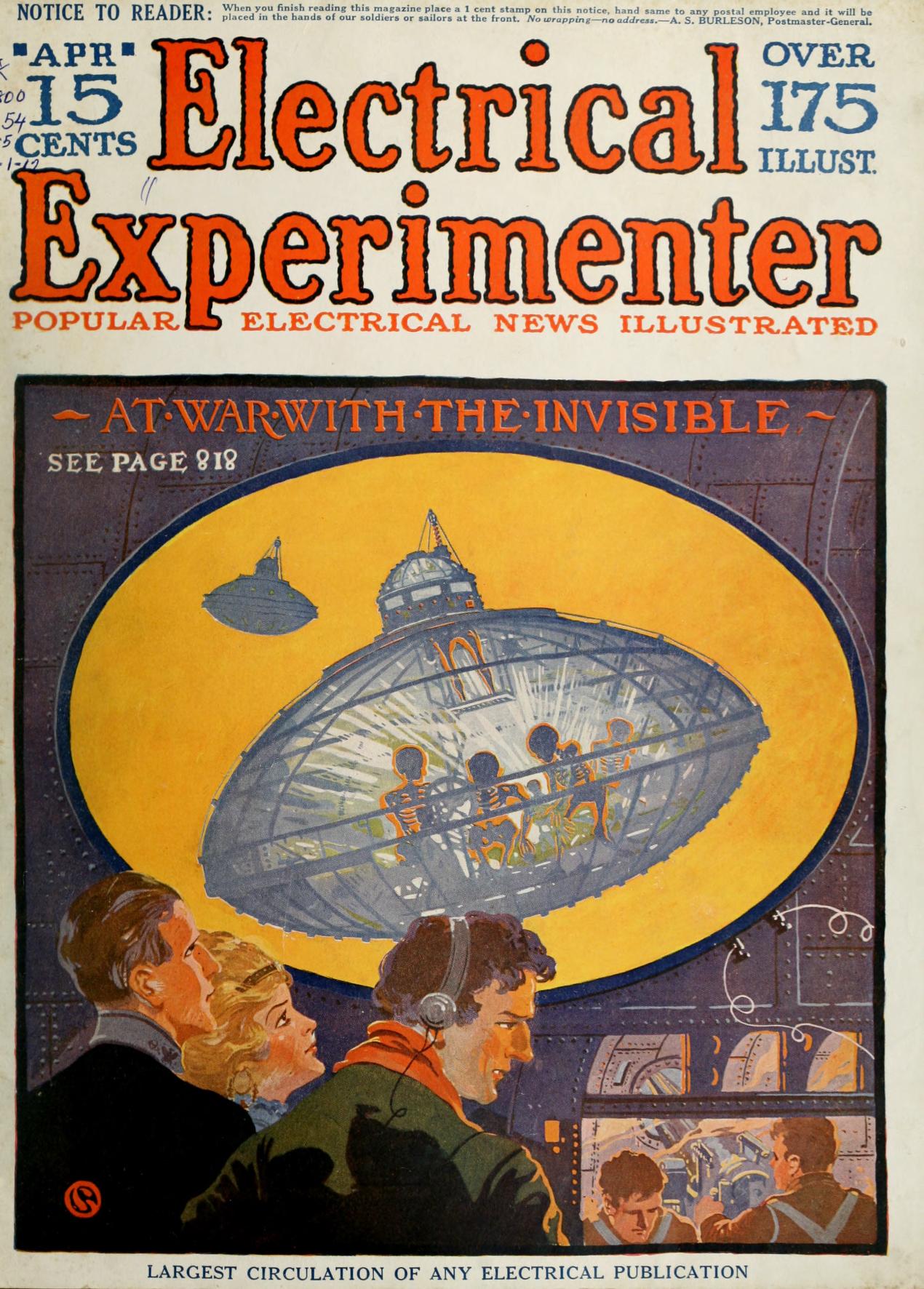
    Better yet (?) is this appearance in 1918 of an anti-gravity craft with invisibility options: 

    Antigravity and invisible

    [Image source: Inernet Archive, here.]

    And then of course there are examples like this, found in another early post on this blog, “Anti-gravity Atomic-powered Sun-fed Underground Woman of the Year 5000!”, here.

    In any event, these are a few example of the anti-gravity idea in the 1880-1920 period. No doubt there is a rich and full literature on this very thing–mainly what I wanted to do here was captued Airmnded‘s image to use for another day.  

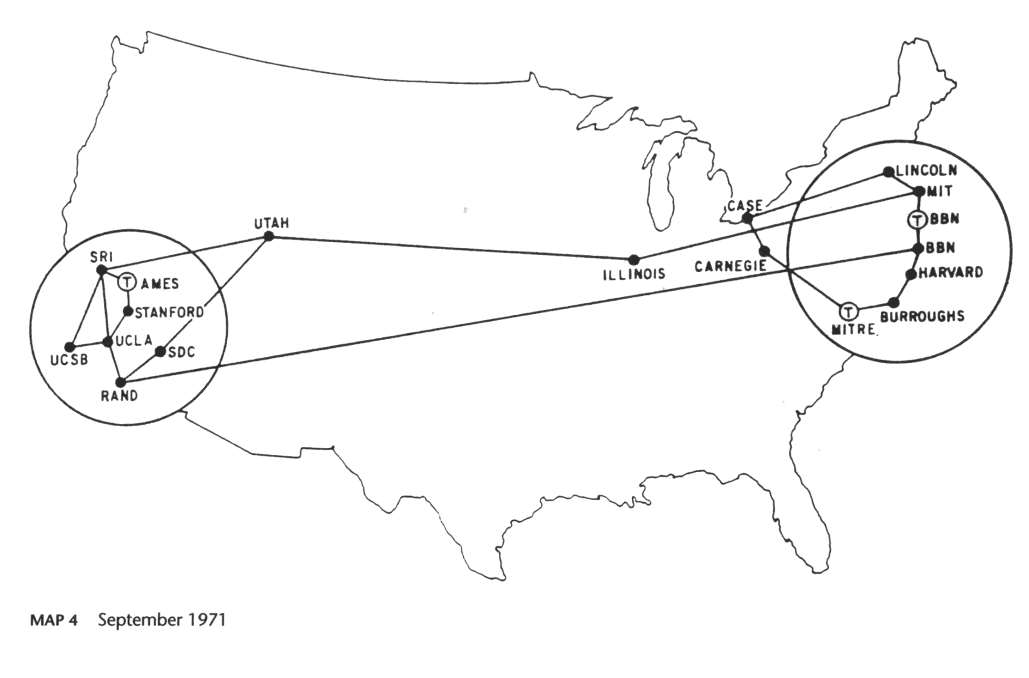
  • Map of the Information Dirt Road, 1971

    JF Ptak Science Books   Quick Post

    Arpanet3

    [Source: An Atlas of Cyberspace. See also Mappa Mundi for a good article on the 1980 version of this map, here.]

    I can feel the enormous hail coming down on me right now for this title–but by comparison, this 1981 map of ARPAnet must seem somewhat like the first three minutes of creation in the Big Bang saga, in its way.  This was absolutely, positively a remarkable accomplishment for the time, but compared to what it would become–measured in any number of different ways–this map seems proto-historic.  Compared to not being able to construct this map because there was no ARPAnet–well, that would have been a devastating thing. 

    The other thing about looking at the picture of the birth of something was that–unlike many other revolutionary creations–there were many people of high influence who saw the possibilities of the expansion of the thing.  Even Graham Bell and Edison had a difficult time looking into the future of the telephone…

  • Unusual Elevations

    JF Ptak Science Books  Quick Post

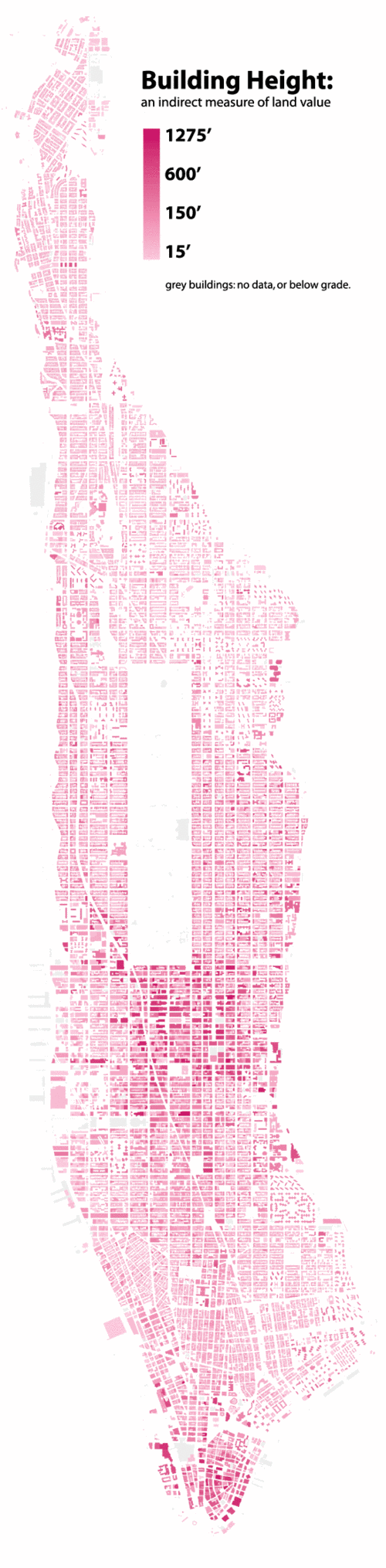
    It has seemed to me that an elevation map of the United States may be an interesting way of collecting and categorizing regional similarities and differences. For example, high desert folks probably have more affinity to one another than suggested by state maps–so to for Eastern states high elevation people in the Appalachian chain, similarities indicated more so by the number of feet above sea level than a state lines between North Carolina and Virginia (and so on). So far as I can tell no such map exists–but it came back to mind seeing this wonderful and innovative map of Manhattan building heights, brought to us by Bill Rankin of Radical Cartography.  


    Map manhattan-heights

Recent Posts

Archives

Categories