A Daily History of Holes, Dots, Lines, Science, History, Math, Physics, Art, the Unintentional Absurd, Architecture, Maps, Data Visualization, Blank and Missing Things, and so on. |1.6 million words, 7500 images, 4.9 million hits| Press & appearances in The Times, Le Figaro, Mensa, The Economist, The Guardian, Discovery News, Slate, Le Monde, Sci American Blogs, Le Pont, and many other places… 5000+ total posts since 2008.

  • Magic in NATURE, 1896

    JF Ptak Science Books  Quick Post    

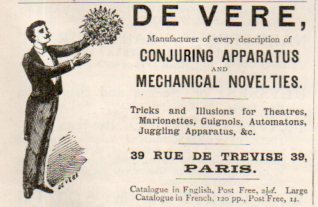
    Here’s a very unusual bit that I found deep in the a volume of the great Nature magazine, for July 9, 1896.  There were only 23 pages of text for the standard issue, with this one carrying eight very full pages of advertisements.  The issue is full of the expected–and then there was this, a great unexpected ad:

    Nature--ads471

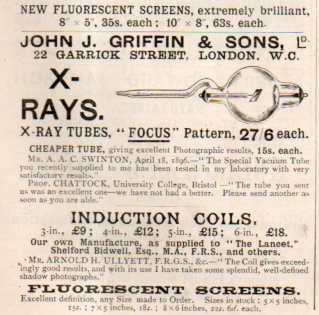
    Nature was a semi-popular magazine for the general sciences in the great Victorian age, so it is quite possible that a generalist/not-necessarily-science type woud place an ad in it. The “magic” part is odd, though the “mechanical novelties” part of it makes a lot of sense.  The other ads are lovely and engrossing and cover a wide spectrum of what teh active scientific mind in 1896 might want: x-ray tubes (for the earth-shatteringly new discovery of just months earlier), rock and mineral specimens, live specimens for dissection, galvanometers, descriptions of courses for science schools, mathematical instruments, and so on.  It would be a high privilege to see teh store associated with any one of these advertisements.  

    Nature--ads463


    ·Posted by :

    ·in:

  • A (Possibly) Famous Chair

    JF Ptak Science Books   Quick Post

    Chair detail

    This is actually part of the Tech Quiz series on this blog, though it should probably be in a Why-is-it-Famous series (if there was one) better yet.  It is a hard chair to identify byt itself, but as soon as you see it in context you’ll know what it is.

    And so:

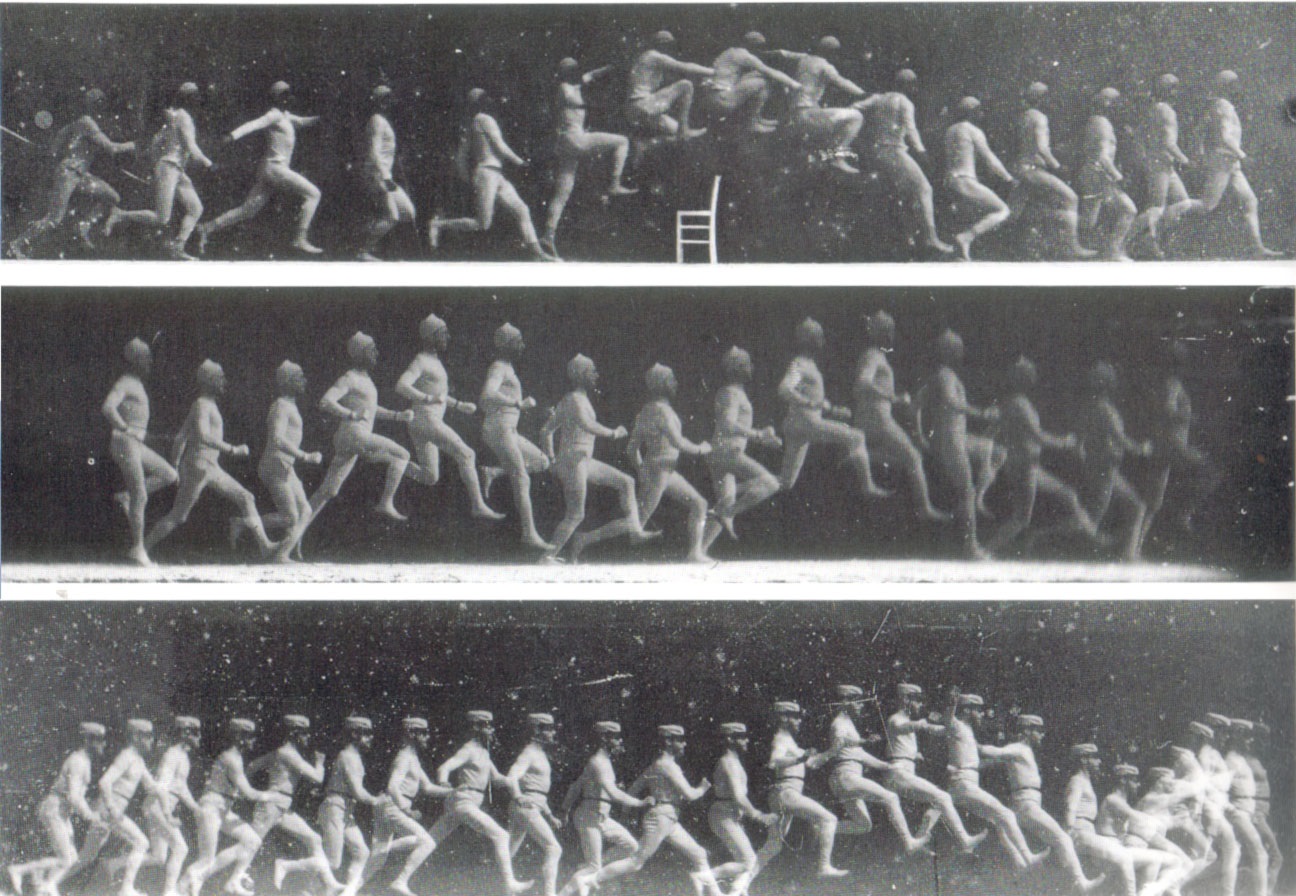
    Chair Muybridge

    Prior to the invention of photography, printed works on how humans should move in a given way and for a given task are uncommon and, generally, somewhat complex. The image I have in my head is the epochal work of the somewhat forgotten Etienne Marey who in the 1870’s created what was essentially the world’s first “slow motion” device. One iteration of Marey’s apparatus was basically a long series of ganged cameras recording a motion for a simple task at a given time frame and presented on a continuous strip of photographic paper, sort of like a motion picture with the camera speed set at three frames per second. The resulting images were phenomenal and showed people for the first time the exactness of all manners of simple motions–motions that no longer looked so “simple” once all of its aspects could be studied from captured photographic evidence.  Even the act of hopping over a small chair or bending to pick up a bucket of water were enormously revealing in a way like Robert Hooke’s Micrographia displayed the great detail and complexity of the seemingly simple fly.  Perhaps the most famous of Marey’s series of images was that of a galloping horse, which also for the first time revealed what exactly the horse’s legs were doing and proving that almost every painter in the history of art represented the galloping horse incorrectly. But Marey doesn’t actually fit the mold of directing the motions of people for a particular instructional purposes, though he does of course photographically reveal hundreds of actions that led to a revolutionary understanding of the body-in-motion.  

    Perhaps one of the most famous series of photographs was of the man jumping over a chair, and action so seemingly common that people wouldn’t pay too much attention to it.  But when there are 15 connected photographs of a 1.5 second event, there are entirely new worlds of motion revealed.  And the chair, that white chair, was at the heart of it, and may be one of the most iconoclastic props in Marey’s full cabinet.  Anyway in my mind it is a famous chair.  

    ·Posted by :

    ·in:

  • The Reverse Children’s Crusade, 1940. A note, with Videos.

    JF Ptak Science Books    Post 2362

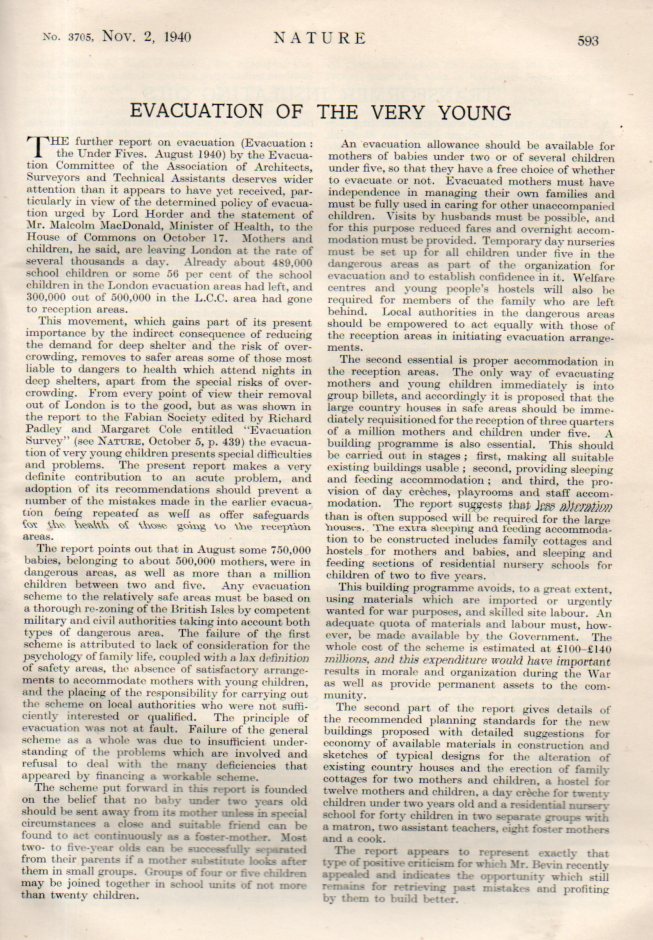
    It is good to remember the early part of the war and the efforts made by the people of Great Britain, and their sacrifices,  This notice appeared in the November 2, 1940 issue of Nature which recounts the evacuation measures of children during the Battle of Britain.  By this point more than half of the school children in the London evacuation areas had been been evacuated, with nearly a million leaving altogether in a total evacuated population of some 3.5 million people.  (At the very beginning of the war there was also an evacuation program for Jewish children from Germany to England–this was the  Kindertransport which brought some 10,000 children to safety.) It was a sort of reverse/anti “Children’s Crusade” (as in the subtitle for Kurt Vonnegut’s Slaughterhouse Five), where rather than an army of children sent to expel or convert Muslims from Jerusalem/Holy Land in the 13th century, the children were sent to safety away from a crusade against their homeland. The major difference besides the existence of their opposition is that this evacuation was real, and the so-called “Children’s Crusade” was not.

    Evacuation474


    The Battle of Britain was fought primarily from 10 July to 31 October 1940, so by the time this report was published the Brits had been able to turn the tide of Hitler’s plan.  (The air strikes wouldn’t really end until the Nazis turned their attention to the Soviet Union in Operation Barbarossa in May 1941.)  And that plan, named Luftschlacht um England, was to overtake and destroy the British capacity in the air, for as long as the English had command of the airspace there would be no way that the Nazis could force an invasion by land/sea (at least in the minds of the Oberkommando der Wehrmacht  and Hitler).  And so the Nazis failed–it was their first major defeat, and, especially, with the turning of attention east, it was a pivotal point of the war

    The numbers of loses: England: 1,023 fighters: 376 bombers, 148 coastal command aircraft  for a total of 1,547 aircraft and  544 pilots and aircrew killed.  There were also 27,450
    civilians killed and 32,138 wounded.  The Germans lost 873 fighters and 1,014
    bombers for a total of 1,887 aircraft and  2,500 pilots


    ·Posted by :

    ·in:

  • A Child’s History of Writing and Books Writ Small, 1726

    JF Ptak Science Books  Quick Post

    On Writing

    Children--writing

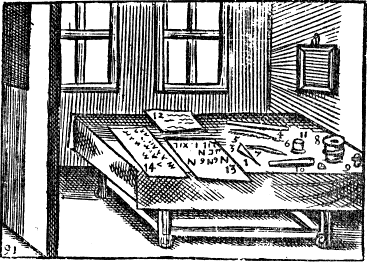
    [Images from John Comenius,  Orbis Senfualium Piélus: Omnium Principalium in Mundo Rerun/ &f m Vita Alопит,  translated as Pictura et Nomenclatur, the Visible World, or A Nomenclature, and Pictures of all Chief Things that are int he World, translated into English by Charles Hoof…1726.  See an earlier post here for more on Comenius. Image Source:  PROJECT GUTENBERG.]

    The Ancients writ
    in Tables done over with wax
    with a brazen Poitrel, 1.
    with the sharp end, 2. whereof
    letters were engraven
    and rubbed out again
    with the broad end, 3.

    Afterwards
    they writ Letters
    with a small Reed, 4.

    We use a Goose-quill, 5.
    the Stem, 6. of which
    we make
    with a Pen-knife, 7.
    then we dip the Neb
    in an Ink-horn, 8.
    which is stopped
    with a Stopple, 9.
    and we put our Pens,
    into a Pennar, 10.

    We dry a Writing
    13with Blotting-paper,
    or Calis-sand
    out of a Sand-box, 11.

    And we indeed
    write from the left hand
    towards the right, 12.
    the Hebrews
    from the right hand
    towards the left, 13.
    the Chinese and other Indians,
    from the top
    downwards, 14.


  • The Crumbling Media is the Crumbling Message, 1939: a Decomposition of American Communism

    JF Ptak Science Books     Post 2363

    Commie pamphlet decomposition476


    Commie pamphlet decomposition475 
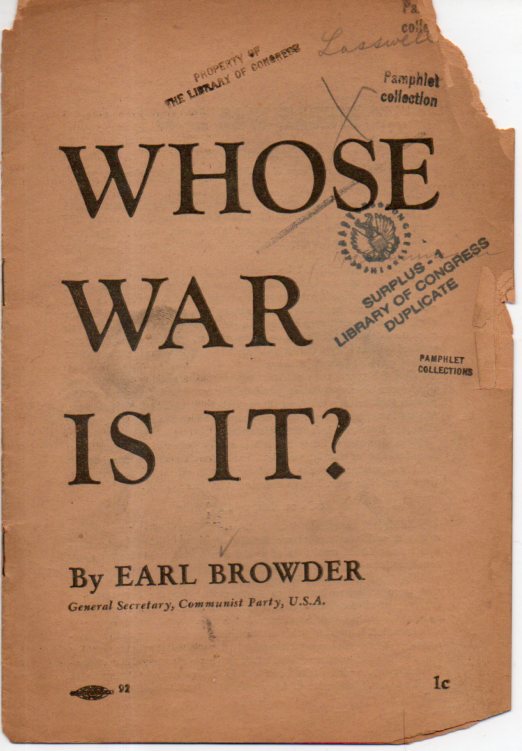
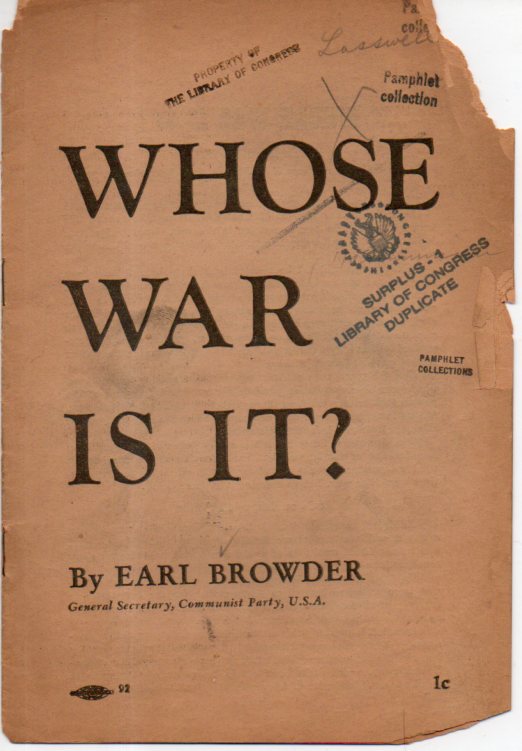
    Earl Browder was the General Secretary  of the Communist Party of the United States, this penny pamphlet (brown and brittle and crumbling today and smelling like a brown and crumbling and brittle Communist penny-pamphlet) is the text of a speech he delivered on the party’s anti-war stance on September 29, 1939–just a few weeks after the otubreak of WWII.  He called it an imperialist’s war, imperialists on both sides, both sides equally at fault.  The Soviet Union of course wants the war to stop-but-not-really, for both sides to cease and desist, sort of–the outcome would be the “brilliant Leninist doctrine” that would have both sides fighting each other to doom, so that the Soviet Union could succeed and replace the two vanquished imperialists. 

    Browder thought that the Communist Party in the USA wouls save the country, so long as the party wasn’t extinguished.

    In the dreamtime of Browder’s plans and hopes Joseph Stalin had this to say to Adolph Hitler in August 1939:

    “To the chancellor of the German Reich, Herr A. Hitler.

    I thank you for your letter. I hope that the German-Soviet Nonaggression Pact will mark a decisive turn for the better in the political relations between our two countries.

    J. Stalin”

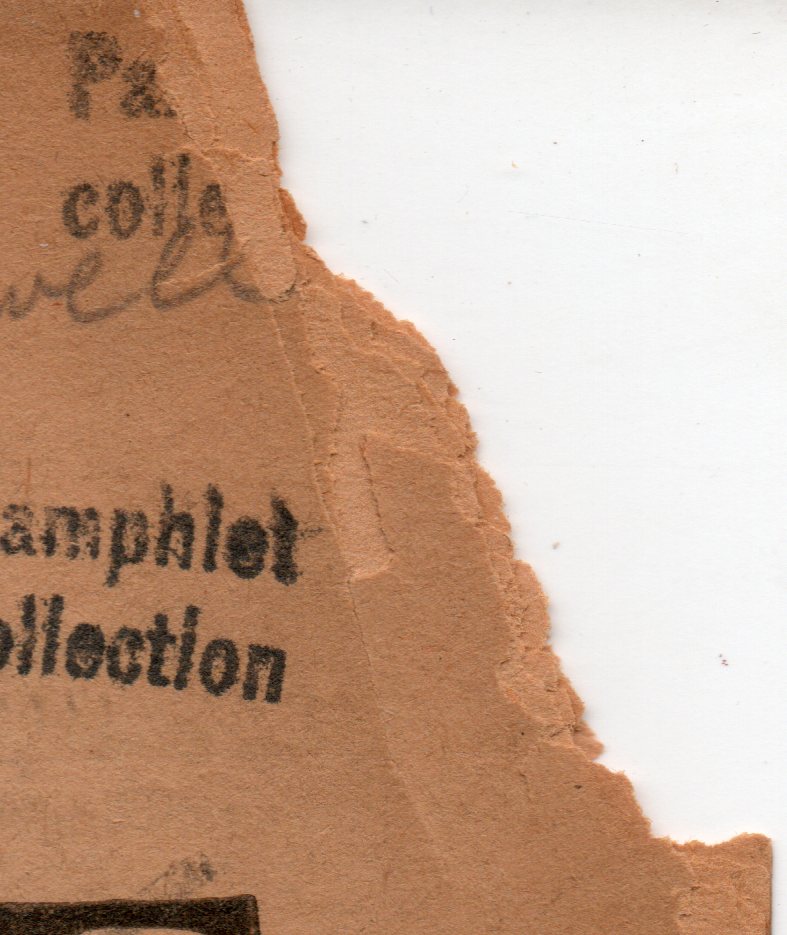
    He had signed a Non-Aggression pact with the Nazis, as well as a Economic Agreement and a Secret Protocol, the last allowing the Soviets to gobble up much of Eastern Europe.  This all changed of course on June 22, 1941, the launch of the Nazi Barbarossa plan, a massive and bloody attack on the Soviet Union.  That is when the Communist plan of anti-intervention in the Imperialist war turned instantly into an all-out war of intervention against the formerly brother Fascists in an effort to save Mother Russia.  On June 21 the USSR was friendly with the Nazis and allowed a semi-passive Imperialist hand to swipe up and ruin countries in Eastern Europe; on June 22 the federation is forgotten and the ill-gained graces destroyed as if they had never existed, and the Communist Party stands for something else.  It all feels that way handling this pamphlet, a not-so-slow disintegration of words and deeds.  

    Advanced decomposition:

    Commie pamphlet decomposition477

    ·Posted by :

    ·in:

  • Bubble Aeronautics

    JF Ptak Science Books  Quick Post

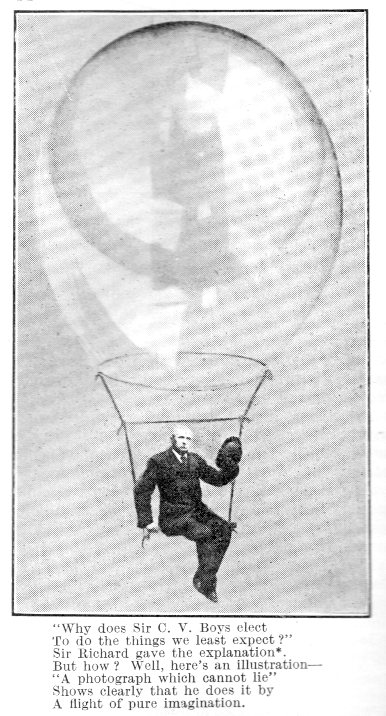
    CV Boys (1855-1944), the great experimentalist and all-around physicist/mechanic, wrote a classic book on bubbles in 1889 that found success and went through several editions—the bubble book not surprisingly was called Soap Bubbles and it was a fascinating journey through the world of bubbles and was they were indeed so fascinating and better called “bubbles” to the popular mind rather than “rotating films”. Late in life (and 53 years after the publication of the book) in the October 17, 1942 edition of the journal Nature Boys writes a funny little note called “A Flight of Pure Imagination” which is illustrated by a photograph Boys’ made in 1912 showing an aeronaut in a gondola of a big bubble balloon. It is a wonderful picture and accompanied by a nice verse about Boys, who for some reason, 30 years later, decided to republish his “permissible diversion”.   

    Boys478

    ·Posted by :

    ·in:

  • The Cold War and Spider Webs (1947)

    JF Ptak Science Books  Quick Post

    Blanche Murray wrote this short pamphlet in 1947, the designer completing the cover in the Russian-spider/American-fly motif. Ms. Murray was trying to warn the U.S. that World War III was “happening now” and that Russia had crept into the U.S. on “cushioned paws”.

    Russia War US479


    The author was more or less correct in the WWIII part, though not so much in the creeping Commie part–my quick-browse didn’t find any “Cold War” reference exactly, but that is what she was talking about there in 1947, two years before the Soviets had their own nuclear weapons (with the so-called Joe-1 shot) and three years before the Korean War began. Mr. Orwell called it in October 1945:

    “For forty or fifty years past, Mr. H. G. Wells and others have been warning us that man is in danger of destroying himself with his own weapons, leaving the ants or some other gregarious species to take over. Anyone who has seen the ruined cities of Germany will find this notion at least thinkable. Nevertheless, looking at the world as a whole, the drift for many decades has been not towards anarchy but towards the reimposition of slavery. We may be heading not for general breakdown but for an epoch as horribly stable as the slave empires of antiquity. James Burnham’s theory has been much discussed, but few people have yet considered its ideological implications — that is, the kind of world-view, the kind of beliefs, and the social structure that would probably prevail in a state which was at once unconquerable and in a permanent state of ‘cold war’ with its neighbors.”–George Orwell, Tribune 19 October 1945 (“You and the Atomic Bomb”) Here, via Project Gutenberg. 

    In any event I like the cover design, which is probably the best part of the pamphlet. Sometimes that is all you really need.  

    ·Posted by :

    ·in:

  • The Deceive-o-Scope–the Motion Picture in 1848

    JF Ptak Science Books    Post 2364

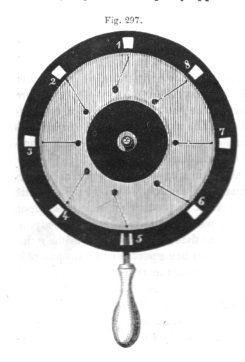
    The moving picture is at base a deception, a series of still shots shown/projected/viewed in order at 16 or 24 or 48 or 60 frames per second (although a new and incredible slow-motion device records at a billion fps) which is enough to allow the brain to fill in the connections in-between the frame with the latent image (persistence of vision) so that our mind perceives that the display is continuous.  The first mechanical approximations of what we think of as the motion picture came into being at about the same time (as these things do happen) and mostly independent of one another.
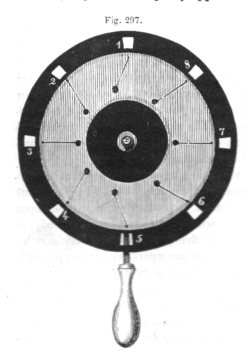
    Plateau491

    [Image:  J. Mueller, Principles of Physics and Meteorology, published in Philadelphia, 1848, image on page 311.]

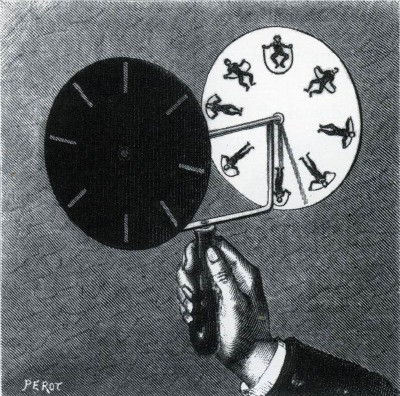
    The biggest name in this small group is Joseph Plateau (1801-1883), who constructed a two-disk slotted device in 1832, just at the same time as Simon Ritter von Stampfer (1792-1864, working in Vienna) constructed his own version.  Plateau called his the Phenakisticope; von Ritter, the Stroboscope–Plateau’s invention is Greek for what is essentially the title of this post.

    The device was relatively simple for the effect it produced and future that it held–in one iteration it was a slotted disk on which 12 or 16 images of successive motion appeared; when spun and observed through one of the slots in front of a mirror, the images seem to come alive, moving in one fluid-ish motion.  There are other models (as shown below) though the principle and effect are the same.
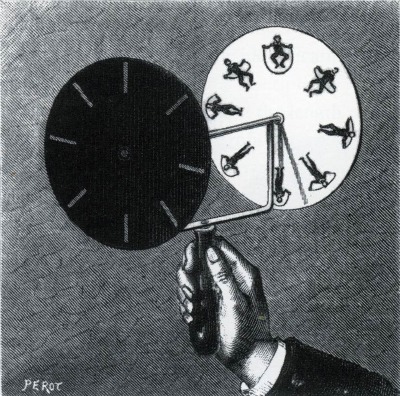
     Plateau

    This was not the earliest attempt at animated motion, though it is the first that comes to resemble what would appear about 60 years later and what we could recognize as a “motion picture” but without the film.  For centuries before this there was entertainment via moving shadows cast by paper/wooden puppets in Shadow Shows (actors using figurines positioned between a light source and a white cloth/screen on which the shadows were projected.  Of course there was also this effect using the hands, with instructionals appearing in book to appeal to the Victorian parlor adult and child (like “Frank Fireside’s” Lights and Shadows on the Wall, a Handy Amusement for Winter Evenings, which actually appeared a little after the Plateau invention but which was cheaper). In the field of applied optics there was the magic lantern, a 17th century invention (though it shows up i the Leonardo notebooks) and appearing in the remarkable Athanasius Kircher’s (S.J>!) Ars MAgna Lucis et Umbrae in 1646. A bit later in the hands of Joahannes Zahn came the Kircher idea but with a sliding disk with several images on it that when projected and moved from left to right suggested movement.  The magic lantern was usually used within or behind an audience and projected forward–Robertson raised the ante on this by being one of those in the 1840’s who projected the images from behind a scree that was in front of the audience, so that the appearance of the images was unforeseen, with shocking results (and thus the naming of his apparatus quite appropriately The Phantasmagoria). 

    Permanent capture of these images would come several years later with the invention of Daguerre in 1839 though that would not come into effect for moving pictures for another 50 years or so. A stop-action photograph of a continuous event would come slightly before that, naturally, with the work of Eadward Mybridge and Etienne Marey whose results were produced in the early 1880’s. Edison’s kinetoscope would come in the early 1890’s and produce the first projected moving images, though there are many other names besides Edison who could lay claim for bring the inventor of cinema, and who are all at least pioneers of the genre, including Le Prince, Varley, Friese-Greene, Dickson, and Sklandanowsky. And most of that pre-history occurred here, with Plateau and Cie. 

    It is interesting that in the short span between Plateau and the publication of the first image in Muller’s work in 1848 that so many other events in the history of science occurred that, in effect, segmented and expanded understanding of previously quick and discrete events.  Like Morse’s telegraph (1837), Theodor Schwann’s cell division (1838), Murchison’s silurian system/stratigraphy, Meyer’s conservation of energy (1842), Doppler’s effect (1842), Joule’s conservation of energy (1847), and of course, Daguerre’s invention of photography. 
    ·Posted by :

    ·in:

  • Memory-Inducing Advertisements—Wartime “Nature”, 1942

    JF Ptak Science Books    Post 2365

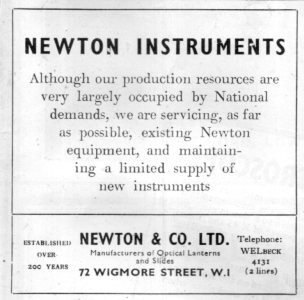
    Yes, it is 1942; yes, Great Britain had been fighting the Nazis for nearly three years at this point, the Americans joining the fight just 10 months prior; yes there were bombings; yes there were hardships. And with great stiff-upper-lippedness, this becomes somewhat seen in advertisements that I noticed in reading through Nature magazine for the last quarter or so of 1942. Scientific instruments and the components that went into their constructions were scarce or non-existent, conscripted to the war effort. For example Newton Instruments (72 Wigmore Str., Lond), announced on the front page of Nature that “our production resources are very largely occupied by National demands”, but that even though their inventory was far down, they were still servicing existing equipment.

    Wwii ads492

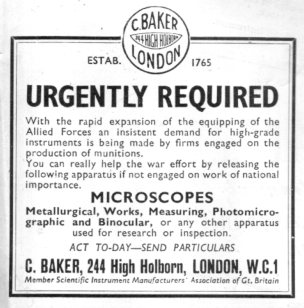
    Baker of High Holburn made a similar announcement, and went a step farther, asking clients in their URGENTLY REQUIRED ad to release scientific equipment to the national war effort.

    Wwii ads493

    On the back back of the October 10, 1942 issue of nature we see the ad for William A. Webb (Skinner Str., London) apologising for being “unable to meet…requirements at the present time, but feel sure you appreciate we are sending out precision balances where the need is greatest.” Then: “later, you will once again be able to get balances…”

    This does give a sense of pause, stopping the reader, finding the outside world, and war, showing itself of a giant scale in small scale in the pages of a scientific journal.

    And what a good show these companies made in their support of the united national effort.   

  • A Big Dark Spot in the History of Spots

    JF Ptak Science Books   Quick Post    

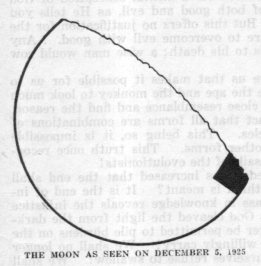
    Spots.  Being in a tight spot, Spot the dog, SPOT satellite, spot-on, spot price, spotlight, Data’s (STNG) Spot the cat, the Great Red Spot, and on and on, most of the remained of “spots” seemingly having to do with animal and largely bird names (spot-billed, -necked, -legged, -breasted, -tailed, etc.). There are certainly “spots” in the history of art, though I have a hard time referring to Malevich’s circles as spots; I have no problem calling Damien Hirst’s spots “spots” though I would not call them “art”. There were spots on the Moon for some time under they were revealed to be Mare, and in the world history of spots I think that was the only spot relating to the Moon, outside of the spot picked for the Apollo spacecraft to land. That is until today, when I bumped into this not-remarkable remarkable outsider-y pamphlet that was ostensibly a screed against the International Court of Justice and the League of Nations…except that the broadside opens with a mighty salvo proclaiming a miracle of a black geometric spot that appeared on the Moon’s surface on December 5, 1925.

    If there was any proof necessary beyond a drawing of the spot, there is none.  Why throughout the world of telescopes and observatories that no one anywhere thought to make a photograph of an irregular quadrilateral shape occupying 5% of the surface of a half-Moon is a secret mysterious outer space mystery secret.  Mystery.

    But there is a drawing of it. And here it is.  

    Moon spot494


    [Source of the mystery:  “The Great Miracle of Yesterday! As Thou Sawest it, so ws it!” , by “A Humanist”, one-page, two-sided broadsheet, printed 1925. I have a number of other bits by the author, all of which are as slippery with commonly-acknowledged reality as this one.]

    ·Posted by :

    ·in:

  • How to Make Yourself Hated by Your Children (1814)

    JF Ptak Science Books   Quick Post

    I was digging through a volume of The Emporium of Arts, and Sciences (Philadelphia, 1813-14), extracting the references for a long and fine article on the still-relatively-new steam engine (it runs 222 pages through several sections of the 448-page volume II) I stumbled upon this collection of pearls on how to raise children. Some of it is pretty good, some not, and some just compeltely and necessarily outdated and dusty and shrivelled and gone. But the first part, the very first bit, the very first sentence, is pretty much the whole enchilada. It was written by Christian Gotthilf Salzmann, who was the founder of the Schnepfenthal Institution, a new approach to education and a certainly-atypical school for the late 18th century.  


    [I own this volume though I’ve used the scans from the Internet Archive rather than spread the big-but-not-undelicate volume on the scanner.]

    ·Posted by :

    ·in:

Recent Posts

Archives

Categories