A Daily History of Holes, Dots, Lines, Science, History, Math, Physics, Art, the Unintentional Absurd, Architecture, Maps, Data Visualization, Blank and Missing Things, and so on. |1.6 million words, 7500 images, 4.9 million hits| Press & appearances in The Times, Le Figaro, Mensa, The Economist, The Guardian, Discovery News, Slate, Le Monde, Sci American Blogs, Le Pont, and many other places… 5000+ total posts since 2008.

  • Tools of a Scientist, ca. 1700

    JF Ptak Science Books    Post 2409

    Friedlein941

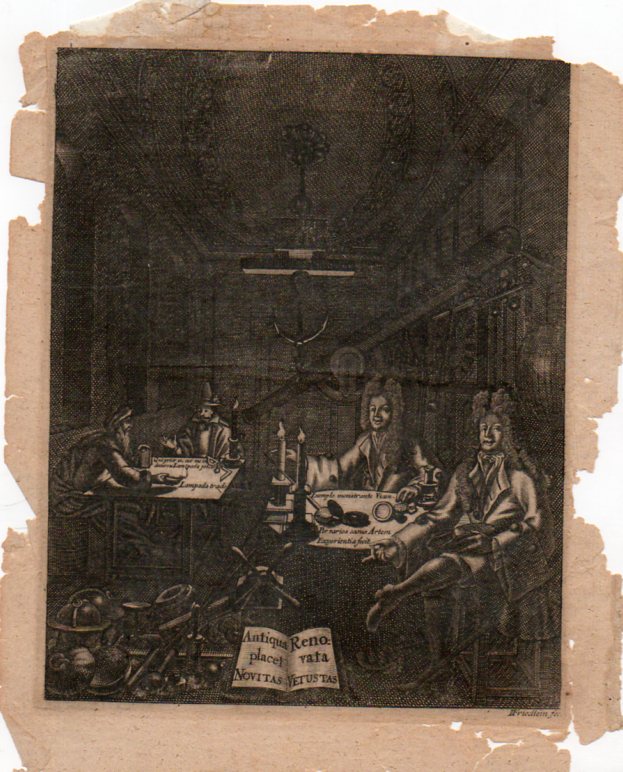
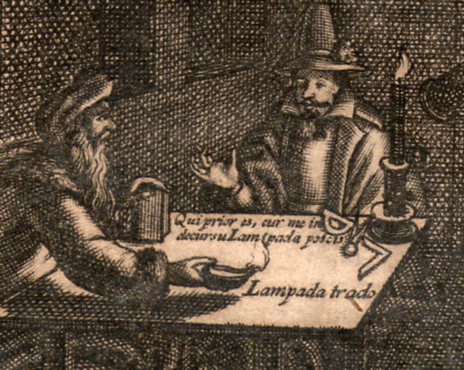
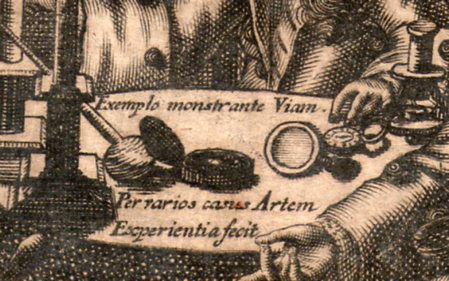
    This is an image of a  philosopher’s cabinet, engraving (on copper?) by “I. Friedlein fec”, who was Johnann Friedlein, an emigree from North Germany to Denmark, and who worked ca. 1680-1705. It shows the tools of the trade for someone working in natural philosophy (the name “scientist” would not come into use for another 130+ years or so1) and is an interesting insight into a small, polite gentleman’s club for experiment and investigation.

    Friedlein938

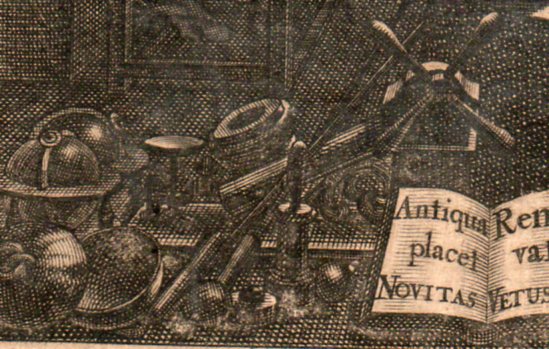
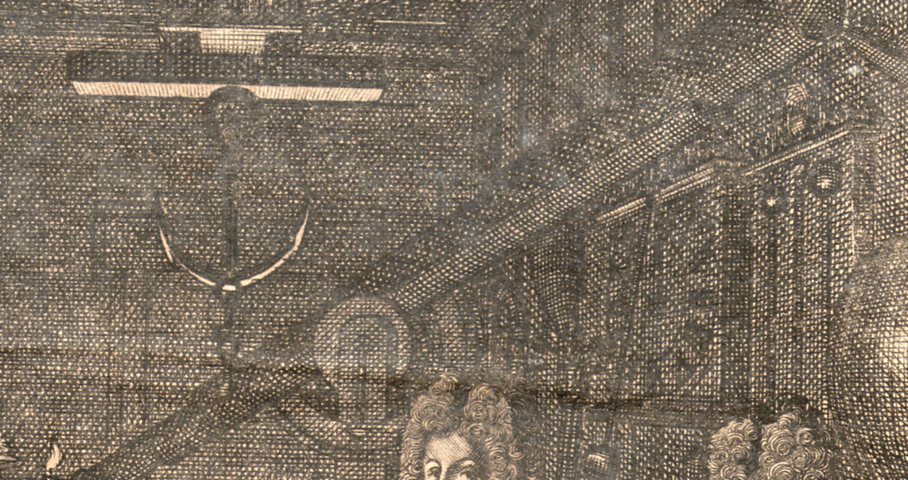
    The men surround a decent collection of scientific instruments–I can locate a compass, dividers, oil lamp, magnifying glass, microscope2  (at the right elbow of the figure on the right), terrestrial and celestial globes,  a (large) clock, barometer, and various weights and scales, and  behind it all looms a rather large refracting telescope3 (is it five inches?) 

    Friedlein939


    Friedlein940

    Friedlein942

    For all of these expensive and current instruments, the lighting these gentlemen set up for themselves is pretty poor, though of course it does add to the mystery and dark experience of the image.  

    Here’s another example of Friedlein’s  work, a frontispiece to Cryptographia, oder geheime Schrifften by Johann Balthasar Friderici, printed in 1685:

    Frontispiece, illustration from 'Cryptographia, oder geheime Schrifften' by Johann Balthasar Friderici, engraved by Johan Friedlein (17th century) published in Hamburg, 1685

    Nyt dansk kunstnerlexikon: bd. Indenlandske kunstnere (fortsættelse …)by Philip Weilbach:


    Notes:

    1. “Scientist”, in the Oxford English Dictionary (“science” is a much older word in English):

    1. A person who conducts scientific research or investigation; an expert in or student of science, esp. one or more of the natural or physical sciences.computer, earth, mad, natural, rocket scientist, etc.: see the first element.

    It is possible that the ‘ingenious gentleman’ referred to in quot. 1834  is Whewell himself.

    1834   W. Whewell in Q. Rev. 51 59   Science..loses all traces of unity. A curious illustration of this result may be observed in the want of any name by which we can designate the students of the knowledge of the material world collectively. We are informed that this difficulty was felt very oppressively by the members of the British Association for the Advancement of Science, at their meetings..in the last three summers… Philosophers was felt to be too wide and too lofty a term,..; savans was rather assuming,..; some ingenious gentleman proposed that, by analogy with artist, they might form scientist, and added that there could be no scruple in making free with this termination when we have such words as sciolist, economist, and atheist—but this was not generally palatable.
     
    1840   W. Whewell Philos. Inductive Sci. I. Introd. p. cxiii,   We need very much a name to describe a cultivator of science in general. I should incline to call him a Scientist. Thus we might say, that as an Artist is a Musician, Painter, or Poet, a Scientist is a Mathematician, Physicist, or Naturalist.
     
    2. “Microscope” (as a noun) in its earliest uses in English, in the OED: 
    1648   Bp. J. Wilkins Math. Magick i. xvi. 115   We see what strange discoveries of extream minute bodies, (as lice, wheal-worms, mites, and the like) are made by the Microscope, wherein their severall parts (which are altogether invisible to the bare eye) will distinctly appear.
    1651   N. Highmore Hist. Generation viii. 70   The white circle..by a Microscope appears now to be the Carina or back and neck of the Chick.
     
    3. “Telescope” (as a noun) in its earliest uses in English, in the OED:
    [1619   J. Bainbridge Astron. Descr. Late Comet 19   For the more perspicuous distinction whereof I vsed the Telescopium or Trunke-spectacle.]
    1648   R. Boyle Seraphic Love (1663) xi. 59   Galileo’s optick Glasses,..one of which Telescopioes, that I remember I saw at Florence.
  • 30 Interesting Typefaces, 1906

    JF Ptak Science Books   Quick Post

    The following are some of my favorite selections from the 210-page The Signist’s Book/Modern Alphabets, published in 1906.  

    Source: the Library of Congress, here.  (Thanks to Rebecca Onion at Slate Vault for surfacing this!)


    ·Posted by :

    ·in:

  • Mummy Cloth, New Harmony, and Color (1902-1936)

    JF Ptak Science Books   Post 2410

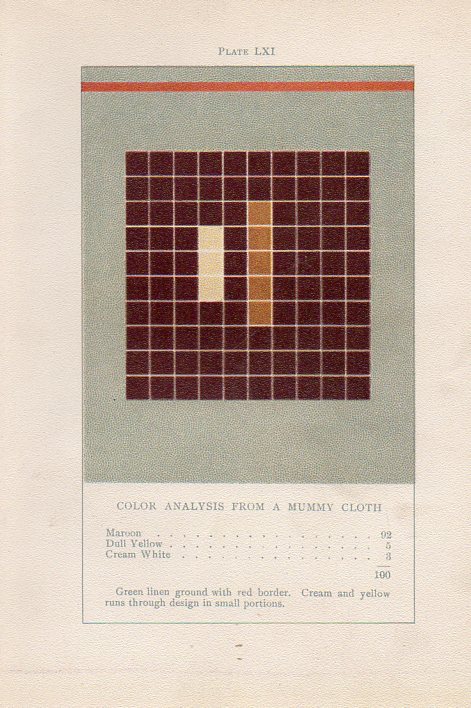
    Earlier in this blog, about seven years ago, I wrote about an extraordinary book by an aesthetician named Emily Vanderpoel called Color problems : a practical manual for the lay student of color (1902).  It is “extraordinary” in a narrower sense, and that “extraordinary” might not actually be positive for its original intent.  The extra-intent of the book, what has come out of it for me, was something that was unintentionally accomplished by the author.  The images that she used to illustrate her color theory ideas–the basis of which are not really comprehensible to me–turn out to be artwork in themselves, a found art, the artistry of the images taking over the original intention for the arrangement of their color.  She winds up with beautiful illustrations all on their own, a pre-abstract art abstract art, predating the non-representational art world by 11 years.  

    Here’s an example of her vision:  
    Art-vanderpoel186
    Here are some earlier posts on Vanderpoel on this blog:
    • What Color “Is”–an Unintentional Modernist Masterpiece of Book Illustration? (Here)
    • Quantifying art: the Art-ematics of Roger de Piles and Emily Vanderpoel (Here)

    Color theory is old and pretty—as a matter of fact there is a very attractive gathering of color theory models (in black and white, though) displaying some two dozen or more color models from the last 400 years.  People like Della Porta (1593), our old friend and resident oddball polymath crank Kircher (1646), the smarter-than-you-could-imagine Newton (1660), Waller (1686), Lambert (1772), the wide ranging and again polymathic Goethe (1792), Herschel (1817, who also ushered in our understanding of the other light-sensitive shape spacing medium of photography in 1840), the semi-forgotten Chevreul (1835), the beautiful Maxwell (1857), Wundt (1874, the early experimental psychologist who also looked for spirits/spiritmus and ghosts), von Bezold (1878), Rood (1879), Munsell (1918) Kandinsky (1914 and not decipherable by me) and Klee (1924), and so on towards the present, all tried to analyze the prospects of color.

    The funny thing is here is that I didn’t look at the Klees, so I didn’t see how much they have in common with the Vanderpoel color studies.  In a way it seems that they were both after the same thing: an understanding of the object in color-sense.  

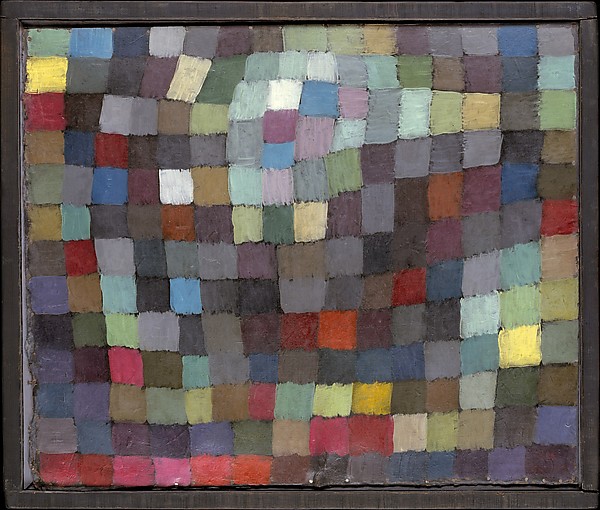
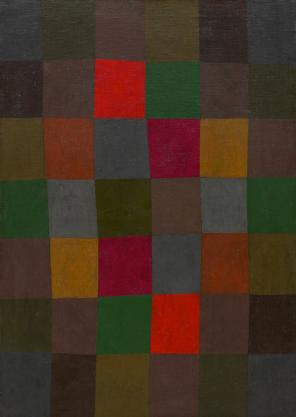
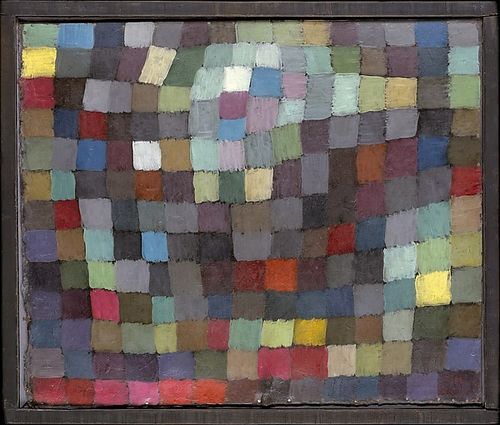
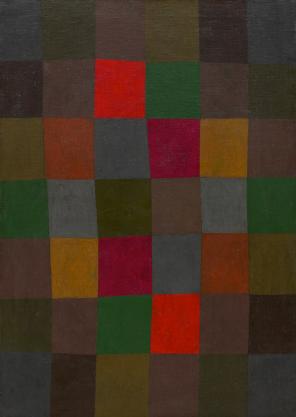
    Here are some examples of Klee’s grid paintings,  so-called (by Will Grohmann) “Magic Squares”, which weren’t square and not even straight, necessarily, but they were magical, and they did generate a divisional articulation of the color field that Klee was studying.  And in their way they do remind me of the earlier Vanderpoel work.  

    There is of course a lot that has been written on this aspect of Klee’s work,by Klee himself and many others, so I’m not going down that road this morning–I really just wanted to get on board with the Vanderpoel/Klee attributions.  
    Klee maibild

     
    Maibild  1925 (“May Picture”)  Source: Metropolitan Museum of Art
     
     
    Klee new harmon

    New Harmony (Neue Harmonie) 1936, via the Guggenheim Museum and the Painters Table 
     

    ·Posted by :

    ·in:

  • Graphic Display of U.S. Patents, 1836-1915

    JF Ptak Science Books   Quick Post

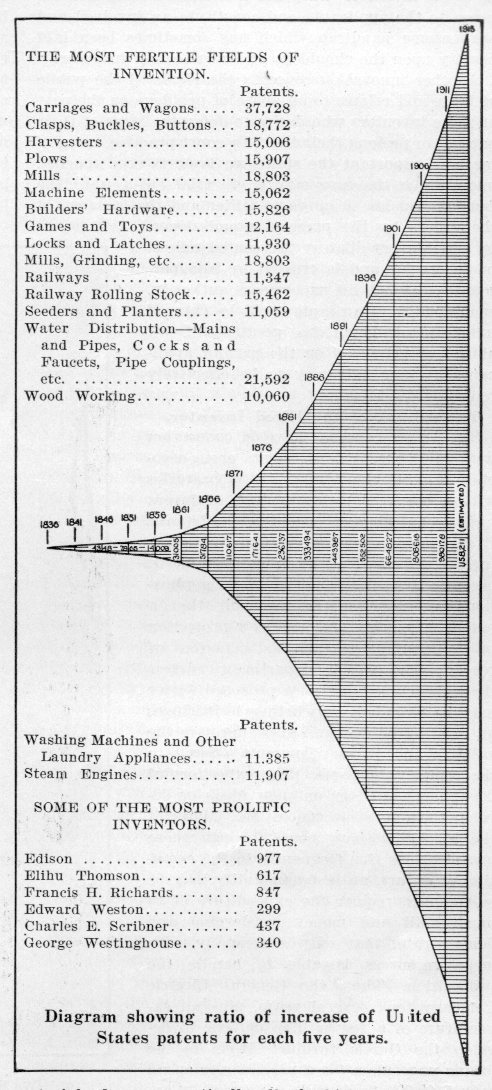
    In one of the articles celebrating its 70th Anniversary, Scientific American published these two graphs showing the development of patents from 1836 to 1915. They appeared in the June 5, 1915 issue, and distributed the patents also according to type. It is interesting to note that for decades that the magazine kept one page (or part of it) devoted to displaying newly-recorded patents–that practice was abandoned by the time the 1915 article appeared, which is too bad, because it was enjoyable to dip into the archive and see what was being patented at weekly intervals over the years.  In any event I’m not sure that I’ve seen visual displays quite like this, and so I share them:  

    Patent graph725

  • Roosevelt Ghosts and Hitler Caskets–Two Outsider Polemics (1943 and 1947)

    JF Ptak Science Books   Quick Post     Part of the Unusual Book Titles series

    Roosevelt Death723

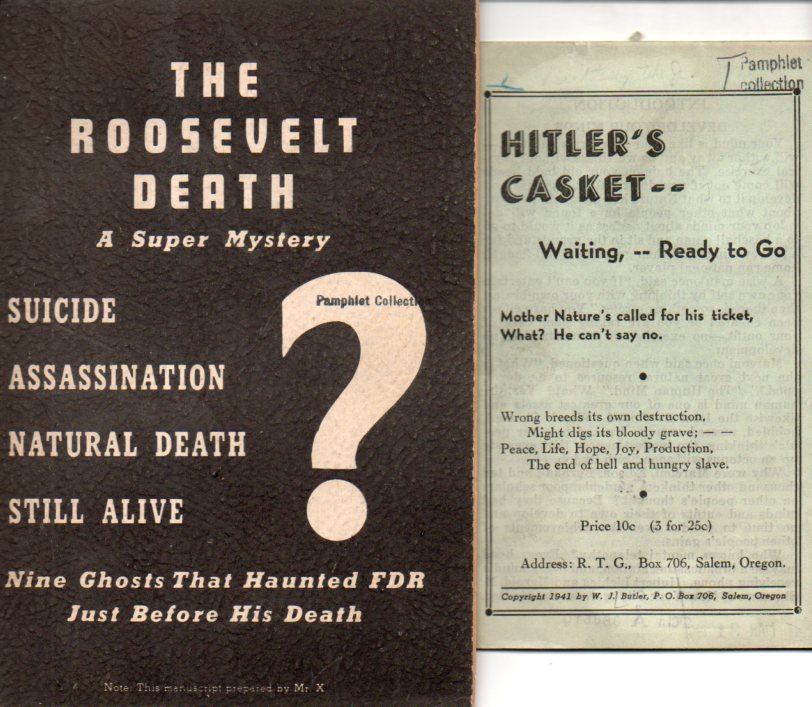
    I have my doubts that these two pamphlets have ever been placed side-by-side like this before this morning.  They are both, well, “reaching” in their respective pursuits, perhaps one more than the other.  The first, on the Roosevelt “mystery”, was published in 1947, and really had nothing to do with a conspiracy surrounding the president’s death–it was more a polemic against Roosevelt’s social policies, an anti-Communist and -Socialist screed  of some sort, a sort of awful thing. The cover though is full of weird questioning demands, which would make it either (a) hard to not pick up or (b) impossible to pick up–it is a close call.

    Now the second pamphlet is even more of a mystery, a mysterious secret mystery of questionable and excited mystery logic.  Published in 1943, it starts “In the beginning God made man from the mineral eggs in the rocks…God left man the job to make the devil, and Hitler’s co-workers took over the job.” I have no problem with the anti-Hitler-casket’s-waiting stuff, though it is wrapped up in swaddling-spaghetti-created-speak that is hard to unravel–again, that isn’t that big a problem, except that all I started to find was cold and wet spaghetti when statements were unraveled.  So I include these two items in the “Book Titles, Strange and Unusual” category and wait for the day that the many hundreds of these that I have here can be all displayed in a single room for their greater questionable glories.  

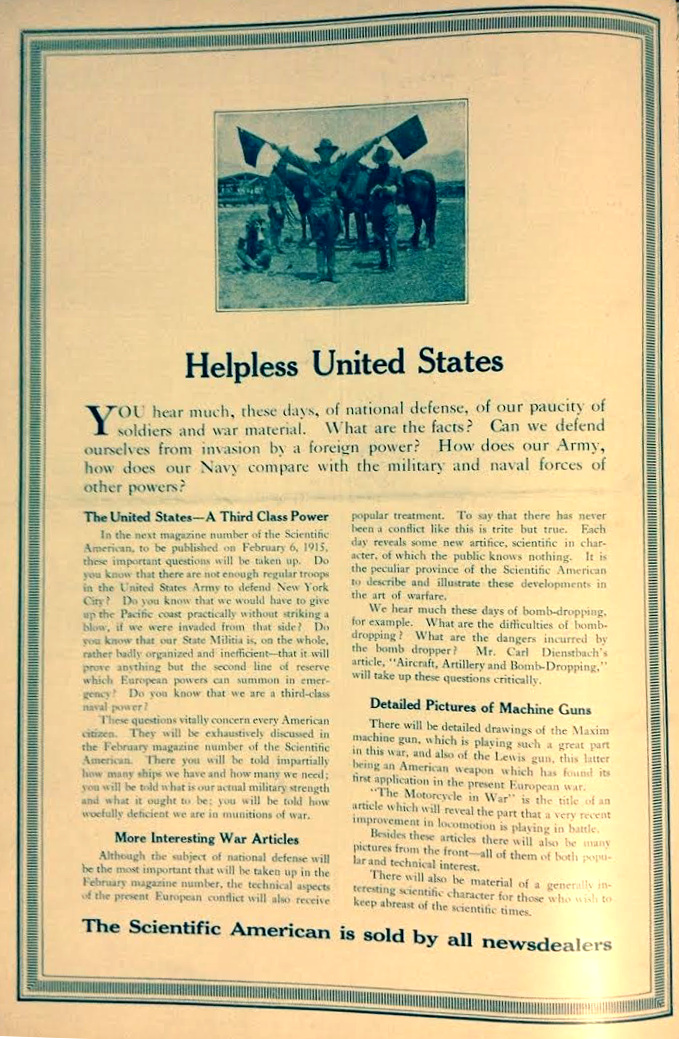
  • “Helpless United States”, 1915

    JF Ptak Science Books   Quick Post

    In January, 1915, in the  pre-Luistania/post beginning of WWI (by six months) days, Scientific American declared an interest in the state of the United States military and found it lacking. It posted this very strong statement to advertise a coming special issue investigating the status of the armed services.  

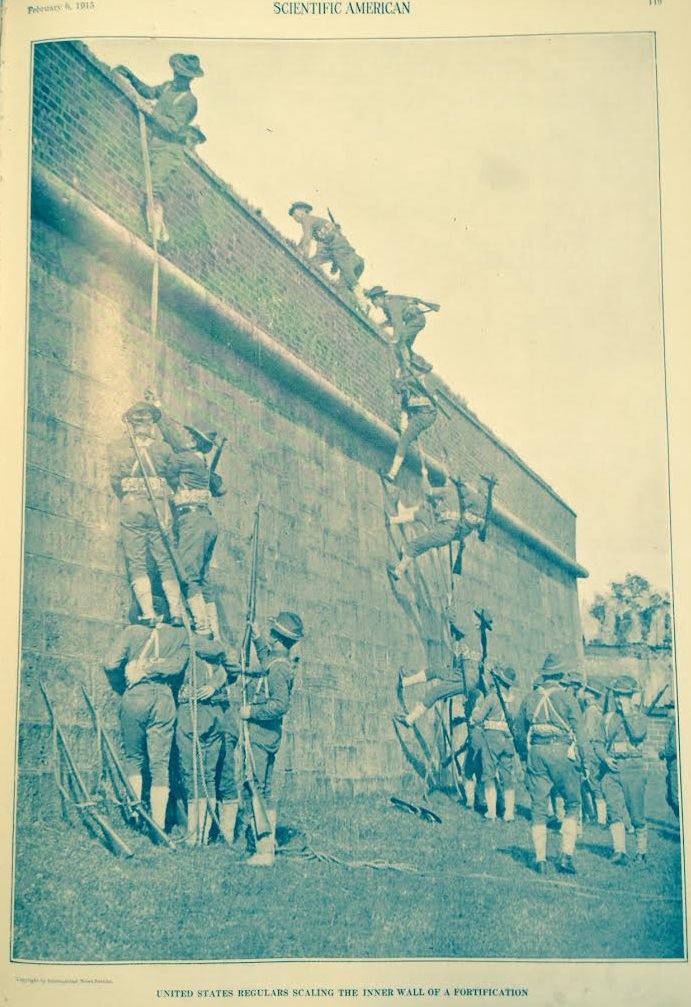
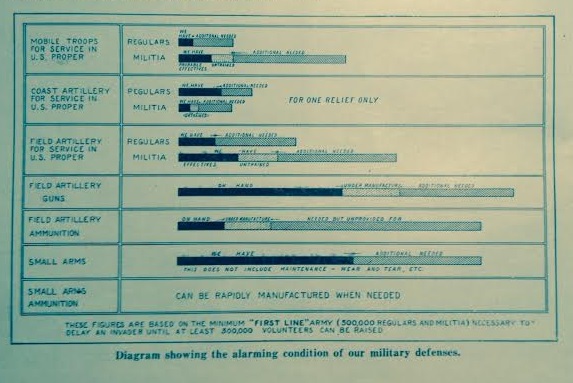
    Perhaps the most telling image in that special issue (of 5 February 1915) was an image of soldiers scaling a fortress wall–that’s pretty much the polar opposite of what training should have been happening, what with trench warfare and all.  There is also a photograph of practicing cavalry–and not a hint of a tank. There was little or no attention being paid to the developments in aerial/gas/tank/trench warfare, the armaments and munitions of war were ancient-esque, and the standing army numbered around 100,000 (plus 120k in National Guard), which was hardly anything at all compared to the fact the French Army on a single day (August 22, 1914)  in the Alsace-Lorraine region lost 27,000 dead and 40,000 wounded, and that there were already 3 million dead/wounded in the European theater.  There would be readiness factions and peace factions at work for the heart and mind of the U.S., but that wouldn’t really start for another month or two.  In the meantime, though, Scientific American took stock of the military situation, and found that the U.S. was militarily-prepared for almost nothing, so far as global war was concerned.  

    Helpless U.S.


    An indicator of the state of affairs:  

    WWI Army 1915 fortress

    WWi US army 1915

  • The Time Equation in Robotic Workers (1922)

    JF Ptak Science Books  Quick Post                                                                   

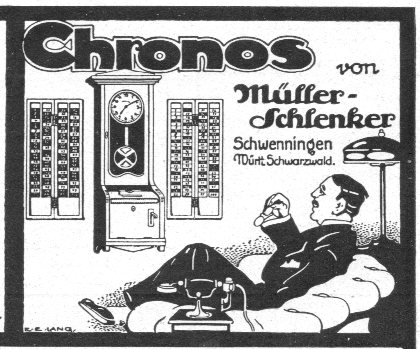
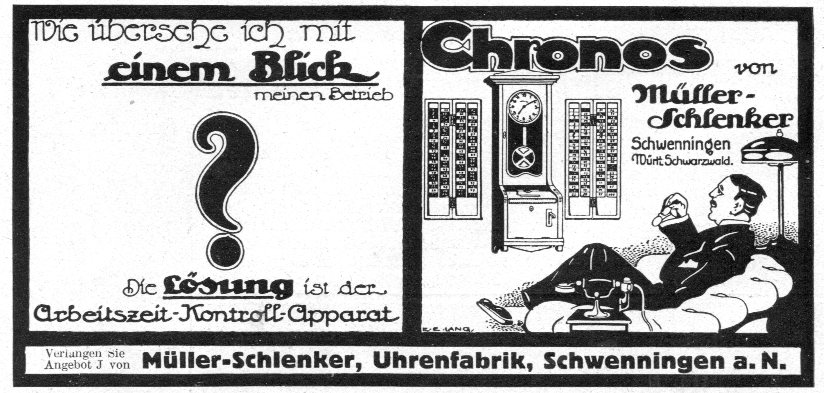
    This ad (which was tiny in real life) appeared in the back pages of the last issue in June 1922 of the Illustrirte Zeitung (Leipzig), and to me it is a little peep into the future of vast industrialization and the coming of robotic replacements for certain human interactions. In this case, the robotics (here three years after the term “robot” was coined by Karel Capek in his R.U.R. Rosumovi Univerzální Roboti)) is a time-card machine.  Here the happy business owner is able to recognize what workers were working and via a short stroll over to the wall of cards he could tell who was at work and for how long.  It was a control of worker’s time and in a sense of their output, a real sense of ownership of the worker and industrialization of people.  Time and motion studies and Taylorism had started nearly 20 years earlier, but I do not recall seeing many advertisements that were disposed to suggest these new relationships.  

    German--time cards523

    Which is a detail from:

    German--time cards521

  • “High Finance and High Treason (are) Synonymous” (1933)

    JF Ptak Science Books     Quick Post

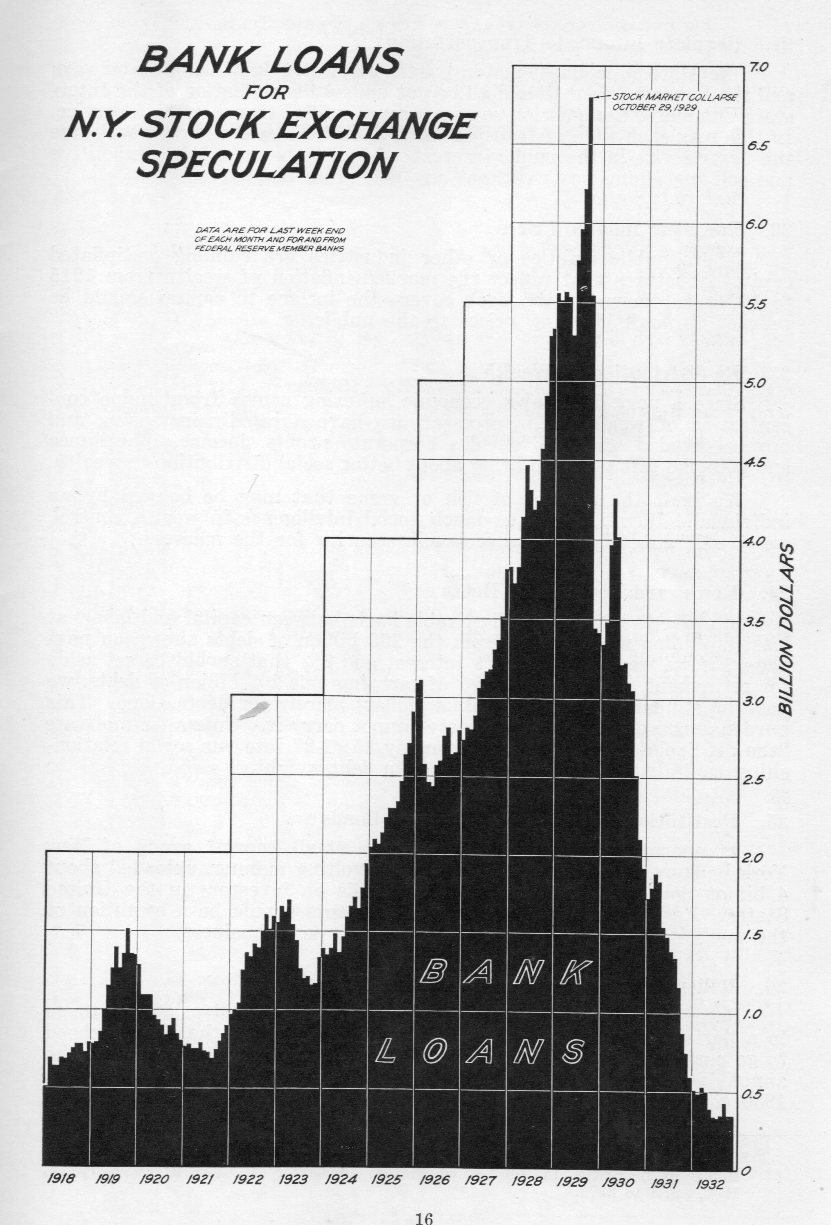
    Contributions to Way Out of Today’s Depression is a pamphlet written in a econo-engineering fashion by an engineer with some strong opinions on regulatory economics, many of which seem as far outside the normative and at the other end of the spectrum of the investing practices that necessitated such thinking. (For example, in addition to a discussion of very closely regulated federal interventions there is a statement that would make “high finace” a crime like treason, with similar punishment.) There was much flotsam amidst the jetsam and vice versa and perhaps nothing to salvage in the sinking mess, but this graph at least looked interesting: 

    Bank loans515


    And the very out-of-the-ordinary cover, which has a very definite Outsider quality to it:

  • What if the Future Got Here All at Once?

    JF Ptak Science Books  Quick Post

    I retrieved something just today that I wrote a long time ago on the nature of the future. It is not the standard Stanford Encyclopedia of Philosophy, or Oxford English Dictionary, or Websters (1st edition), or Johnson’s Dictionary definitions, and would be closer to Ambrose Bierce’s Devil’s Dictionary if mine was only smarter. 

    Question mark[Design from an ad in Illustrirte Zeitung, 1922.]

    Johnson’s definition of “that which will be hereafter” is simple and pleasant and nicely sandwiched between two other words that give some greater flavoring if only by chance:”futtocks” (“the lower timbers that hold the ship together”) and to “fuzz” (“to fly out, in small particles”), both of which can be applied to the idea of the future.  Bierce’s “that period of time in which our affairs prosper, our friends are true and our happiness is assured” may be closer to the truth if we made the truth up as necessary. The Stanford examples get too difficult too quickly and are extremely wide and varied and left me to do nothing but push on to the maker of American words, Mr. Webster, who is fairly poetic on the issue.  “That which is to come hereafter” he writes, “that will exist at any time after the present, indefinitely. The next moment is future to the present”.  The OED is pretty and smart: “That is to be, or will be, hereafter. Often qualifying a n., with the sense: The person or thing that is expected to be” and giving the first example of use from Chaucer, “Futur tyme, er I was in the snare, Coude I not seen”.

    In any event, here on January 1, I offer my Five Points of reference about the future:

    1. The future doesn’t necessarily get here all at once–if it did we’d be in trouble. Big Trouble. Then everything that will ever be is going on at the same time.
    2. The future may already be here but is not recognized.
    3. The future may be interesting or not but at least it is different from the present until it becomes that itself.
    4. The future may be stupid and it may be smart–that all depends on the observer.
    5. Outside of the past and the present, the future is the only thing we’ve got. 

    As I type this out in my present the words are accompanied by David Byrne, “In the Future”, from his Knee Plays which to me will continue to be a great song (in the future).  See an earlier post on Mr. Byrne, Dividing by Zero: David Byrne and Herman (“the Fat Man”) Kahn Sing the Future Blues.

  • A Solid Ring of Neutrality–German Propaganda, 1940

    JF Ptak Science Books  Quick Post

    German trade war539

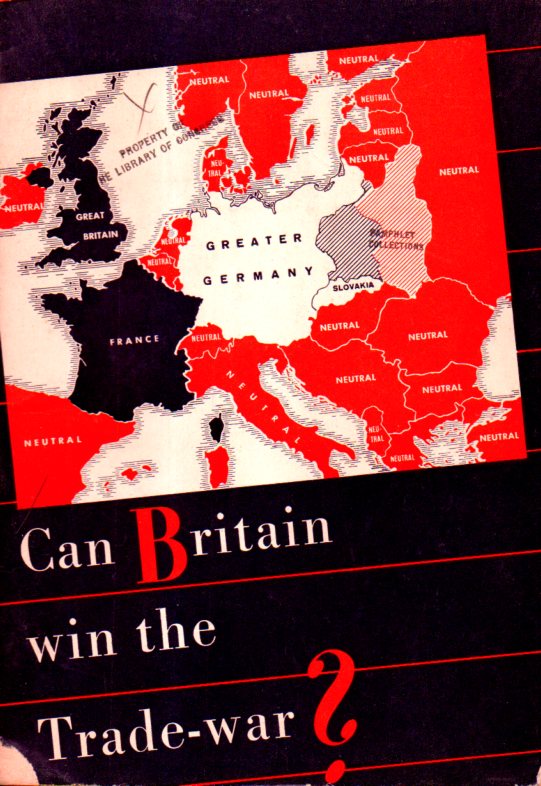
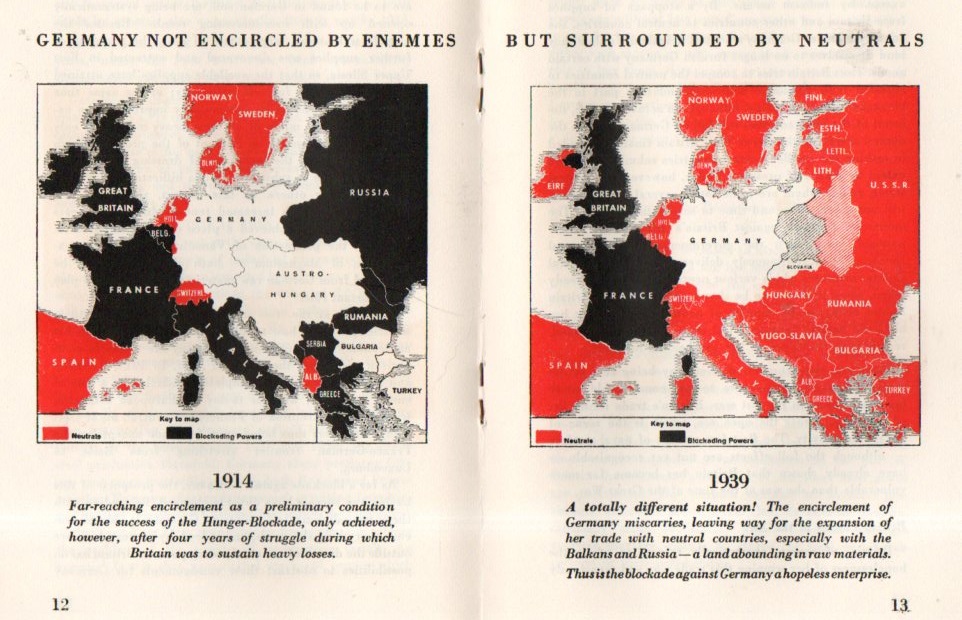
    One thing is for sure–this pamphlet, which has no place of publication or date–was definitely a German war propaganda effort, printed in English, published in Germany, and I guess distributed wherever the English-language-winds and luck would take it.  My copy come from a collection that I purchased from the Library of Congress, and it is luckily stamped August 6, 1940, for the date it was received by the library. So the summer (or earlier) of 1940 is the date: the Battle of Britain had begun in July, Dunkirk had been evacuated June 4, France surrendered a few weeks later, and the war was not going well for the U.K.  Germany was still a year away from their disastrous attempt to conquer the Soviet Union with Operation Barbarossa, and at this time in 1940, the U.S.S.R. was its vital trading partner. Great Britain was waging a successful economic war/blockade against Germany, which was without any real finance and with no reserves to purchase foreign goods, so in spite of the successes of the invasions and Blitzkreig, the Brits were enjoying a certain level of success. And so this pamphlet appears, one of others, a small part of a hearts-and-minds campaign to try and apply pressure to Britain’s allies to convince her to sue for peace.  

    German trade war540

    The main thrust of the maps of the pamphlet was to show Germany surrounded by not-threatening allies, pillowed by neutrals and countries it had overtaken (with no attempt made to label Poland).  The interior map (above) is a very faint attempt to show the comparative strength of Germany being surrounded by neutrals in 1939 as compared with being surrounded by enemy countries in 1914. The message of course was that Germany was strong in 1914-1918 in spite of the “threatening” neighbors, so with relatively benevolent neighbors in 1939 they would be even more effective as a war-making national machine.  Perhaps this had some influence somewhere, maybe among the Vichy French.  And some elements in the U.S. 

    The Nazis certainly liked their red.

  • Blitzkrieg Baby You Look So Cute (1941)

    JF Ptak Science Books  Quick Post

    Blitzkrieg baby music[Source:  University of Missouri – Kansas City.http://library.umkc.edu/spec-col/ww2/1939/jive.htm#jive]  I made a post just now on German propaganda warning and harrowing the Brits to come to the peace table because Germany was surrounded by non-threatening neutral countries which in effect were surrounding Great Britain.  Of course when I posted it I immediately bumped into this piece of music, “Blitzkrieg Baby (You Can’t Bomb Me)”, by F. and D. Fisher. The ong is much like its title, a kind of a neutral song so far as where it stood on neutrality and Blitzkrieg, though it does imply that if the Germans did attack that whoever it was would not be neutral, though that woul dbe stating the obvious.  Anyway, it is an interesting find to me, and the performance is first class: greats Lester Young on sax and Una Mae Carlisle singing make this high, um, calibre.  

    ·Posted by :

    ·in:

Recent Posts

Archives

Categories