A Daily History of Holes, Dots, Lines, Science, History, Math, Physics, Art, the Unintentional Absurd, Architecture, Maps, Data Visualization, Blank and Missing Things, and so on. |1.6 million words, 7500 images, 4.9 million hits| Press & appearances in The Times, Le Figaro, Mensa, The Economist, The Guardian, Discovery News, Slate, Le Monde, Sci American Blogs, Le Pont, and many other places… 5000+ total posts since 2008.

Tools of a Scientist, ca. 1700

JF Ptak Science Books    Post 2409
Friedlein941

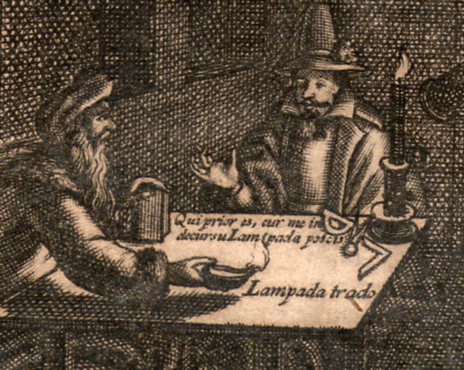
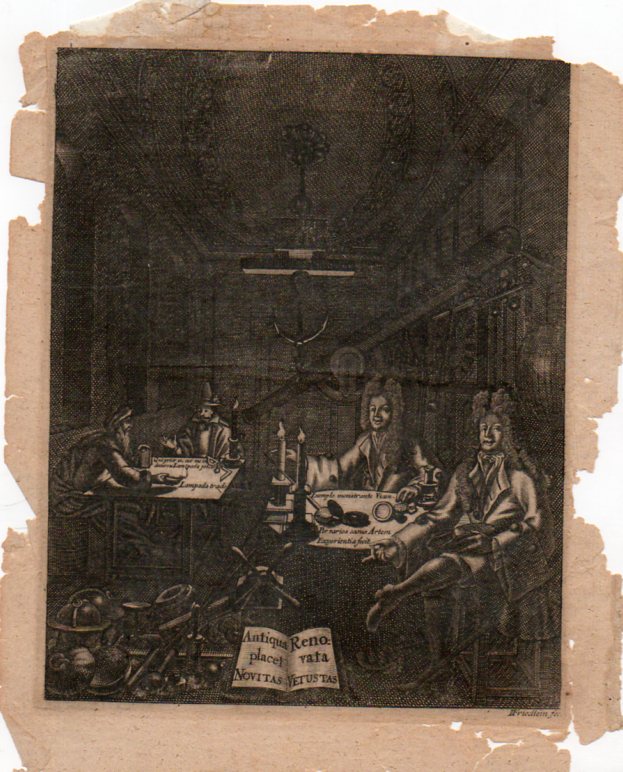
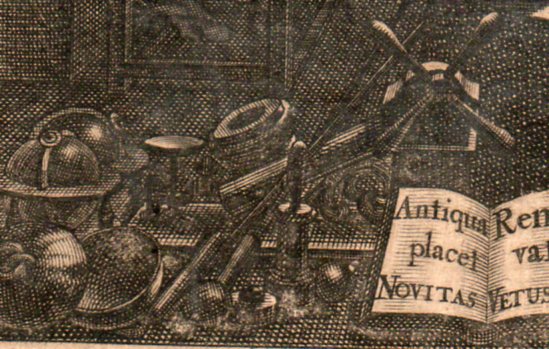
This is an image of a  philosopher’s cabinet, engraving (on copper?) by “I. Friedlein fec”, who was Johnann Friedlein, an emigree from North Germany to Denmark, and who worked ca. 1680-1705. It shows the tools of the trade for someone working in natural philosophy (the name “scientist” would not come into use for another 130+ years or so1) and is an interesting insight into a small, polite gentleman’s club for experiment and investigation.
Friedlein938

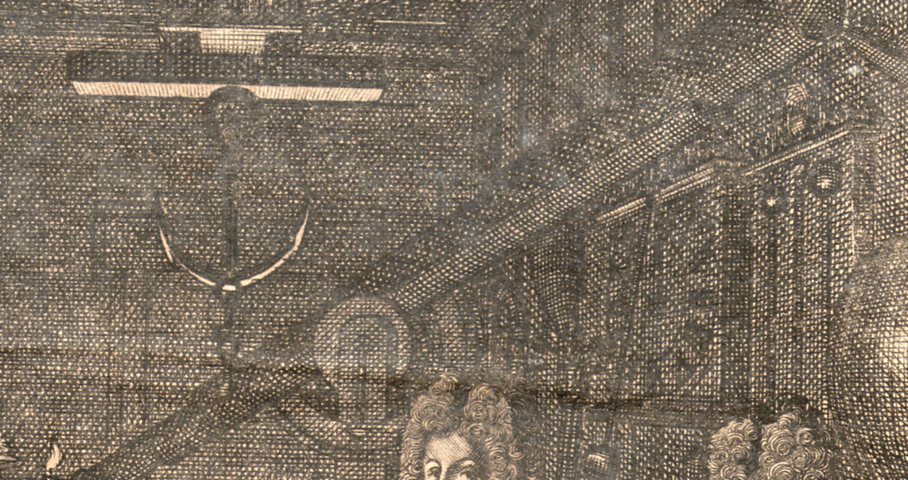
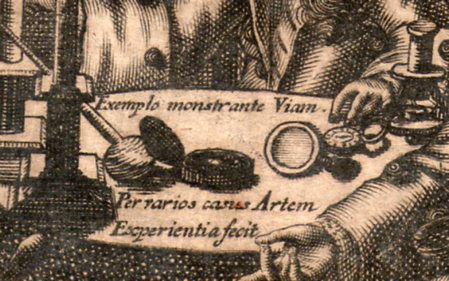
The men surround a decent collection of scientific instruments–I can locate a compass, dividers, oil lamp, magnifying glass, microscope2  (at the right elbow of the figure on the right), terrestrial and celestial globes,  a (large) clock, barometer, and various weights and scales, and  behind it all looms a rather large refracting telescope3 (is it five inches?) 
Friedlein939


Friedlein940

Friedlein942

For all of these expensive and current instruments, the lighting these gentlemen set up for themselves is pretty poor, though of course it does add to the mystery and dark experience of the image.  

Here’s another example of Friedlein’s  work, a frontispiece to Cryptographia, oder geheime Schrifften by Johann Balthasar Friderici, printed in 1685:

Frontispiece, illustration from 'Cryptographia, oder geheime Schrifften' by Johann Balthasar Friderici, engraved by Johan Friedlein (17th century) published in Hamburg, 1685

Nyt dansk kunstnerlexikon: bd. Indenlandske kunstnere (fortsættelse …)by Philip Weilbach:


Notes:

1. “Scientist”, in the Oxford English Dictionary (“science” is a much older word in English):

1. A person who conducts scientific research or investigation; an expert in or student of science, esp. one or more of the natural or physical sciences.computer, earth, mad, natural, rocket scientist, etc.: see the first element.

It is possible that the ‘ingenious gentleman’ referred to in quot. 1834  is Whewell himself.

1834   W. Whewell in Q. Rev. 51 59   Science..loses all traces of unity. A curious illustration of this result may be observed in the want of any name by which we can designate the students of the knowledge of the material world collectively. We are informed that this difficulty was felt very oppressively by the members of the British Association for the Advancement of Science, at their meetings..in the last three summers… Philosophers was felt to be too wide and too lofty a term,..; savans was rather assuming,..; some ingenious gentleman proposed that, by analogy with artist, they might form scientist, and added that there could be no scruple in making free with this termination when we have such words as sciolist, economist, and atheist—but this was not generally palatable.
 
1840   W. Whewell Philos. Inductive Sci. I. Introd. p. cxiii,   We need very much a name to describe a cultivator of science in general. I should incline to call him a Scientist. Thus we might say, that as an Artist is a Musician, Painter, or Poet, a Scientist is a Mathematician, Physicist, or Naturalist.
 
2. “Microscope” (as a noun) in its earliest uses in English, in the OED: 
1648   Bp. J. Wilkins Math. Magick i. xvi. 115   We see what strange discoveries of extream minute bodies, (as lice, wheal-worms, mites, and the like) are made by the Microscope, wherein their severall parts (which are altogether invisible to the bare eye) will distinctly appear.
1651   N. Highmore Hist. Generation viii. 70   The white circle..by a Microscope appears now to be the Carina or back and neck of the Chick.
 
3. “Telescope” (as a noun) in its earliest uses in English, in the OED:
[1619   J. Bainbridge Astron. Descr. Late Comet 19   For the more perspicuous distinction whereof I vsed the Telescopium or Trunke-spectacle.]
1648   R. Boyle Seraphic Love (1663) xi. 59   Galileo’s optick Glasses,..one of which Telescopioes, that I remember I saw at Florence.

Recent Posts

Archives

Categories