A Daily History of Holes, Dots, Lines, Science, History, Math, Physics, Art, the Unintentional Absurd, Architecture, Maps, Data Visualization, Blank and Missing Things, and so on. |1.6 million words, 7500 images, 4.9 million hits| Press & appearances in The Times, Le Figaro, Mensa, The Economist, The Guardian, Discovery News, Slate, Le Monde, Sci American Blogs, Le Pont, and many other places… 5000+ total posts since 2008.

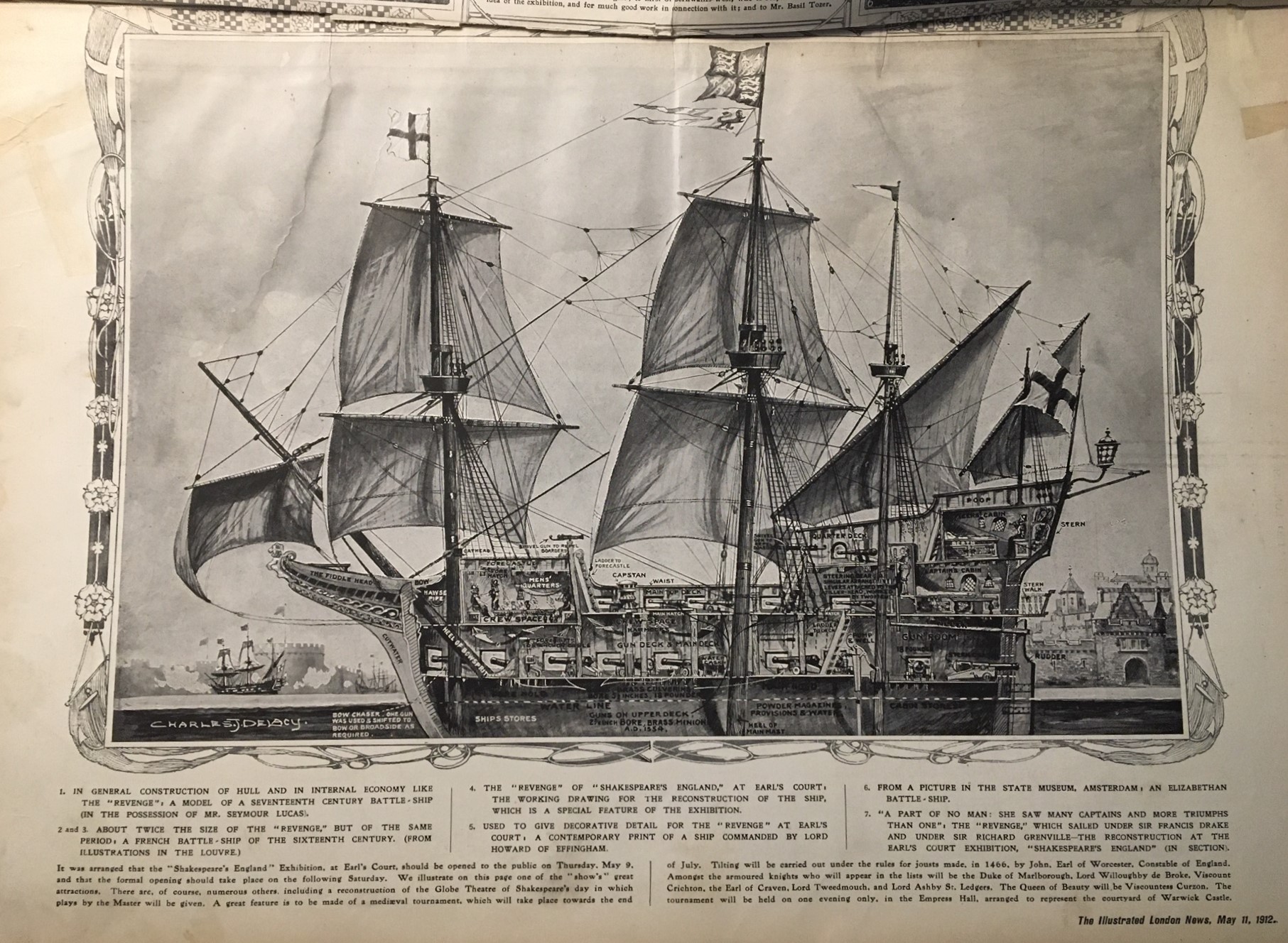
  • Great Cross Section: HMS Revenge of 1577 (1912)

    JF Ptak Science Books  Quick Post

    ILN 1912 Cutaway cross section REVENGE _2_

    [Image source: Illustrated London News, 11 May, 1912.]

    I’ve made dozens of posts on this site on cross sections, exploded views, and cutaways–today’s installment is another of the high-artistic variety and depicts the first (of fourteen?) of the HMS Revenge ships, laid down in 1577. 

    [Detail below.]

    “On July 20 the day on which the London Devonians celebrated the 324th anniversary the defeat of the Spanish Armada the King and Queen paid a visit to the England Exhibition at Earl’s Court. Amongst other things they inspected the model of the Revenge famous not only as the one of the one and the fifty three whose great fight Tennyson tells so dramatically in The Revenge, A Ballad of the Fleet but as the flag ship of Drake beyond doubt the greatest man who ever set foot aboard her. The ship as reconstructed at Earl’s Court is 104 feet long from stem to stern with a height of 127 feet from water line to top of mainmast and a breadth of beam of 28 feet…” Illustrated London News, 10 August 1912.

  • Light Bombs, 1913

    JF Ptak Science Books  Post 2897

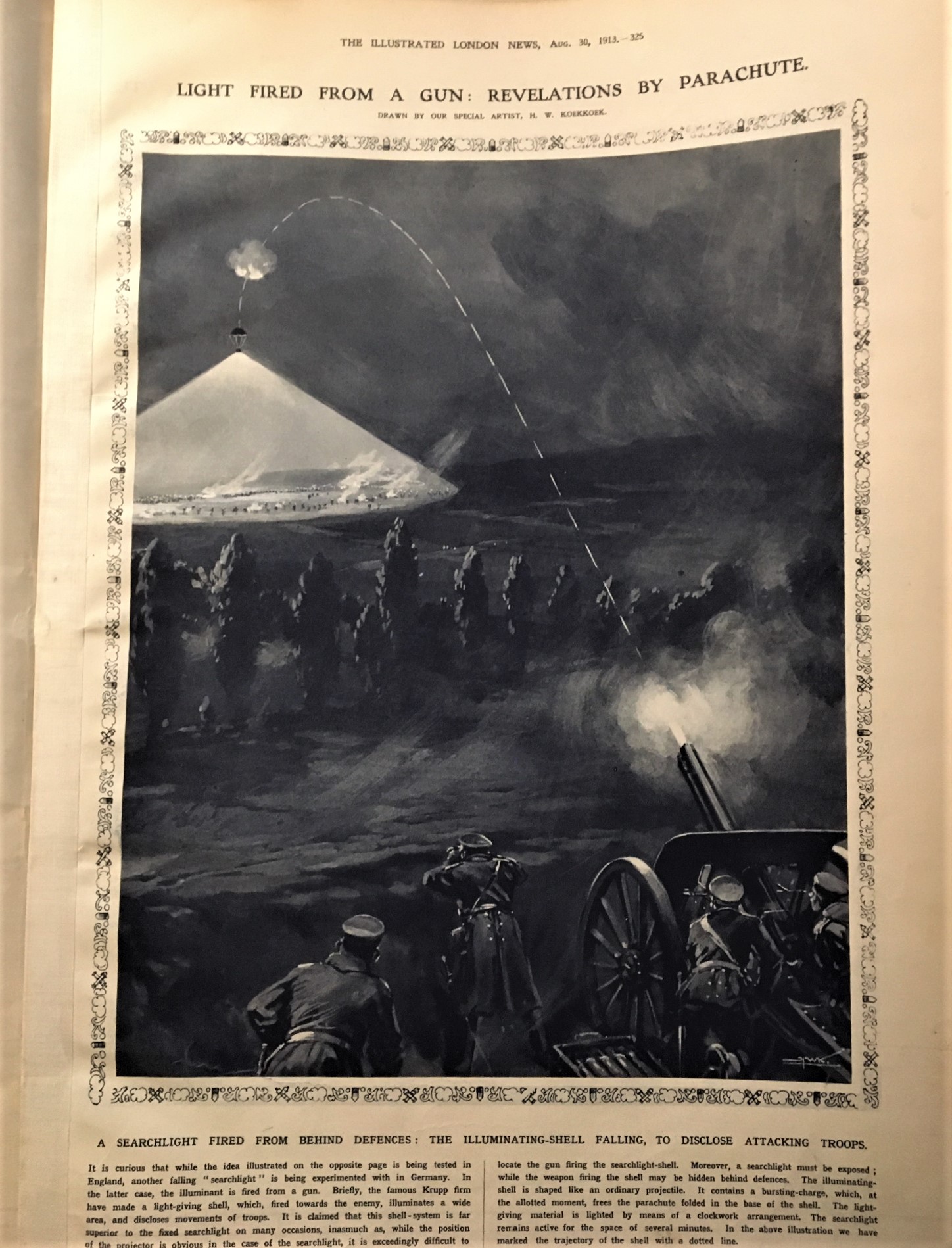
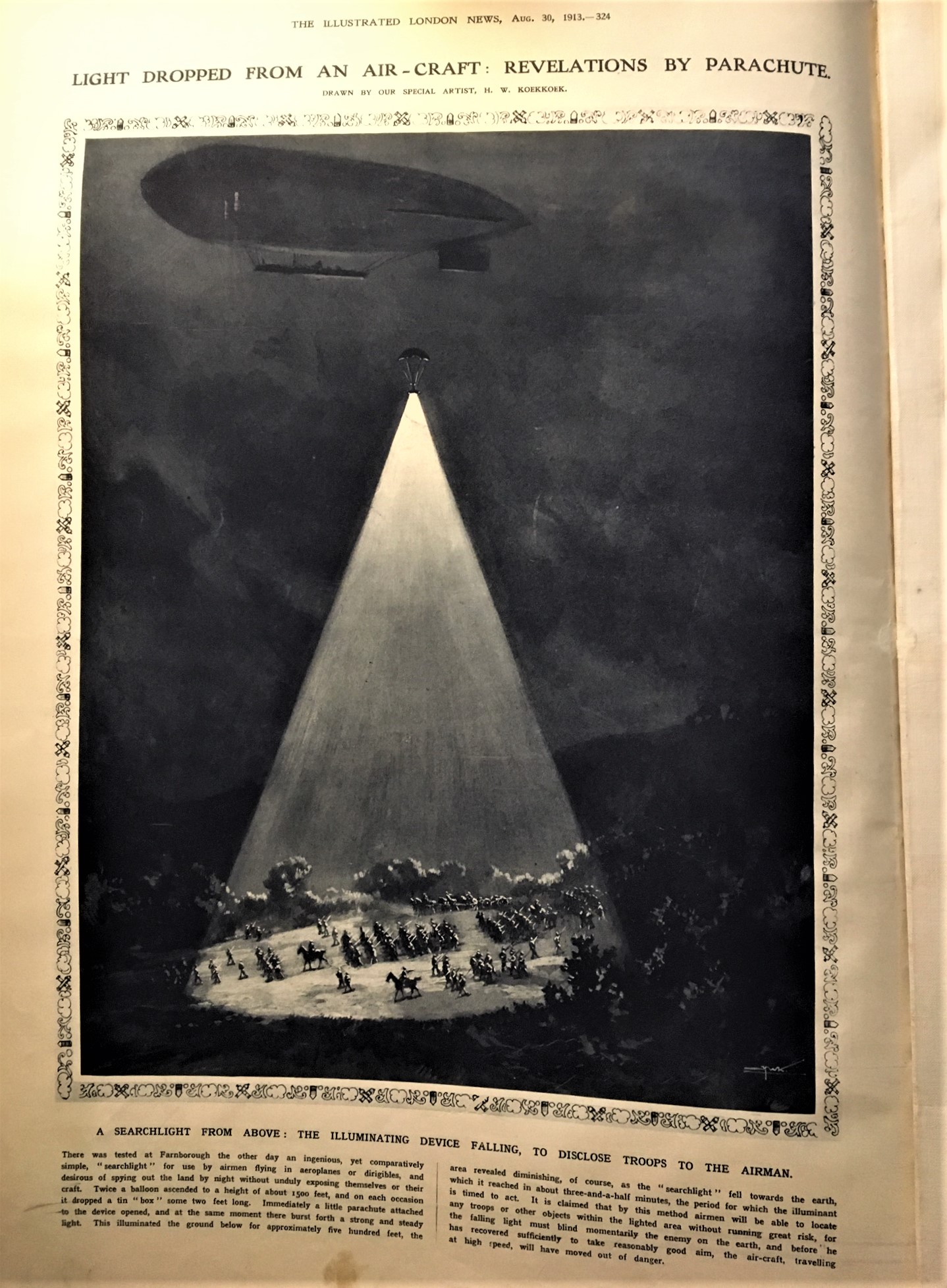
    In the earliest periods of the history of bombing it seems as though the among the first generations of “bombs” dropped from flying machines were “light” or light sources, as we can see in this pair of illustrations from the Illustrated London News for 30 August 1913. These weapons appeared almost two years after Lt. Giulio Gavotti dropped an actual explosive from his plane on 1 November 1911 in a battle of the Italo-Turkish War1. Not that the exploding bombs weren’t  heavy (they weren’t) but that the feature of the weapon dropped in the 1913 case was capable of generating a penetrating or at least illuminating light.  We are told in the legend of the print that the light-bomb dropped from the dirigible was attached to a parachute which opened immediately, and from the height of 1500 ‘ at release the writer states that it would take the weapon three minutes to descend to the ground. (Of course the illuminated area would get together an tighter in descent, though it seems like there would be a good minute of so where there was some intelligence gathering possibilities.)

    Even though this package wasn’t exploding, it did provide the observers from above time to gather information on the position of the enemy and relay that data so it could be employed in tactical or strategic manners.  

    Notes:

    1. Lt. Gavotti (1882-1939) actually dropped four four-pound grenades from a height of 600′ from his Etrich Taube monoplane in action against the Ottoman Turks in Libya. This was the first instance of bombing from a heavier-than-air aircraft, bombs being dropped from balloons for several decades already by the turn of the century. Dropping bombs from balloons was deemed an illegal act of war and outlawed in the Hague Convention of 1899–but as the Wright flight was still a few years away at that point there was no provision established for bombing from aircraft that didn’t yet exist.  There were other instances of bombing from aircraft before the start of WWI, with the first instance during the Great War occurring when German Zeppelins bombed the city center of Antwerp a few weeks after the war began on 24 August 1914. The Brits launched an aeroplane attack  against two Zep bases in Cologne and Dusseldorf in response, and, well, and so on, raids and bombs becoming more sophisticated, cities becoming targets, and the race to destruction became developed. 

    ILN 1913 Light BombILN 1913 Light Bomb


  • Defining What “Flying” Is, or Was (1894)

    JF Ptak Science Books  Post 2899    

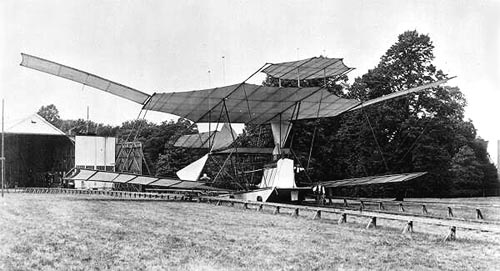
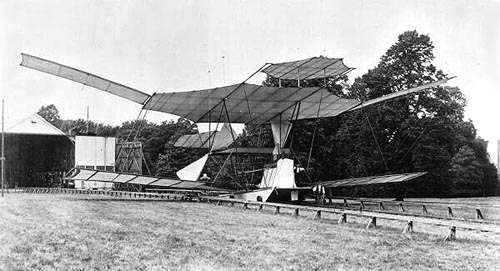
    What does “flight” mean, anyway? How much do you have to be off the ground for something to be “flying”? If the answer is “two feet off the ground for 500 feet”, then Hiram Maxim did indeed succeed in being the first to construct a heavier-than-air aircraft that “flew”. Perhaps this definition might be a little broad, or narrow, though it does make falling sound like flying, too.
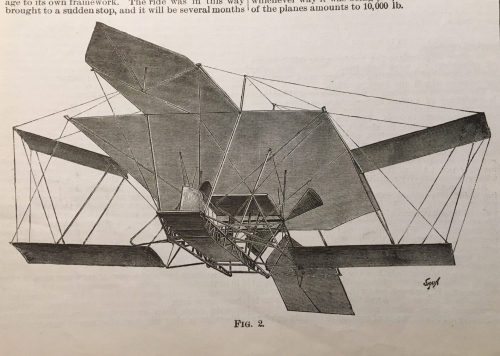
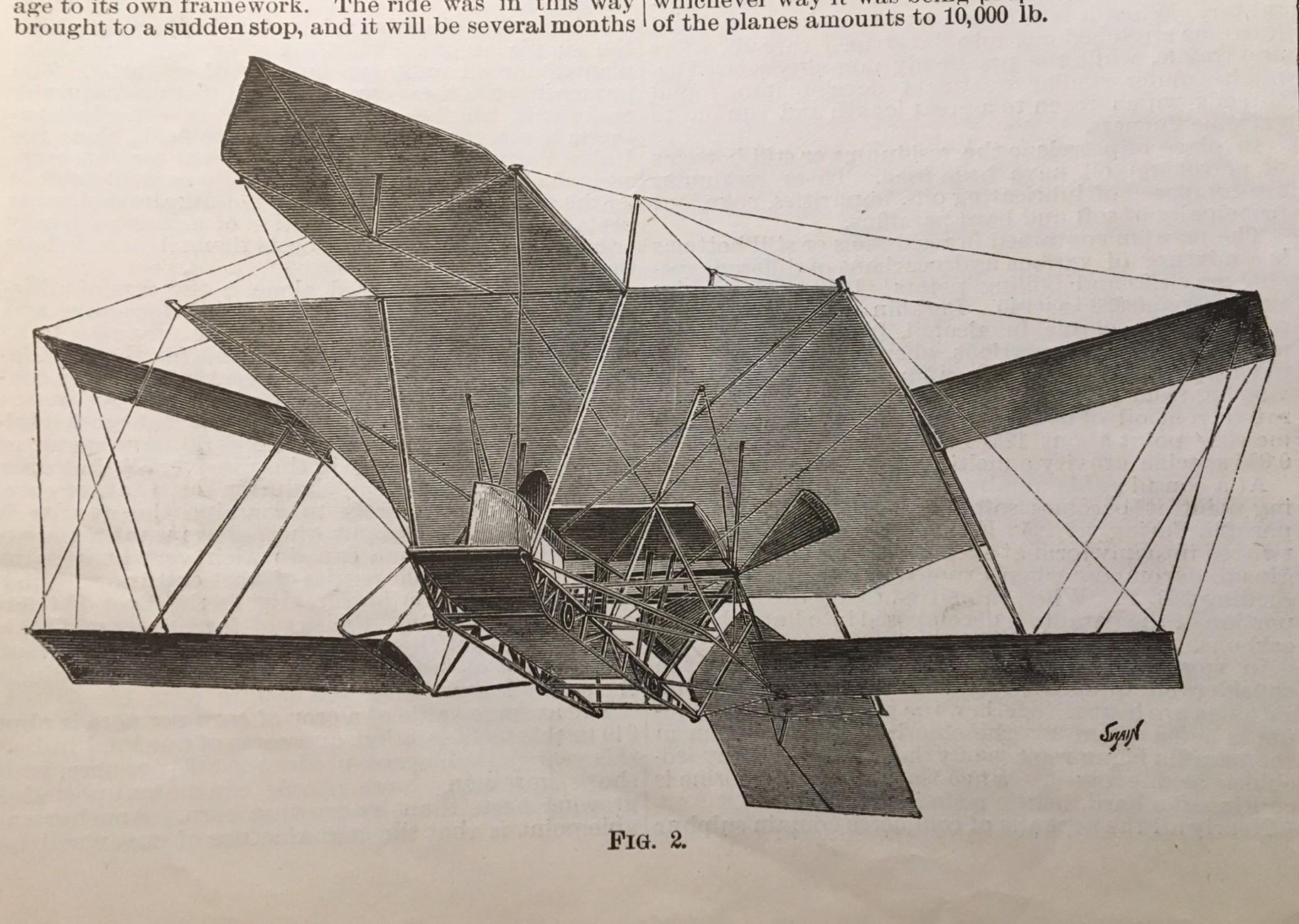
    IMG_2168In any event, that is what Mr. Maxim (1840-1916) did on 31 July 1894 with his enormous aeroplane as reported in the Scientific American of 15 September 1894 (“Maxim’s Flying Machine”).  He invested a good amount of money in the project funded by his tremendously successful “Hiram gun”, creating a number of aircraft before settling in on a great beast of a flying machine in 1894.

    The image of the aircraft is a perspective looking up at it, as though it were in flight. It wasn’t, though it was a semi-romantical thought and presentation. It had big numbers: 7000 pounds, 17.5′ diameter propellers, 2 steam-powered 180hp engines, 120′ long and 105′ wide, and 8” cylinders with a 5” stroke. Big numbers.

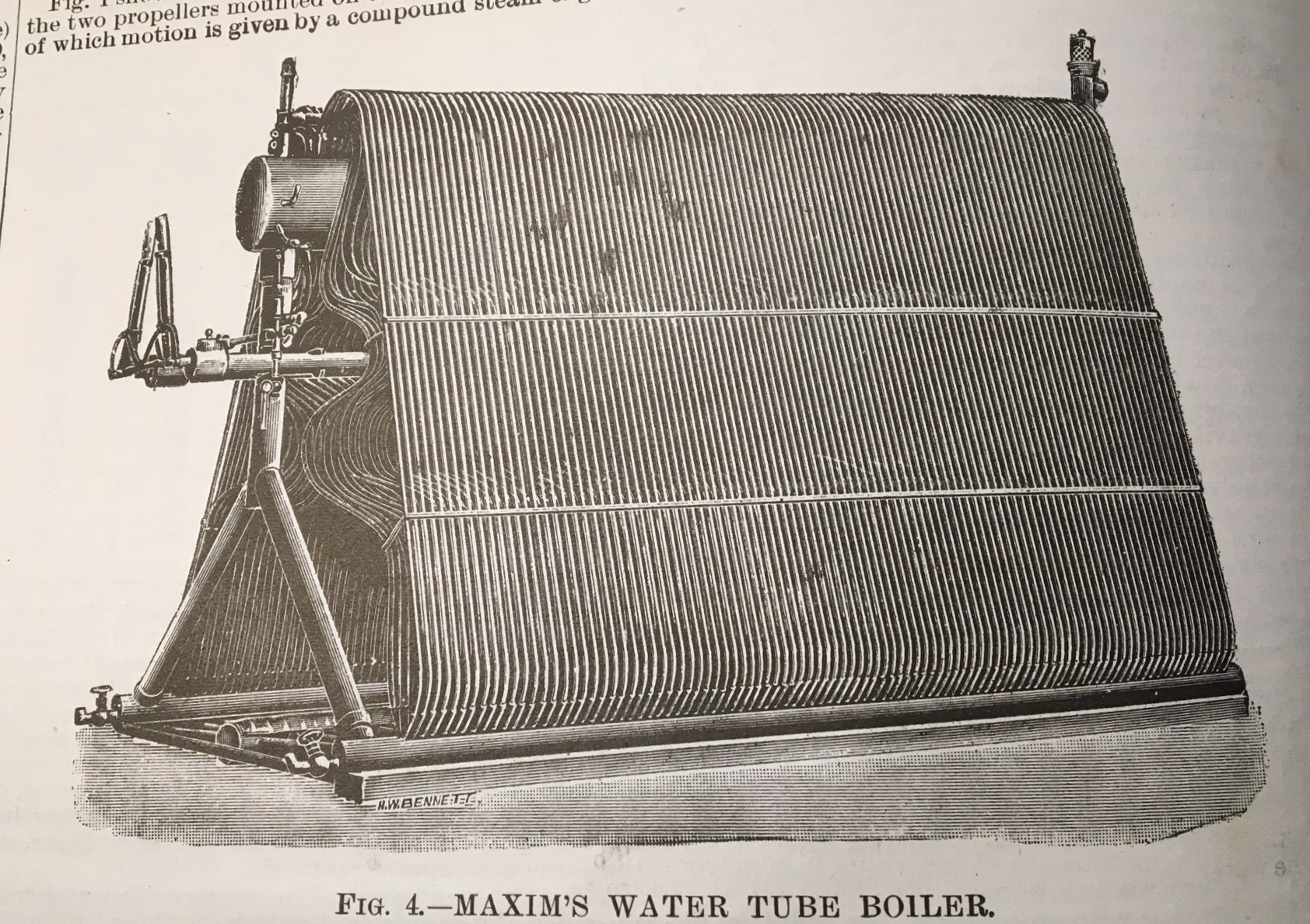
    One of the images that really struck me though was the steam chamber, which looks absolutely huge (though I can’t find dimensions for it), but you can make it out on the aircraft’s bow. For test runs 600 pounds of water were needed—2500 pound were needed to generate lift. IMG_2169
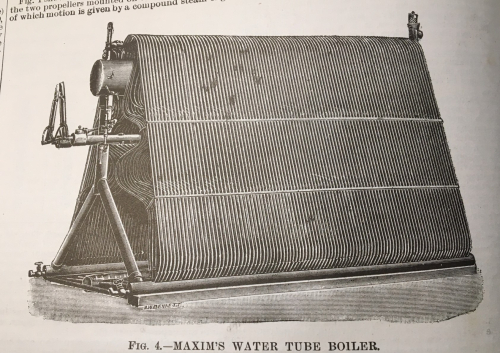
    So back to the “flight” issue; Mr. Maxim was on board the 3-person-crew aircraft on the day of the test. The aircraft was tethered to an 1800′ wooden rail to prevent it from actually taking off if it could…I think mainly because they were really just testing lift, as controlled flight was still yet another enormous issue. The aircraft did manage to achieve lift two feet above the rail, but the force was so great it ripped up the rail and crashed. (Mr. maxim found himself in a somewhat similar position to that of Frankenstein when overpowered by the monster which he himself had fabricated and endowed with life.”) No one was hurt, though the aircraft was decimated. As the writer in the Sci Am stated, “the ride in this way was brought to a sudden stop, and it will be several months before it can be renewed”. It isn’t anything like the Wright’s flight nine years later, though some do consider this Maxim experiment to constitute a “first flight”.

    One thing is certain: it was a lovely and impressive thing that Maxim built–it wasn’t elegant by any means, though it had a certain crushing charm to it.  

    Here’s a photo of the aircraft (with a person standing right there in front of it, for scale):
    Maxim aeroplane

    (Image source: ctie.monesh.edu.au/hargrave/maxim.html)
  • A Good and Quirky Basis for a Holmesian Mystery–How to Kill Someone With Silk Thread (1877)

    JF Ptak Science Books  Quick Post

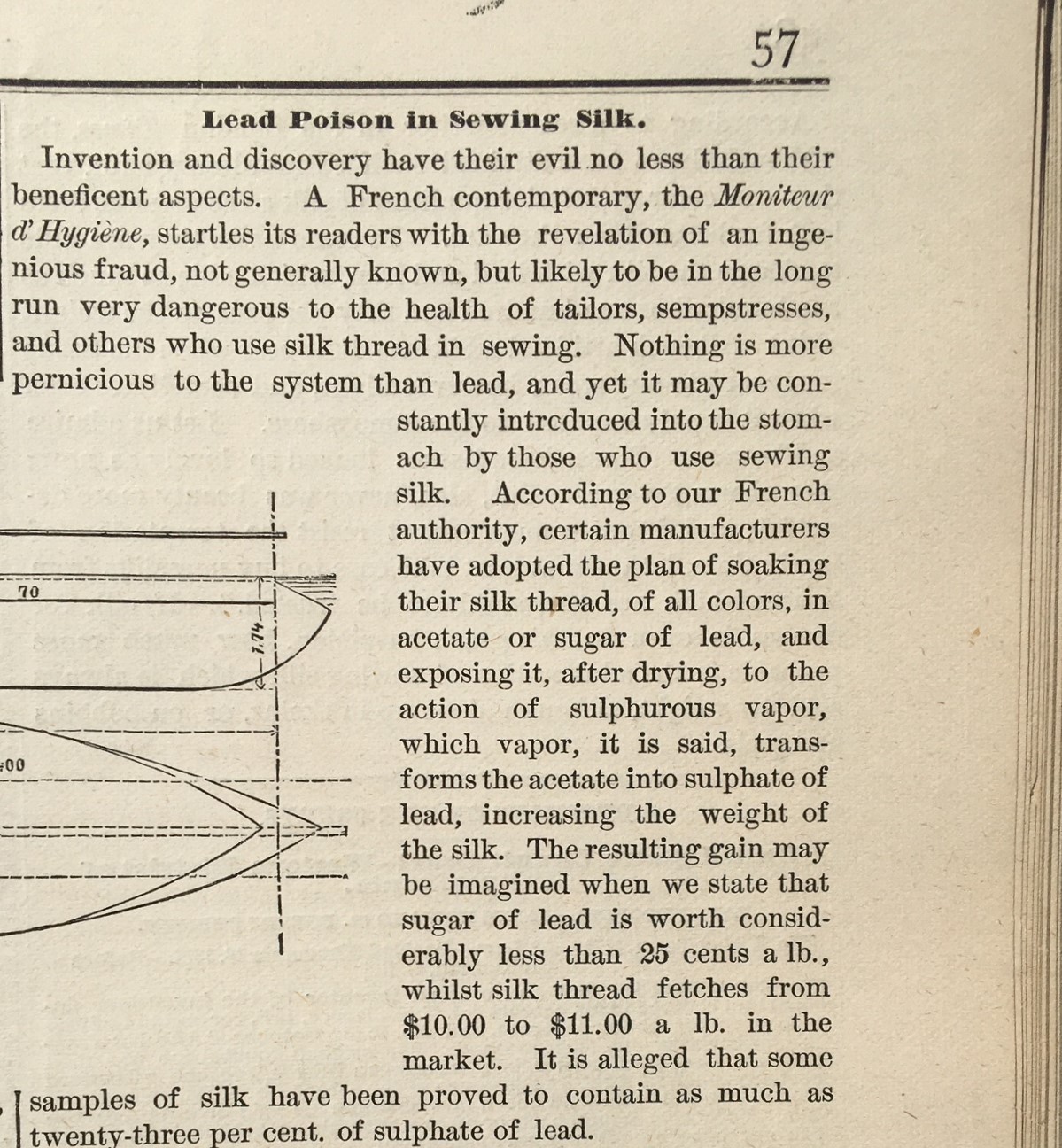
    And so it came to pass that a metal merchant was found drowned in the Thames, weighed down by his own wares, his jacket and greatcoat and pants–even his hat–filled with lead, his feet encased in lead, as were his hands.  The only reason the body was found was because of a severe summer drought which lowered the level of the river enough to reveal all manner of hidden nastiness, including the leaden mineral maven, Mr. Sockety. In and of itself this murder wasn’t all that interesting aside from it being bizarre…except over the following months there were a number of deaths of young women who had, as it turned out, a common touchstone–they all were seamtresses, and their specialty was silk thread. Then place here all of the interesting stuff that happens in mysteries >HERE<  until we get to the Eureka! moment that Holmes would know about halfway through==>they were looking for the tradesperson, Mr. Plump, who supplied the silk thread to these workers. Silk thread was expensive, so Mr. Plump committed fraud  and treated his silk thread with lead, multiplying the expensive thread’s value and which also made it lethal to its users.  Plump–seeing the damage that had been done and the people who had been killed as a result of his fraud–decides to kill Sockety to cover his tracks.  So on.

    This all came about as a result of seeing this interesting sidebar story in the 15 July 1877 issue of Scientific American:

    IMG_2179


    ·Posted by :

    ·in:

  • Von Braun’s Insulting Use of the Word “Holocaust” (1950)

    JF Ptak Science Books  Post 2900

    There’s a very subdued and whitewashed biography of Wernher von Braun sleeping in a few pages of the Journal of the British Interplanetary Society1, published in March 1950, when war wounds were still wounds, and the dead still of course dead.

    Probably one of the worst examples here of gliding through history is the mention that “some 4,450 men and women were employed at Peenemunde…”. It is unclear who the author is referring to, or if he is at all making reference to the more than 20,000 concentration camp inmates and others who were slave labor and forced to work on the rocket projects, living an dying in abject squalor. It has been established that von Braun knew of the conditions and knew of these workers, but later after capture he insisted that he did not know of the KL or of the Holocaust. It is bitterly bad that a quote from him is used in this biographical minute that actually employs the word “holocaust”, though he uses it referring to the combat between two opposed forces with the same “star-inspired ideas”, and not to The Holocaust. It is also a matter of record that well into life that the conservative right-wing German nationalist von Braun had nothing to say about the Holocaust, and would not add anything to what he already hadn’t said much about. He was at least comfortable with the Nazis if not a Nazi himself, and was comfortable with the deals he made with Hitler, even in spite of being arrested by the Gestpo late in the war.

    By choosing to not address the Holocaust, and by using the term “holocaust” to describe diametrically opposed political struggles between scientific communities is a gross violation of decency. That blatantly chooses to lessen the impact of the meaning of “Holocaust” to use in a relatively trivial way is obscene. And yet, there it is.

    In any event I’ve included the two-page bio, bellow.

    Also in this issue of the journal there is a great review of a German film on rocket development and the history of rocketry that spreads out over 8pp and which was evidently released sometime during WWII. The film is reviewed by members of the Society, and the comments on it are incisive and useful. It would be great to see the film, though to know that it exists is a step forward. Of a side interest to interplanetary flight is a short reference to “Spaceship I” (pictured below)–it is all very intriguing, though outside of two images of models for the proposed dirigible-like behemoth almost no other information is presented.

    Notes:

    1. London, 1950. (von Braun, Wernher) “A Biography.” In: Journal of the British Interplanetary Society, March, vol 2 #9, pp 57-8 in the issue of pp 49-92.

    ·Posted by :

    ·in:

  • Things-out-of-Place Department: Old Maps in Space

    JF Ptak Science Books  Quick Post

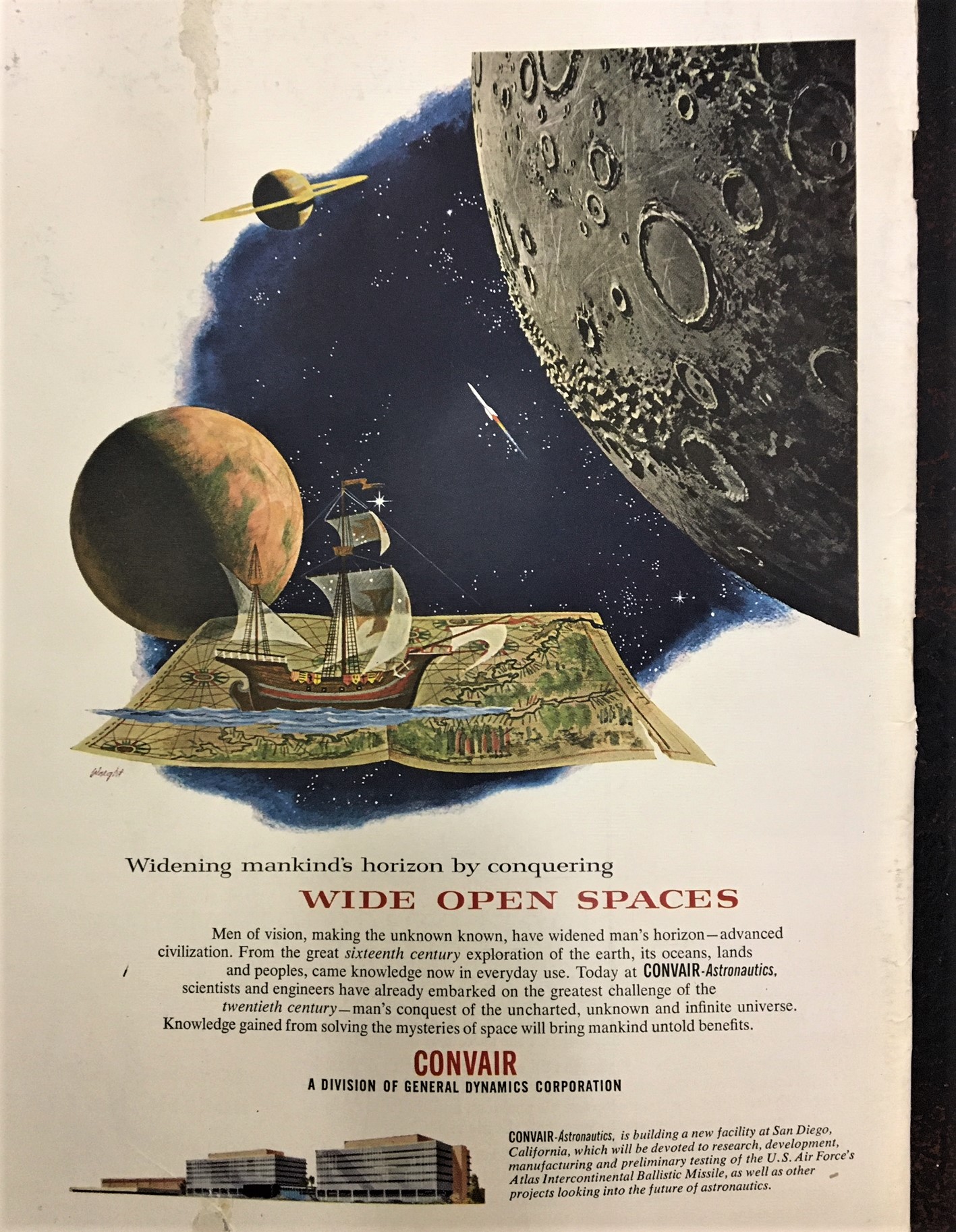
    IMG_2246This is just a short, funny little bit here–I can’t remember noticing an antiquarian map being used as part of the design or decoration based on extraterrestrial objects.  I guess that’s why this image struck me so quickly as being unusual…I just can’t recall another image like it. I mean, this isn’t exactly a towering visual achievement, and in many ways it is ordinary, except that (I think) it isn’t. Anyway, I share it with you now (the source being the Scientific American, July 1957):


  • A Proposed Solution for Traffic Congestion, Los Angeles, 1939: Suspended Roadways and MonorailsÂ

    JF Ptak Science Books  Quick Post

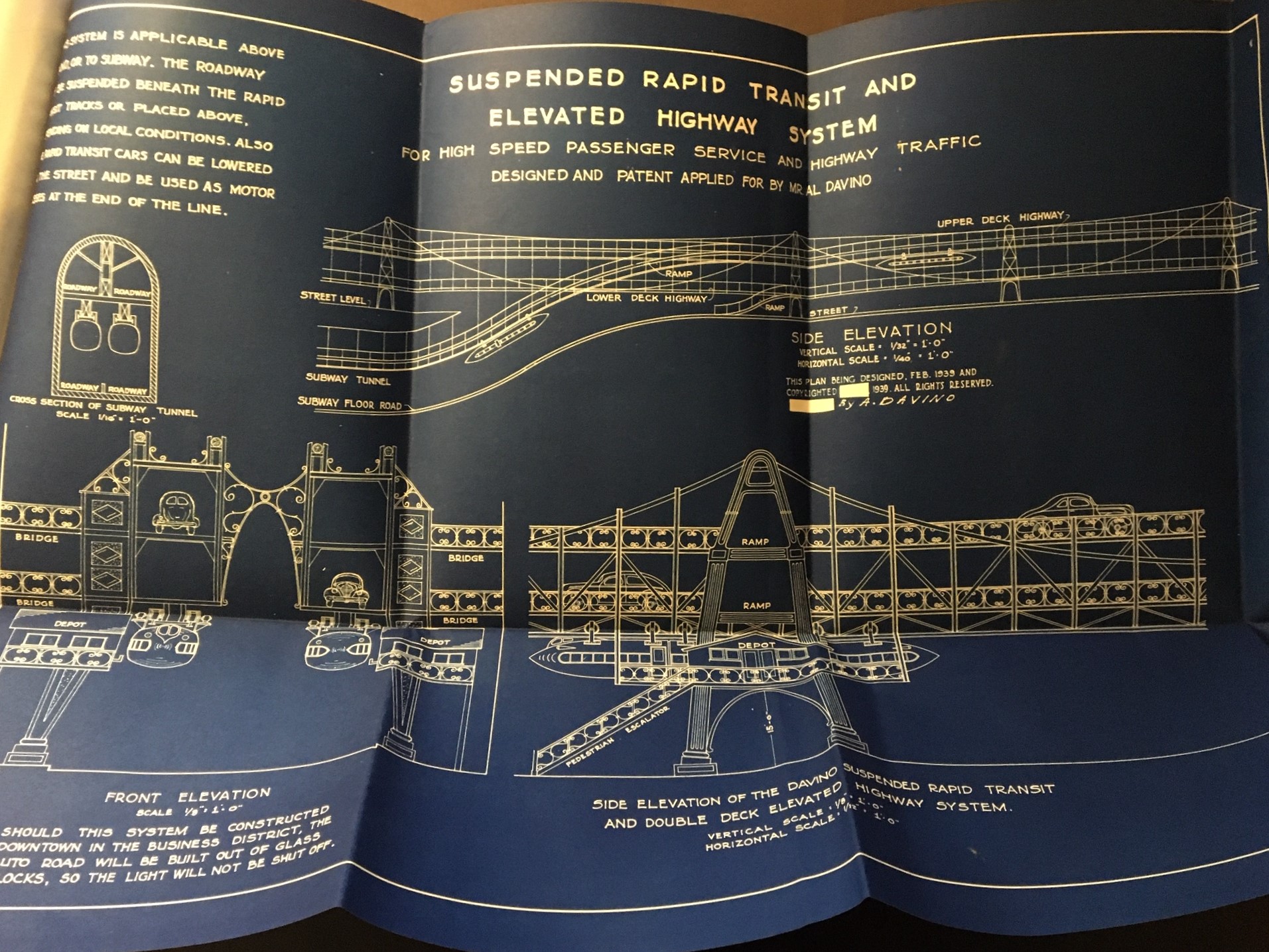
    This Quick Post entry is a simple one, repeating an entry that I’ve made to the bookstore section of this blog–I’m doing so just to make the info available, as the booklet is interesting and rare, and possibly a unique.  It is a work by A(lphonse) Davino, of Los Angeles, who had evidently maintained a lifelong interest in advanced transportation systems for cities–in this case, Mr. Davino approached the city of Los Angeles with his system. From what I can see the Davino System was a series of suspended monorails and auto lanes that would be used in conjunction with existing roads to address the increasing metropolitan congestion. If nothing else, Mr. Davino’s plans are really quite lovely.  Here’s a blueprint for the mainstay structures of the plan:

    IMG_2251

  • Snow, Gloriosum Miracula (1692)

    JF Ptak Science Books  Quick Post

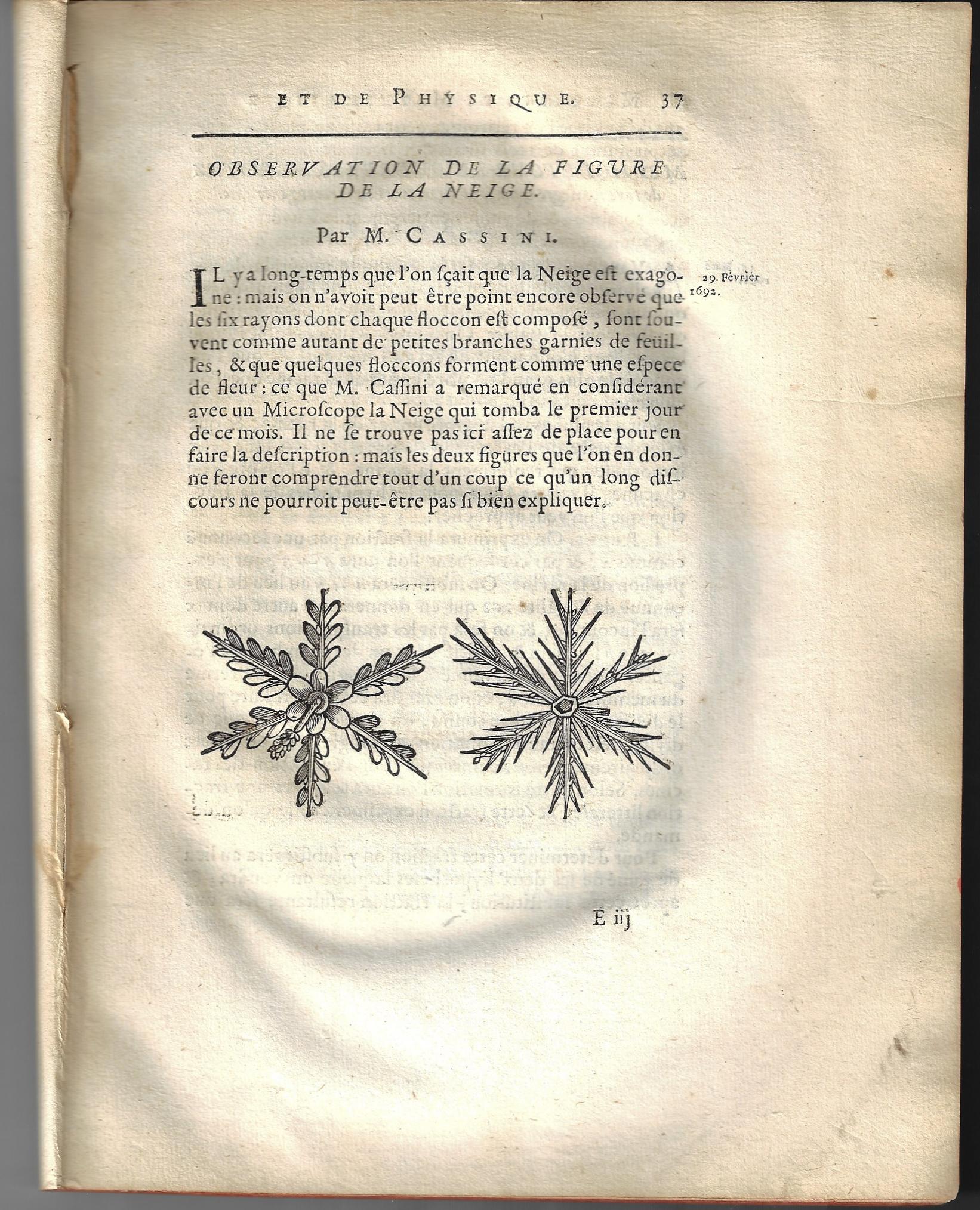
    This short notice by Cassini1 published in 1730 has a lot going for it–I just like the design, and the way it sits on the page, unrushed by another article beginning right underneath it, plenty of space, wide margins, and so on. Also the content is pretty interesting–the great astronomer went out and collected some new fallen snow and had a peep of it under a microscope (the instrument 100 years old or so at this point), and briefly reports his lovely findings. The editors state that there are “so many branches furnished with leaves that a few flakes form like a specie of flower. Cassini–a very busy man–states that he didn’t have the journal space nor his own time to write something about what he saw in the snowflakes, so simply presented the editor with an engraving of what he witnessed. The image of the snowflakes will “suddenly make one understand what a long speech might not be able to explain”.  (“Il ne fe trouve pas ici allez de place pour en faire la defeription : mais les deux figures que l’on en donne feront comprendre tout d’un coup ce qu’un long discours ne pourroit peut-être pas fi bien expliquer.”) I think you could say it is still fairly early to see these snowflake images, though I’m not sure yet when the first published micrographic images of snowflakes appeared. (Robert Hooke published micro images in his Micrographia in 1665, though I don’t know if his were the first. Earlier still were Kepler and his famous Charles Bridge observations of the six-cornered snowflake, though the images weren’t made via a microscope though they were the first scientific endeavors with the snowflake…)


    Cassini snow

    Notes:

    1.  Giovanni Cassini, 1625-1712. The note appears in Memoires de l’Academie Royale des Sciences, Depuis 1666 jusqua 1699, Paris, 1730, and was first published in 1692.  

    ·Posted by :

    ·in:

  • “The Conflagration May Lead to a Good Result…” (1877)

    JF Ptak Science Books  Quick Post

    IMG_2227 (1)

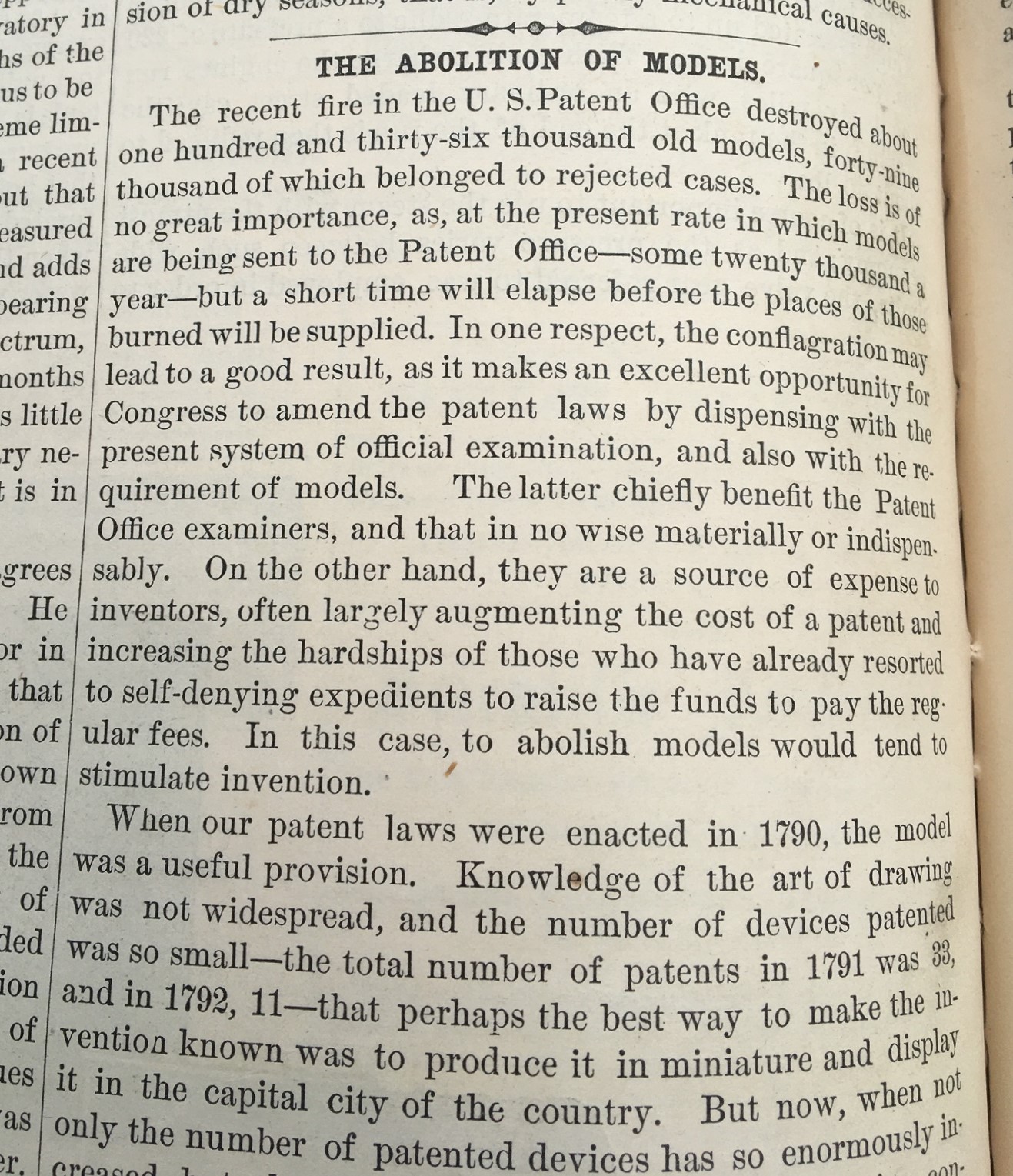
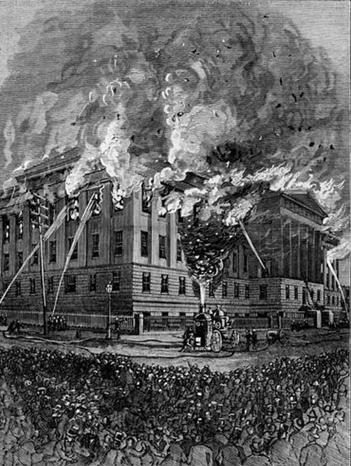
    There are sometimes positive results from fires, though I think not so in this case of the devastating fire that burned much of the U.S. Patent Office building on 24 September 1877 that is the subject fire of the header of this post. Perhaps the writer of the piece (appearing in Scientific American on 1 October 1877) was desperate to find some ray of goodness in the great fire that destroyed half of the USPO building along with 136,000 patent models…which in the old days to that present was a requirement in some areas to obtain a patent in the U.S. About the fire-consumed models the writer states that “the loss is of no great importance” which is a bizarre statement, and that their places on the shelves come along at 20,000 new patents per year, so the new space generated by their loss would be occupied in seven years. The case is then made for the silver lining, which would be to do away with the physical model requirement for a patent.  It was no doubt an appropriate conversation to have, but to try to establish the efficacy of doing away with the models by establishing that it hardly mattered whether the models existed or not is a tough go. 

    This was evidently the second great fire at the USPO (following the 1836 fire) and it consumed much of the building. It was designed by Robert Mills (architect, and designer of the Washington Monument, under construction 1848-1885) and was mostly fireproof, except for the roof and all of the stuff inside the building, so it was fireproof for all that was fireproof, and not for that that wasn’t. 

    Anyway, this was a strange article, well outside my standard experience with SciAm. 

    Patent_Office_1877_fire

  • Interesting Photo of a Communist Demonstration, NYC, 1936

    JF Ptak Science Books  Quick Post

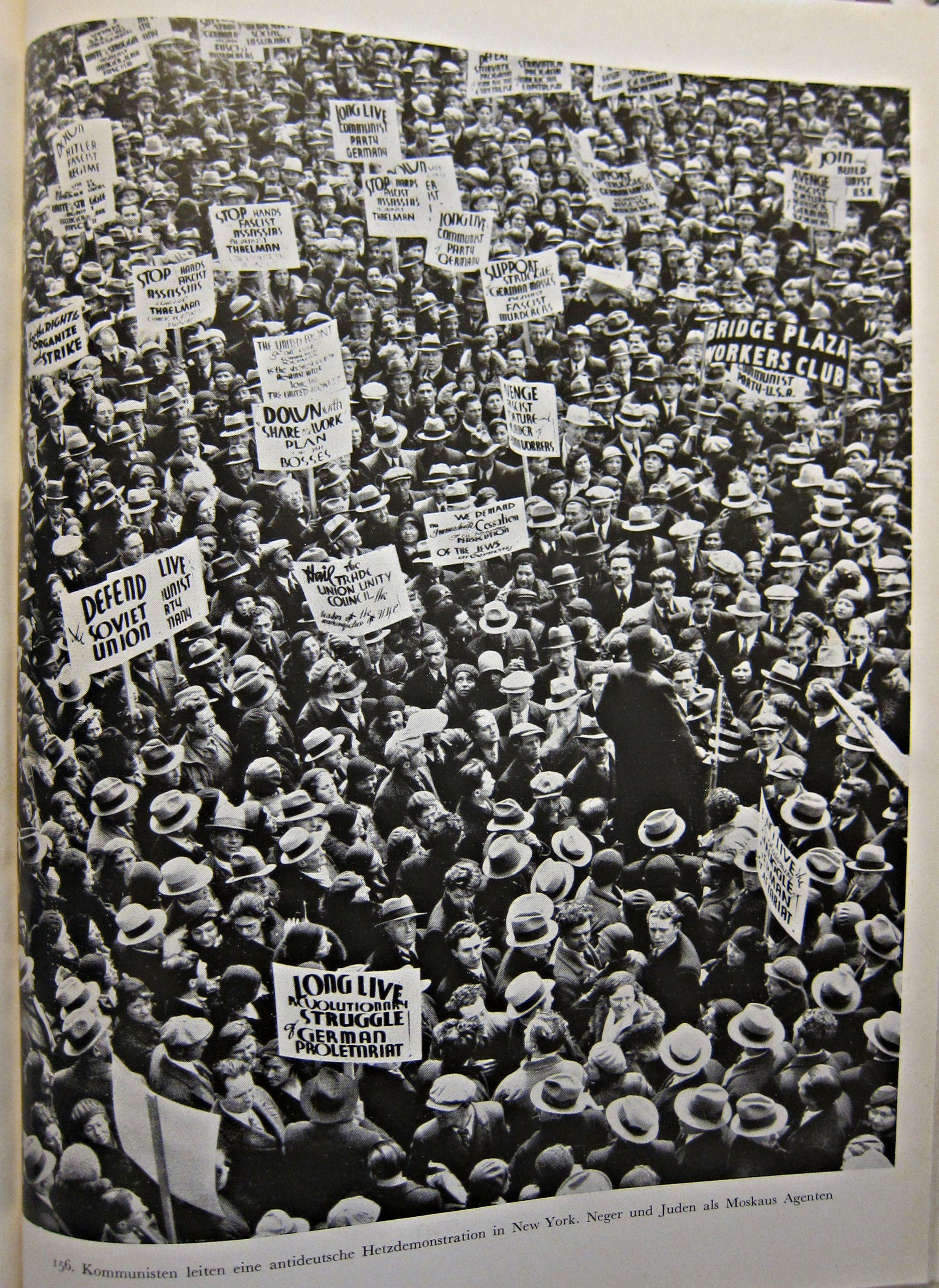
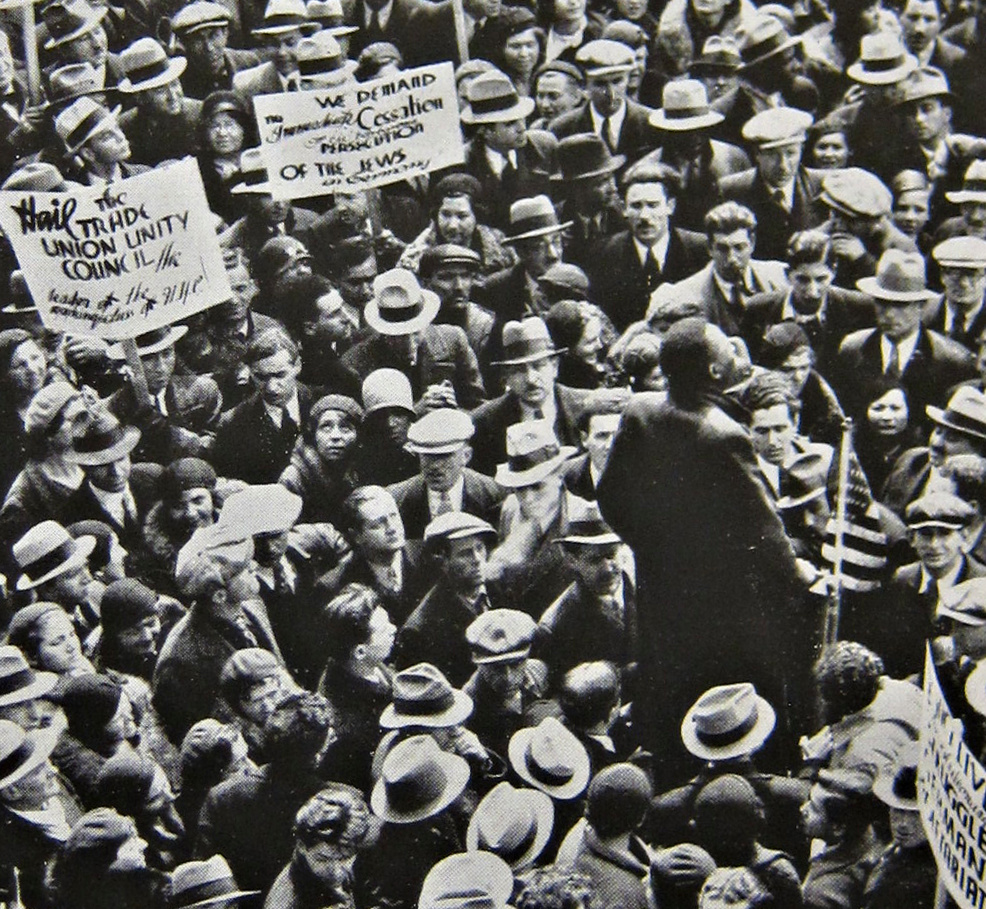
    This evocative crowd scene appears in a piece of Nazi propaganda in 1936 and supposedly (and likely) depicts a Communist demonstration in New York City.  The Nazis of course hated the Communists and much else, and the work in which this appears–Die Weltbolshewismus–is particularly grisly and nasty, illustrated with 100+ photo images as impacting as this one.  Of interest to me were the placards, one of which calls for the “immediate cessation of persecution of the Jews in Germany”, which in 1936 is not a common expression or realization. The speaker here also appears to be Black, addressing a sea of white faces. (No doubt that this was the point of the non sequitur sentence fragment in the legend identifying “Negroes and Jews” as agents of Moscow.)

    Commie 1936

    And a detail:


    Commie 1936 detail


    ·Posted by :

    ·in:

    —
  • Smell-orama without the Rama (1895)


    Smell


    JF Ptak Science Books  Quick Post

    “A true poet does not bother to be poetical. Nor does a nursery gardener scent his roses.” Jean Cocteau

    Maybe so and maybe no, and if not, maybe they should…especially for the poets.  But this come from the writer with only the memory of smell for an olfactory sense.  

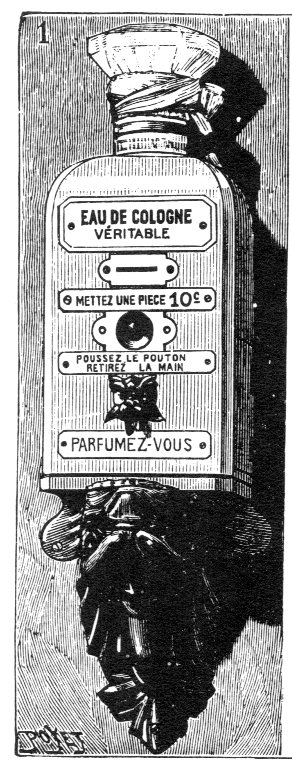
    I looked around without success in Walter Benjamin’s Arcades Project to find something relating to this image, which turns out to be a scent dispenser. These buggers were quite popular (at least in France) and used to be hung at entrances to popular venues where patrons could scent themselves with this-and-that for a few pennies. It seems positively Terry Gilliam-ish to me, but that’s what it was.  

    Source: Scientific American, 1895 (apologies for the skimpy date)

Recent Posts

Archives

Categories