JF Ptak Science Books Quick Post
Source: unknown (perhaps Thomas Simpson, Elements of Geometry…?)
A Daily History of Holes, Dots, Lines, Science, History, Math, Physics, Art, the Unintentional Absurd, Architecture, Maps, Data Visualization, Blank and Missing Things, and so on. |1.6 million words, 7500 images, 4.9 million hits| Press & appearances in The Times, Le Figaro, Mensa, The Economist, The Guardian, Discovery News, Slate, Le Monde, Sci American Blogs, Le Pont, and many other places… 5000+ total posts since 2008.
Contact johnfptak at gmail dot com
JF Ptak Science Books Quick Post
Source: unknown (perhaps Thomas Simpson, Elements of Geometry…?)
JF Ptak Science Books Quick Post
You wouldn’t know about the highly-designed images in the work Highway Transportation by its title (“published in the interests of the shipping public”) by Consolidated Motor Lines Inc (1939). Nor would you assume how dry the interior was by the pamphlet’s cover. In any event the Earth (with the poorly-drawn North America and the trunk-running ring around it)seems to be well under control by trucks, standing by in deference to the enormous quantities of oil consumed by trucks and other truck-related truck things, sweeping past it like the tail of a comet. It is just an odd map, and that’s pretty much that. The sharp and streamlined plastic cover must’ve been shiny enough for everyone to think of it as an advanced work.
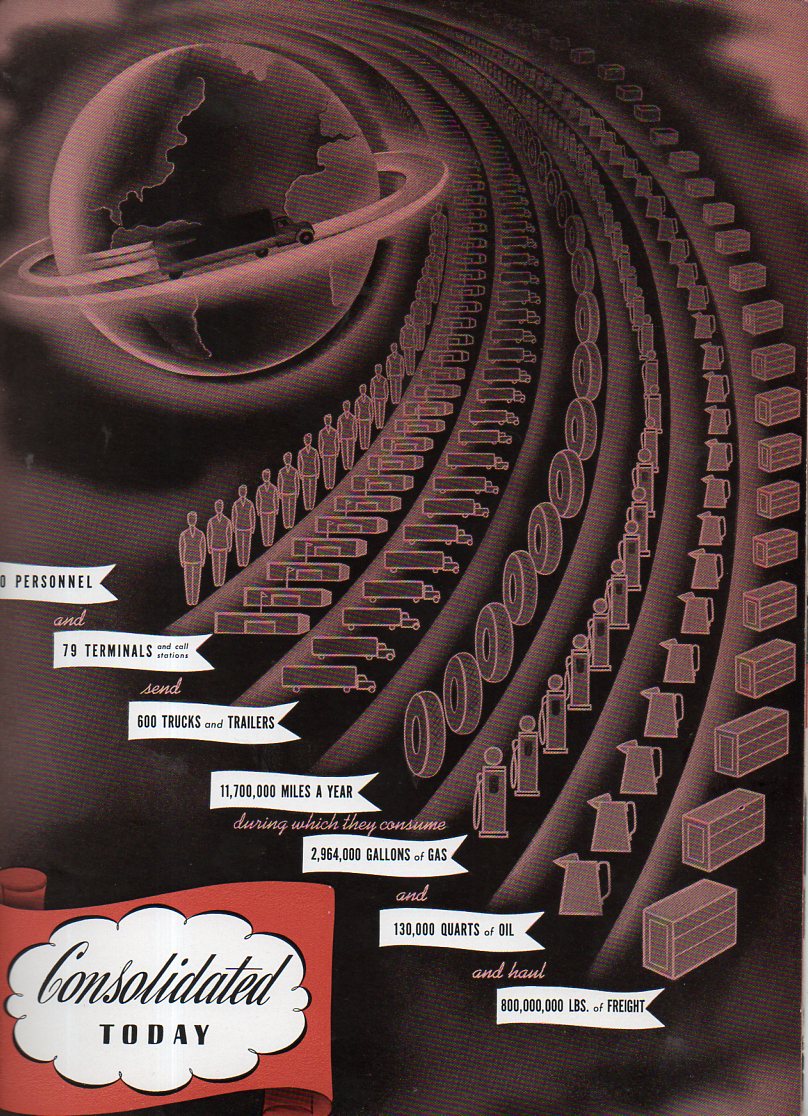
And the equally odd and slightly disturbing streamline-y cover:
JF Ptak Science Books Post 712 (from 2011, extended, with a full text scan of Children Who Work in the Nation’s Crops by Gertrude Folks Zimand, National Child Labor Committee, 1939.)
“The history of childhood is a nightmare from which we have only recently begun to awaken…” Lloyd Demause
“Give me other mothers and I will give you a better world.” St. Augustine, (who does not mention fathers in this context).
The history of kindness to children is a wicked road to tread—I’m not sure why I’m even thinking about it had I the subject not been awakened by bumping into the map seen below. Without any real directed reading on the topic I’ve intuitively felt that “childhood” as an idea, as a part of human development in the Western world, was a young, newish innovation. The simplest way to perhaps measure this is looking for representations of children as children in Medieval and Renaissance art—that is to say children drawn not as little/miniature adults, but drawn as children actually appear. This does not happen very much at all in the early Renaissance, and virtually never happens in the Medieval. Even when looking for images of Christ as a baby in early art it is far more likely to find him depicted as a little man than it is to see him as a child. Children certainly seem to make more appearances as themselves in book illustration (excepting the obvious works on anatomy and childbirth) beginning in the early 16th century, and I’ve a number of reproductions here of children with learning-to-walk walkers and toys from this period. So at the very least the recognition of the concept of difference in very very young adults as “children” in art took a much longer (and unexpected at least to me) time to develop as a concept. And this is only the barest concept, at least recognizing childhood as a stage of development, which doesn’t necessarily say anything about the aspect of kindnesses expressed to them simply because of this stature. That’s an entirely different story.
One way to measure this aspect of childhood–the history of kindness towards children–is in terms of how much work society allowed them to perform in the adult world—and again, it would be shown that it was discovered only recently. As an issue of moral and responsibility, child labor was regulated first in England in a long series of Factory Acts (13 separate acts from 1819 to 1961, including 1819, 1831, 1833, 1844, 1847, 1850, 1874, 1878, 1891, 1901, 1937, 1959, 1961) . That first breathe of morality and responsibility towards happiness (where happiness means not being exploited) codified that children younger than nine were not allowed to work, and that kids between the ages of 9 and 18 could only work up to 72 hours in a six-day week1. Children were used freely and copiously for work in fields, in chimneys, in mines, and in tough bugger places that couldn’t be reached by full-grown adults, as well as in places that could use little hands, or suspended in places where a lightweight helper could be slung, and so on.
Historically speaking, controlling children seems to have been the major part of dealing with a child: from controlling its body function (with enemas and such), to movement (swaddling to completely restrict motion), to crying (dunking a crying infant in a pail of ice cold water to stop it from crying),and to mood (feeding fussy children liquor and opiates to make it docile. ) The severe beating of children was the great “other” option in dealing with all manner of childhood issues, the thorny crown of behavior modification. On this point Lloyd Demause in his “The Evolution of Childhood” examines 2000 statements of advice on child rearing prior to the 18th century and found that most advocated severe beatings. He noted that the severity of the beatings was common and “a regular part of the child’s life.” The instruments of behavior advocacy here included “whips of all kinds, the cat o’nine tails, shovels, iron and wooden rods, bundles of sticks, the discipline—a whip made of small chains–, and special school instruments like the flapper, made to induce raising blisters.” (Demause, page 41.) Rousseau—hardly alone among the great philosophers—advocated whippings and beatings from infancy; plenty of the great social thinkers from this period and earlier had little use or accommodation for children, even their own.
There’s also the controlling of the mind via images and fear and promise of retribution of hell, as well as the introduction of spooks, ghosts, goblins and other sorts of child-stealers and –eaters. You’d think that the rough and tough and pretty scary stories of Brothers Grimm would be enough, but it doesn’t come close to the really scary guys: Mormo, Canida, Poine, Sybaris, Acco, Empuss, Gorgon, Ephiatles and others were brought in to do the job of control that spanking and beating and hell couldn’t modify.
Then there’s the sexual misconduct and abuse, which was evidently deep and well practiced for thousands of years, with older Roman men and Athenian rent-a-boy being famous examples of something wider and established. Just from reading a bit through some of the standard histories of childhood it is very easy to see the vast amount of sanctioned abuse that seems to constitute one of society’s many sorely soft and cancerous underbellies.
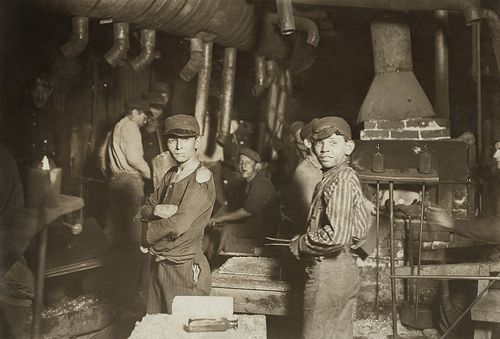
Returning to child labor, for most people in the United States the grotesque nature of this activity was finally revealed to the great masses through the work of the legendary photographer Lewis Hine, whose documentary images of the conditions of children and the laboring classes was an extraordinary dose of reality. It took the unimpeachable foundation of the photograph to hammer home to people that children were being subjected to rigorous labor abuse. (The photo above shows children working in a glass factory at midnight.)
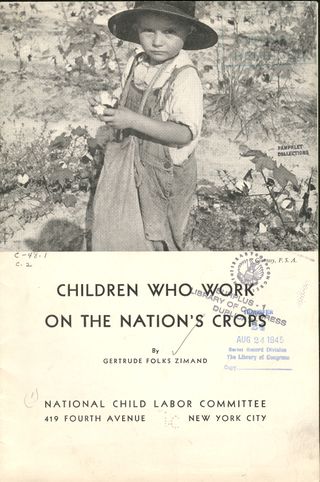
But Factory Acts and Lewis Hine et alia made only incremental change in the exploitation of the very young–evidently economies large and small were addicted to the idea. Which brings us to the map that started this thought: it appeared on the back cover of Children Who Work in the Nation’s Crops, written by Gertrude Folks Zimand, and published by the National Child Labor Committee (NCLC) in 1940. The map on the back cover shows the migration routes of the young workers:
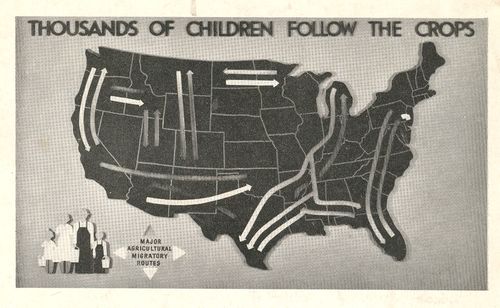
There’s no surprise to what the map showed, though it was a surprise to see the map itself. The NCLC is still around, and so are the children working in the fields. The map has stayed pretty much the same.
The rest of the pamphlet does not pamper the brittle semi-hidden world of the child laborer. I’ve included the entire work, below.
UNICEF states that there are still hundreds of millions of children being worked illegally throughout the world, and I can’t help but wonder who it is that assembles those free Happy Meals toys (watch that copyright!) which are purchased in the millions for a penny or so apiece. When things like that are as cheap as they are, as impossibly cheap as they are, there must be someone, somewhere, paying the price.
NOTES:
1. The high points (taken from Wiki) of the Factory Act of 1833 stated:
Also, good reads on the history of childhood:
G. Rattray Taylor, The Angel Makers
David Hunt, Parents and Children in History
George Payne, The Child in Human Progress
Philippe Aries, Centuries of Childhood
and
Lloyd Demause,editor, The History of Childhood.
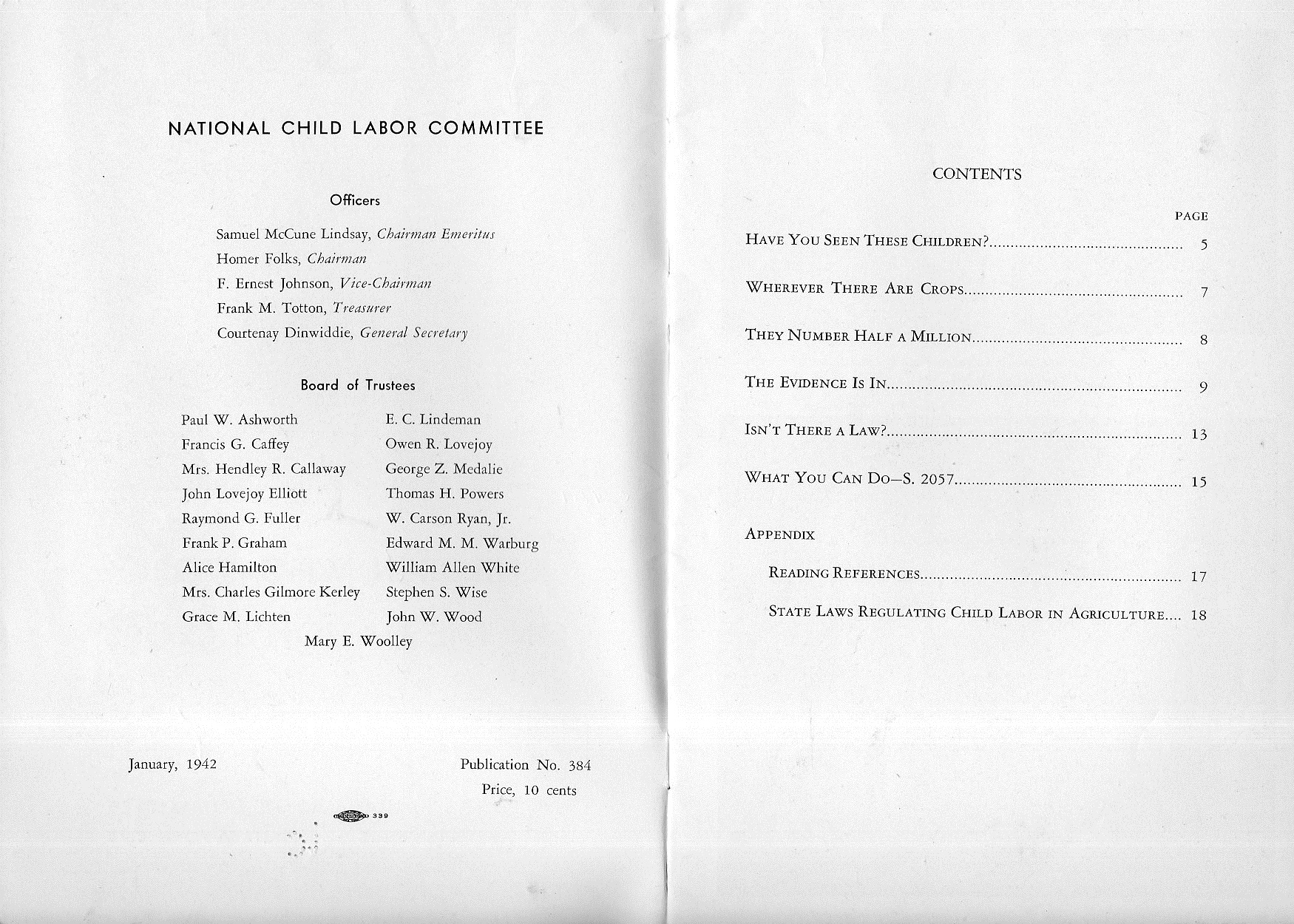
Children Who Work in the Nation’s Crops
by Gertrude Folks Zimand, National Child Labor Committee, New York City January 1942
JF Ptak Science Books Quick Post
Katherine Pollack (b 1905) wrote this informative pamphlet in 1932–it is red though Ms. Pollack wasn’t. She did have a solid and liberal background–Ethical Culture School in NYC, economics at Vassar, grad work at Columbia, “tutoring, teaching and writing for the Bryn Mawr Summer School for Women Workers (1927-49), Brookwood Labor College (1929-32)…field work in Southern textile mill towns and West Virginia coal camps…”1, and then on to national offices for the CIO and then the AFL-CIO.
I hate to say it, but I was drawn to the pamphlet for the design. It turns out that Ms. Pollack had the Right Stuff, and knew her business, and lived that life. I’m glad to have made her acquaintance.
The pamphlet was published by the Brookwood Labor College (1921-1937) evidently the first U.S. college devoted to the study of labor, and published in 1932.
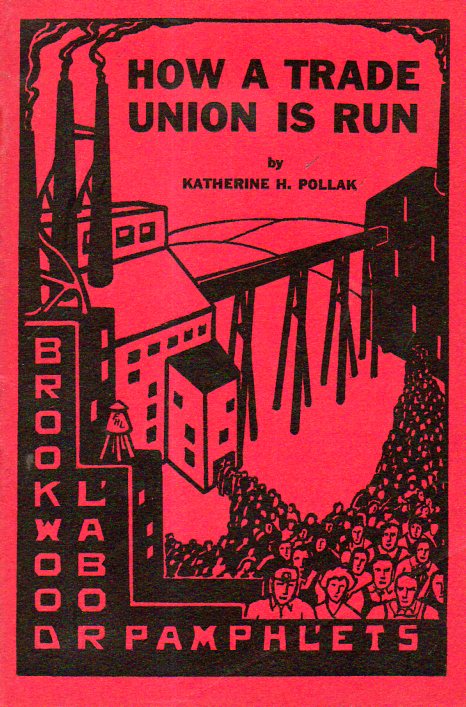
Notes:
1. Katherine Pollack Elikson papers: https://reuther.wayne.edu/files/LP000321.pdf
JF Ptak Science Books Quick Post
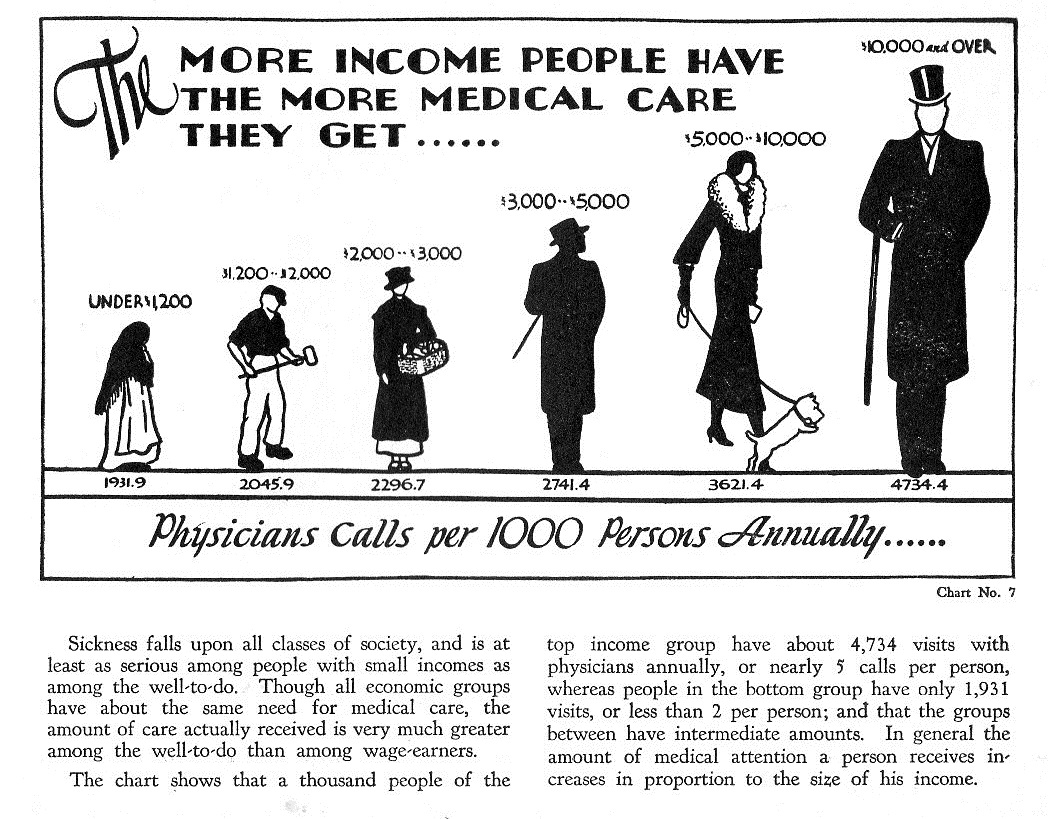
A Picture-Book about the Costs of Medical Care was composed by the Julius Rosenwald Fund in 1932. One of the major data visualizations in the short pamphlet was the distribution of medical care according to income–and it comes as no surprise that during the Depression that the wealthiest people are enjoying more medical care than the other classes. The stats are mostly not displayed in this pamphlet so there’s not much that I think I can say about them–except that it seems that the class distinctions/percentage in this chart are similar to the William Thompson & Joseph Hickey (2005) class model.
So from the Rosenwald Fund the numbers are described like so (with the addition of the bureau of Labor Statistic’s calculated figures for teh purchasing power of the 1932 dollar in 2016):
The Thompson/Hickey model
The bottom two classes in the Rosenwald could constitute the poor and the working poor, making 50% which is what is most in-line with the Thompson/Hickey model. It is a little more difficult to work the numbers and try to distinguish the super rich, rich, upper middle class, and middle class in other models against the Rosenwald graphic. However when you look at two other models the poor and the working poor add up to about the same as above; the Dennis Gilbert model (2002) finds 55% in this category and the Leonard Beeghley (2005) finds 57%. This is real smashmouth statistical surfing, I know, but it does seem as though there is a good correlation between the Rosenwald working class/working poor/poor numbers from 1932 and more recent models.
JF Ptak Science Books Quick Post
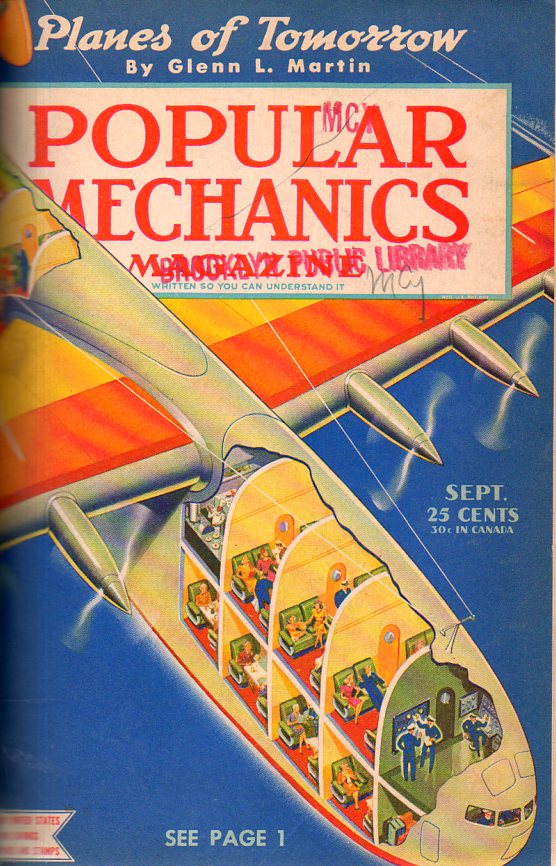
This was a bit of a speculative peep into the future by someone who actually may have been able to see into it–Glenn Martin was on the scene immediately following the Wright Brothers, and would go on to create an aviation company that would become Martin Marietta, and then Lockheed Martin. The article appeared in the September 1942 issue of Popular Mechanics. The plane was a beast, though a pretty one–it was also very restrictive, carrying 100 passengers in spite of its size. Packing people on wasn’t the priority at this point (especially at a conceived round-trip ticket of $400 to Europe, real money in those days)–luxury was. When you look at the Bureau of Labor Statistics inflation calculator for that $400, it turns into about $6,000, which is something you might pay for your first-class accommodation to Europe, except with this plane you get a shower or bath, a lounge car, a ping pong table, and a LOT of leg room.
JF Ptak Science Books
Squidward: What’s that horrible smell?! [sees steam coming out of SpongeBob’s window] Is Patrick thinking again?
Patrick: [sticking his head out of the window] I’m making art!
Squidward: Patrick, it smells like something crawled into your brain and died!
Patrick: That’s the creative process at work!
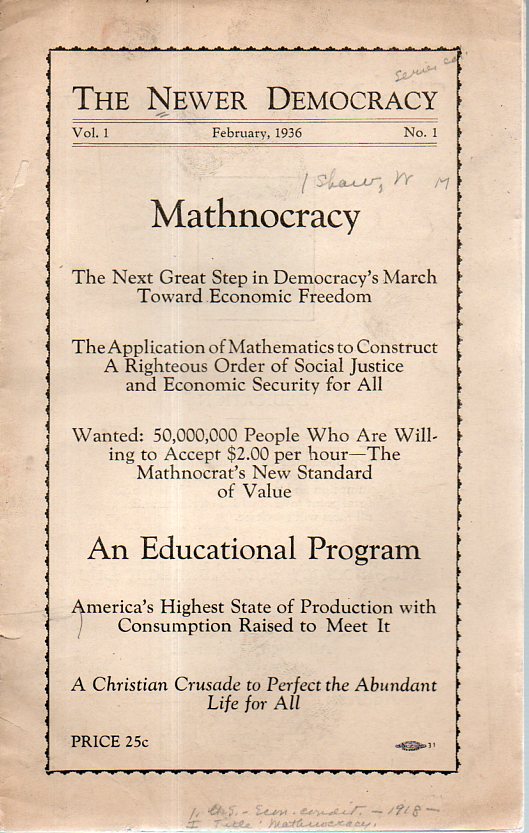
This is one of those pamphlets with a title that goes on and on, and on, and pretty much tells you everything that there is about the work, and perhaps a little more. It is in the fine tradition of The Era of Enormous Book Titles that was so not-uncommon in the 17th c and Western Dime Novels from the turn of the century. This “newer democracy” really didn’t have so much to do with “math” than it did with God being a mathematician, though not invoking much math, per se. I’m not getting into the content very much because it really isn’t worthwhile—and unfortunately the pamphlet is not illustrated. But it has a great title and cover, and is also a new entry in the “-ocracy” contingent, including the far more well-known “Technocracy” and the as-obscure “Humanocracy”, among others. (Aha! I am reminded of an anti-FDR pamphlet called NewDealOcracy that was a fascist something or other…)
JF Ptak Science Books Quick Post
This is the front cover of an impossibly-thin work on social contract and cooperation among the working classes. It was written by a very well-known German (from Stuttgart) liberal social reformer named Victor Aime Huber (1800-1869) and related some of his observations on the conditions of workers during a trip to England and which was published in 1851 in Berlin. I am going to scoot along on this one and not comment on Huber’s social or economic work because I just don’t know anything about it (at least tonight)–all I wanted to do was comment on the beautiful found-art cover for the none-page pamphlet. Non-representational beauty won’t be discovered in the art world for another sixty years or, otherwise sturdy construction of color and drifting text might have been considered artistic. I like it quite a bit for its design–as well as for the very deep and swirling nature of the blue paper wrapper.

(Ueber Association mit besonderer Beziehung auf England. 4. Vortrag, veranstaltet von dem Centralverein fiir das Wohl der arbeitenden Klassen, Berlin, 1851.)
JF Ptak Science Books Quick Post
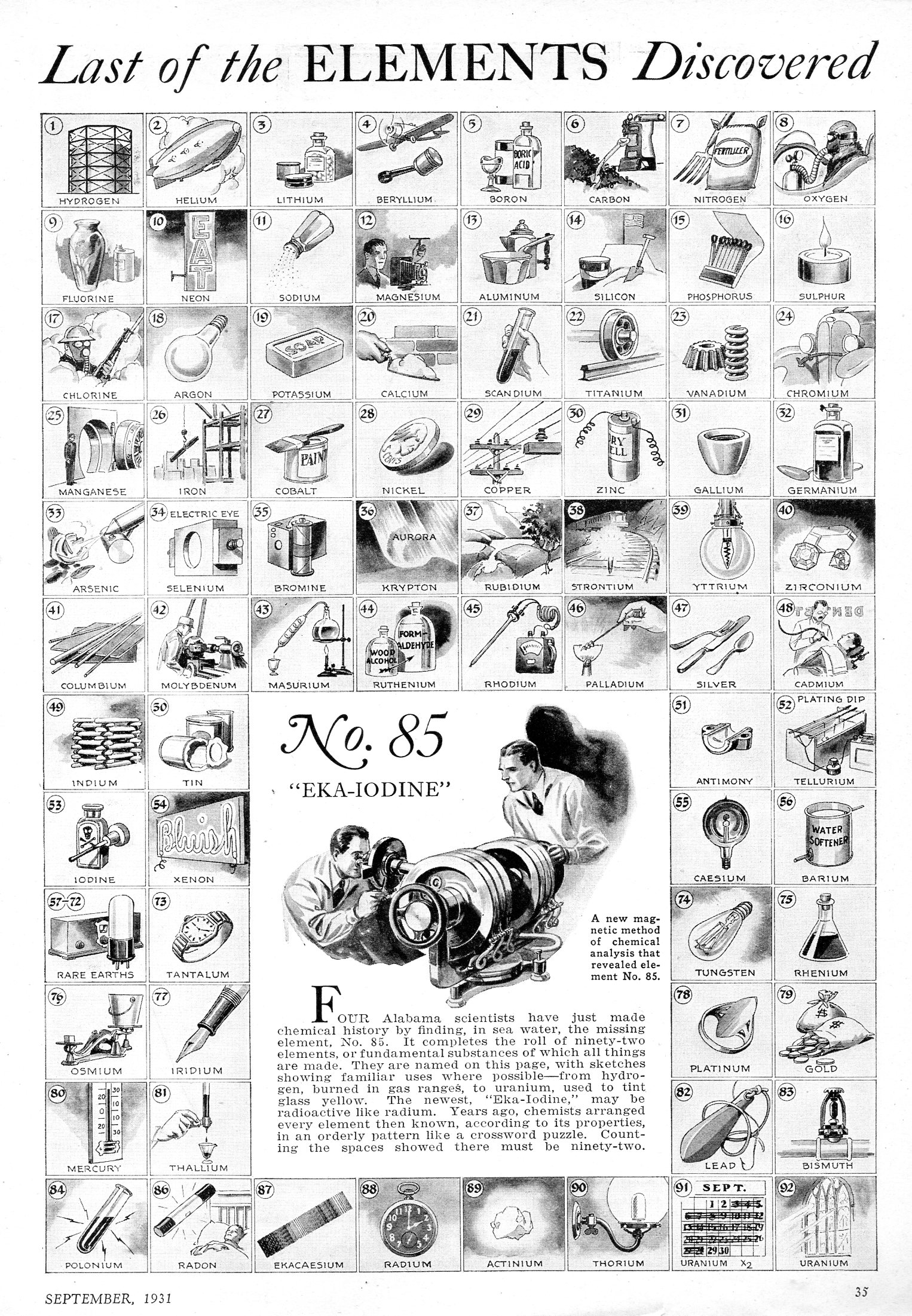
I found this down in the warehouse this morning, published in Popular Science Monthly, September 1951. It sin’t every day that you see a periodic table with drawings showing the employment of the elements, especially the stained glass windows for the element with the atomic number 92. Actually uranium glass was a “thing” once upon a time,, at least until the Cold War kicked in, putting a crimp in the supplies of uranium for glass plates and beads and that sort of thing.
JF Ptak Science Books Quick Post
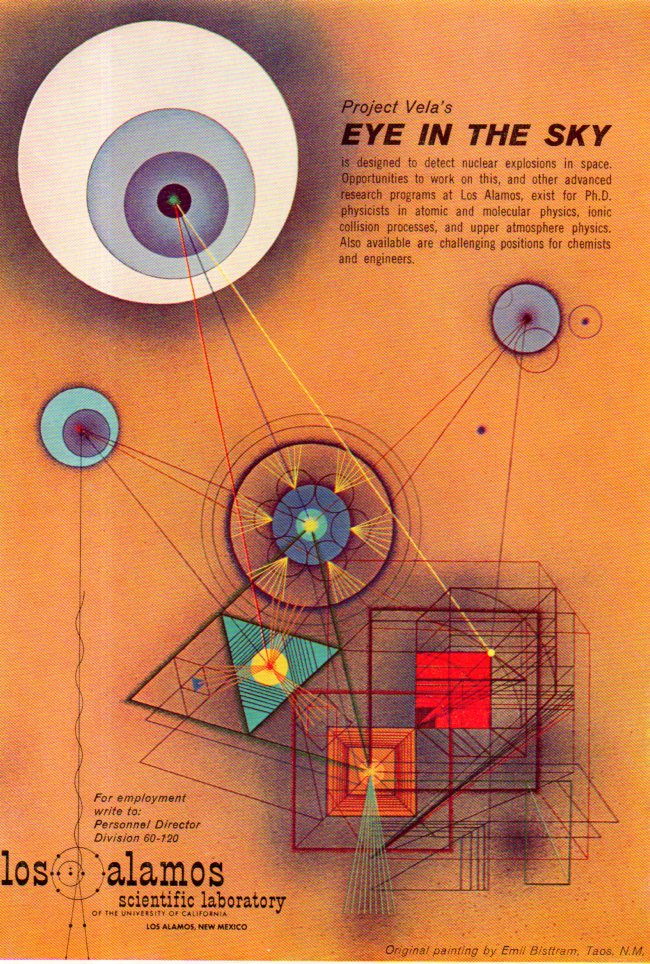
I do not have the source for this though I believe it is from Science Magazine from 1960. The ad was placed LANL looking for new hires, and employed the artwork of Emil Bisttram (Taos, New Mexico), representing the new ARPA (pre-DARPA) work for the detection of nuclear explosion tests conducted in outer space, Project VELA. (“In a continuation of presidentially directed programs, Eisenhower assigned ARPA in the summer of 1959 the task of developing the technologies necessary for the detection of nuclear tests, what would become Project VELA (Vela means watchman in Spanish). This program would examine technologies for detection space and atmospheric tests by satellites (VELA , undertaken by the High Altitude Detection panel (the Panofsky panel) of PSAC, which recommended that a satellite system be employed to detect atmospheric or space nuclear tests as part of a verification system for a possible nuclear test ban treaty.”–“DARPA Space History”, here: http://qnet.me/legal/DARPA%20-%20Background.pdf
JF Ptak Science Books Quick Post
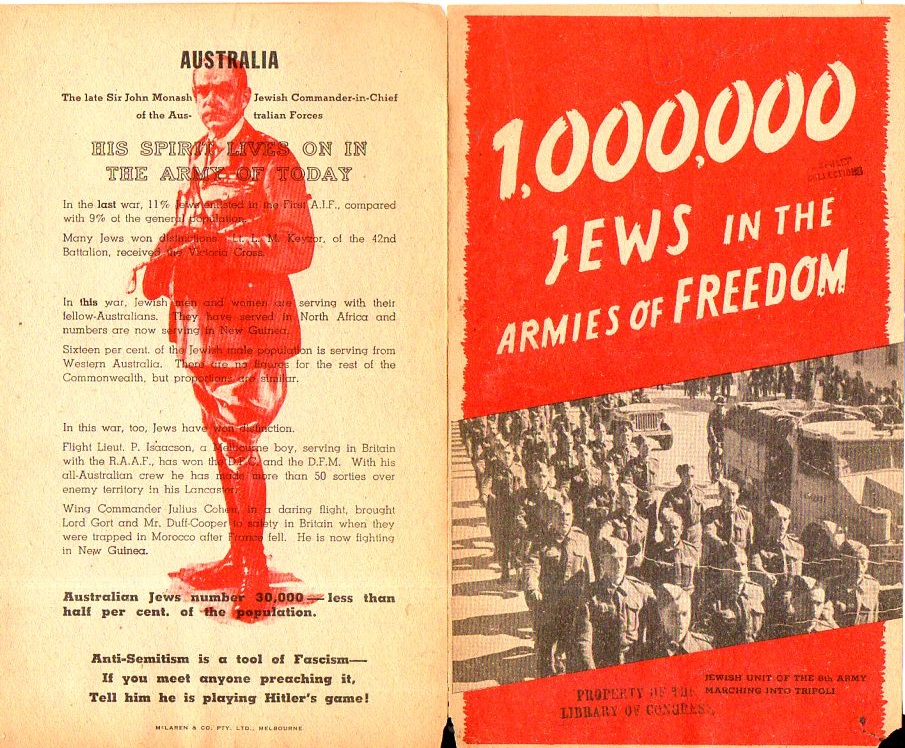
I haven’t seen very many pro-Jewish soldiers printed during the war–especially one in which states that “Hitler’s armies murdered five million civilians in Europe. They killed two million Jews”, which is also unusual, especially in 1944. It seemed to me that since there are only six copies located in libraries worldwide (this via WorldCat/OCLC, with only two of those copies in the U.S.) I thought it might be useful to surface the pamphlet.