A Daily History of Holes, Dots, Lines, Science, History, Math, Physics, Art, the Unintentional Absurd, Architecture, Maps, Data Visualization, Blank and Missing Things, and so on. |1.6 million words, 7500 images, 4.9 million hits| Press & appearances in The Times, Le Figaro, Mensa, The Economist, The Guardian, Discovery News, Slate, Le Monde, Sci American Blogs, Le Pont, and many other places… 5000+ total posts since 2008.

  • Lost Highways–Bad California Road Landscapes of Yesteryear

    JF Ptak Science Books   (Archive Post 1303, expanded)

    “There’s nothing so perfect as imperfection.”–Somebody.

    “The great unconquerables in the geography of human thoughts and ideas are the bad ones.”–Nobody.
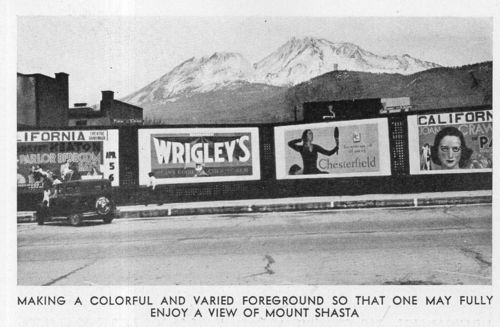
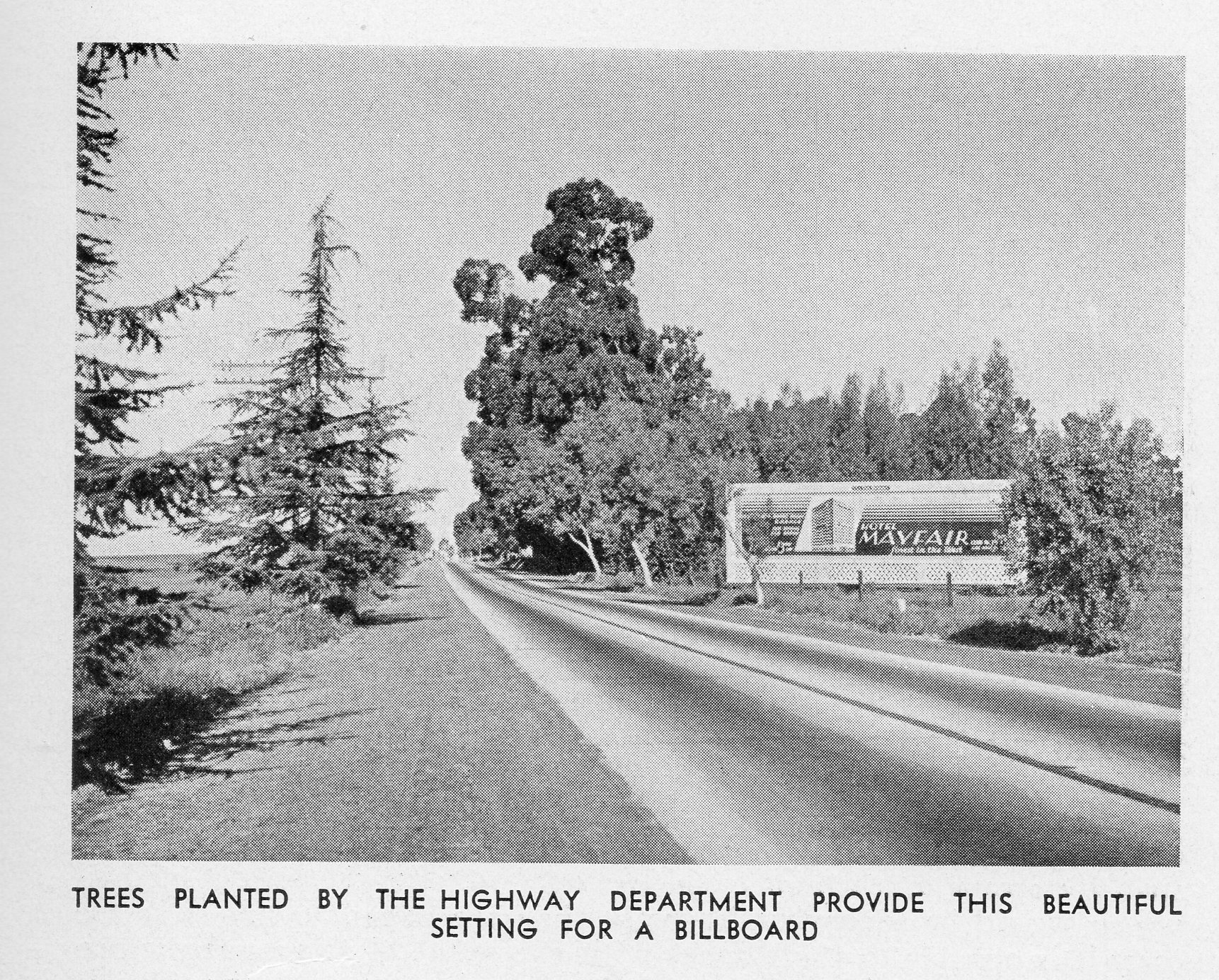
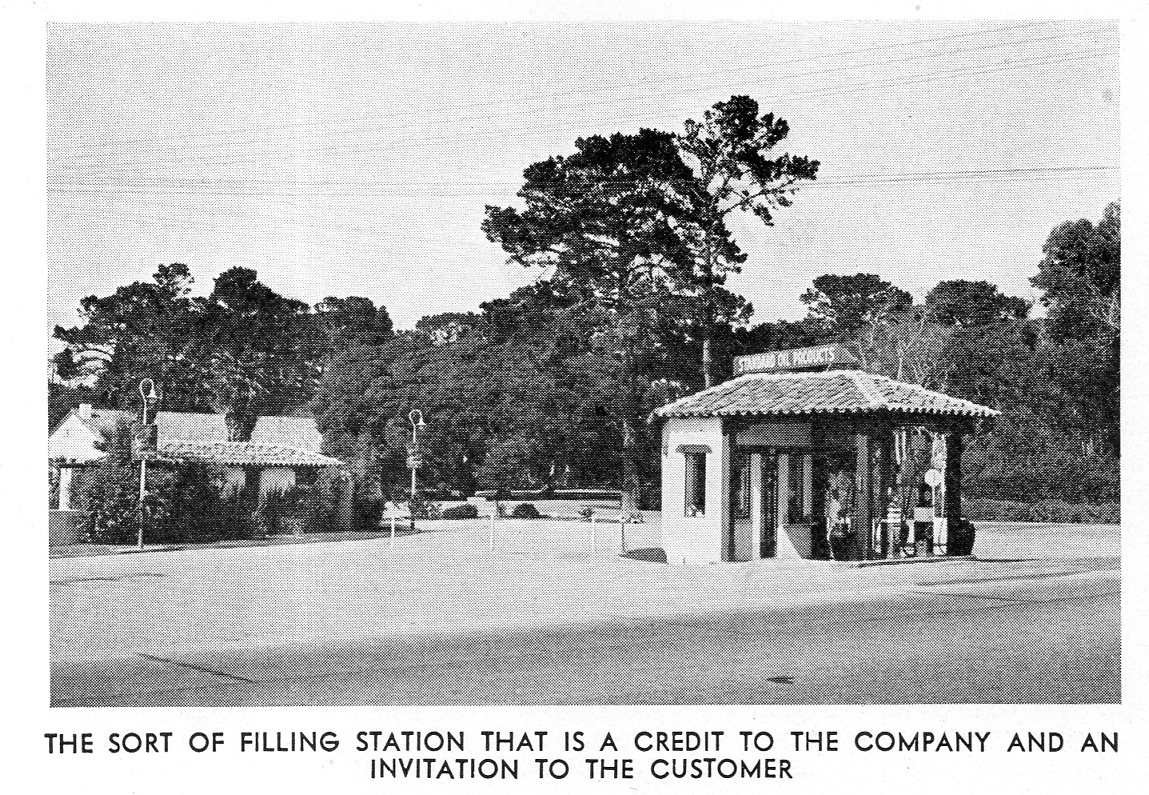
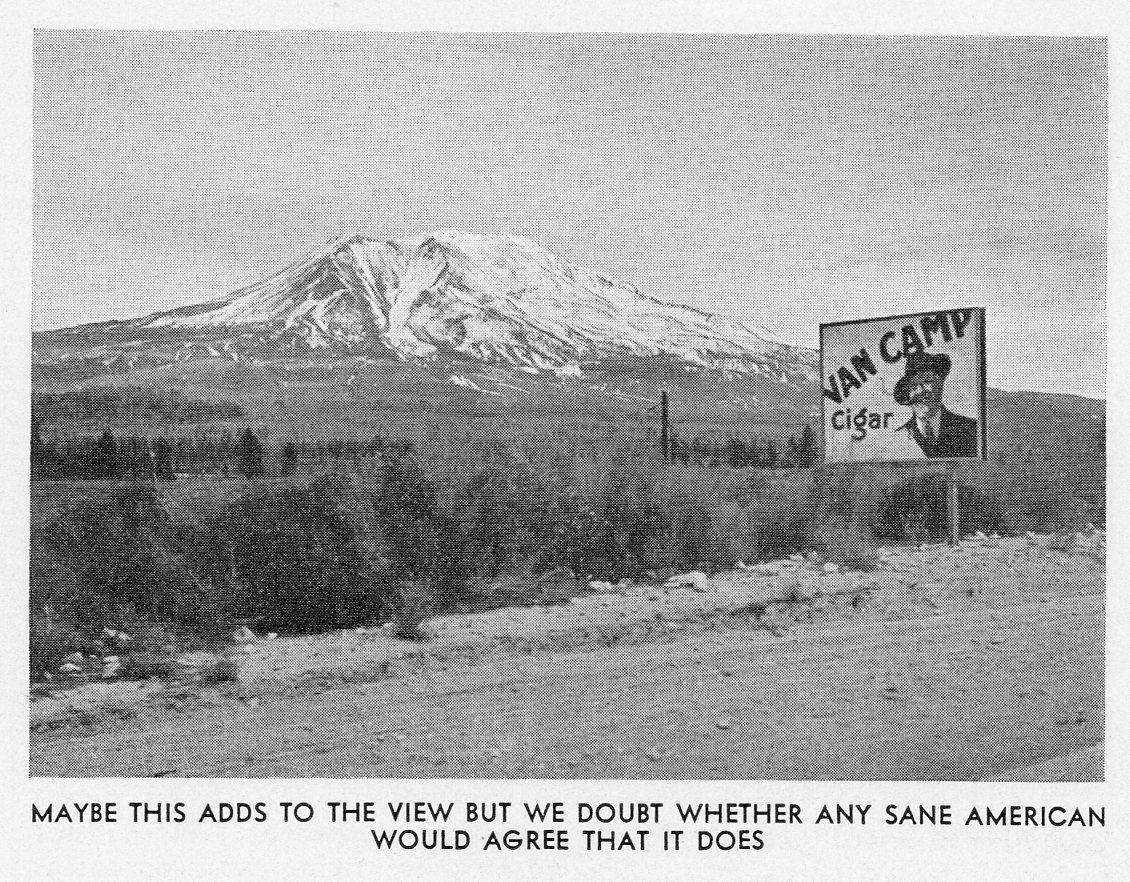
    California roadside d261

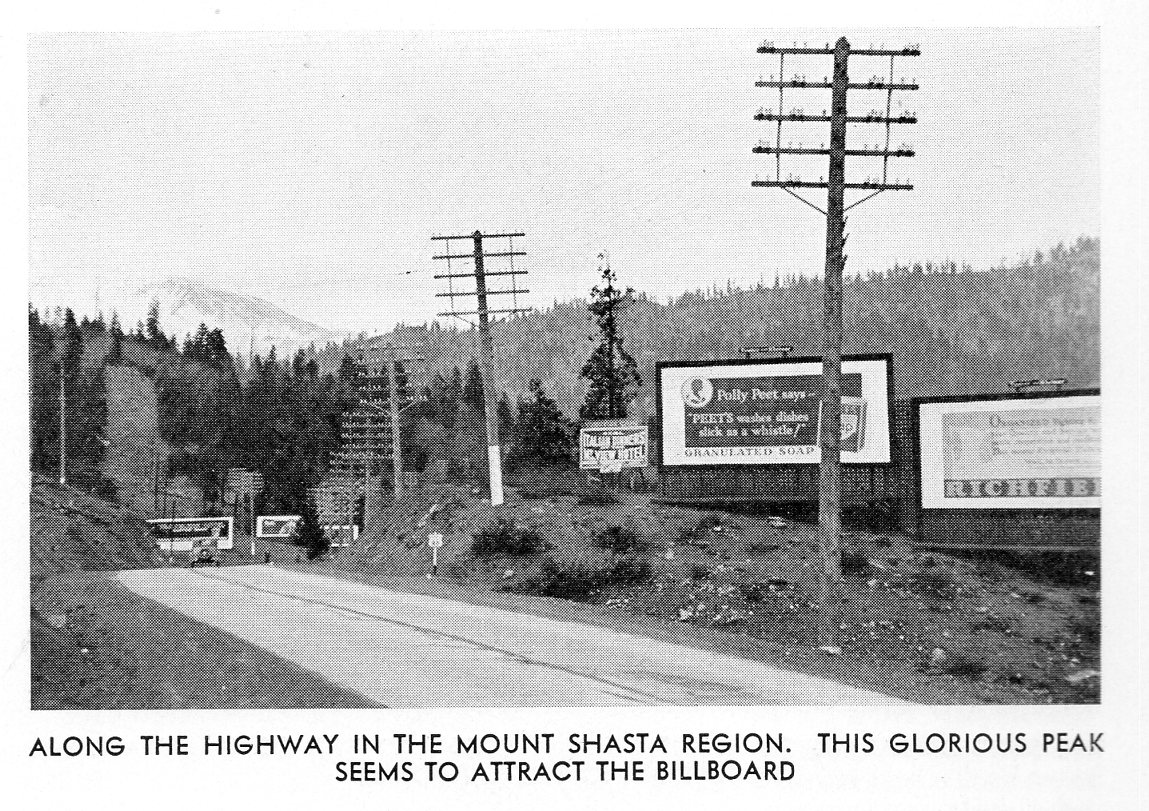
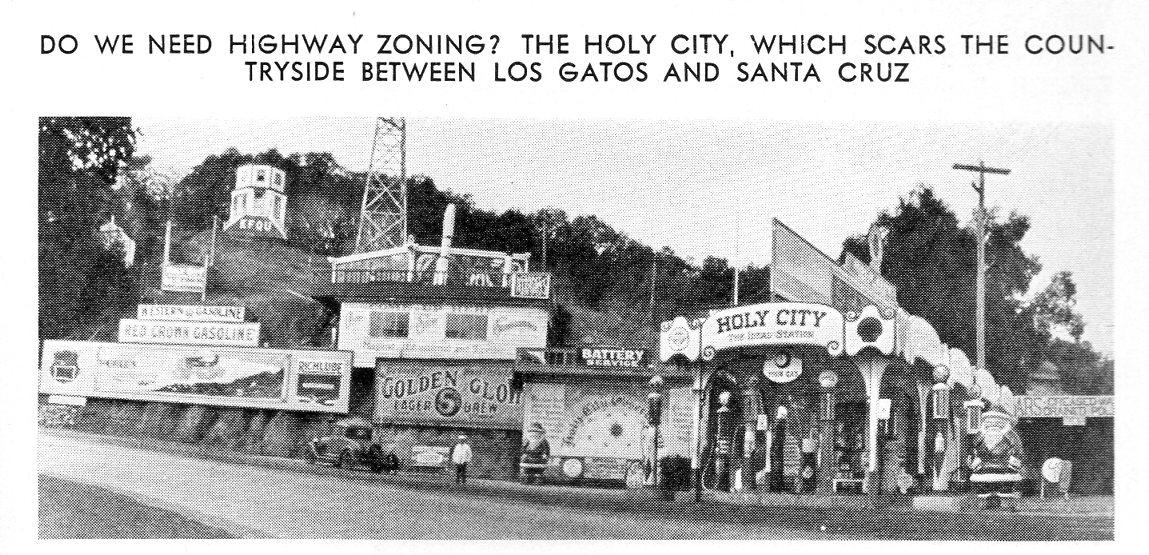
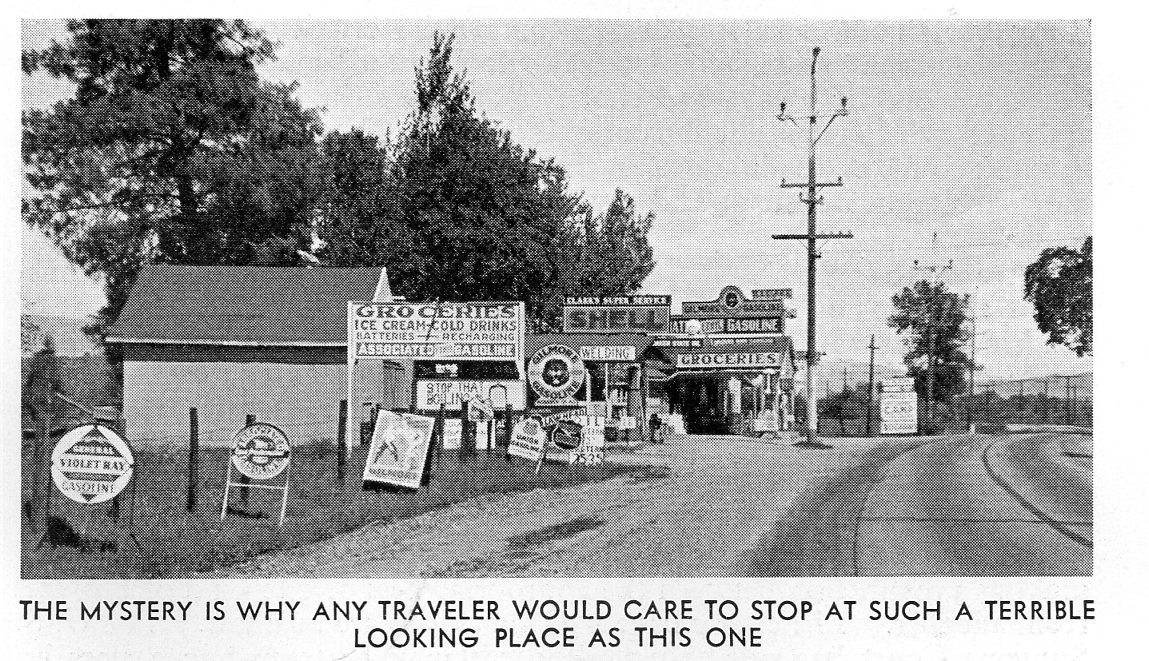
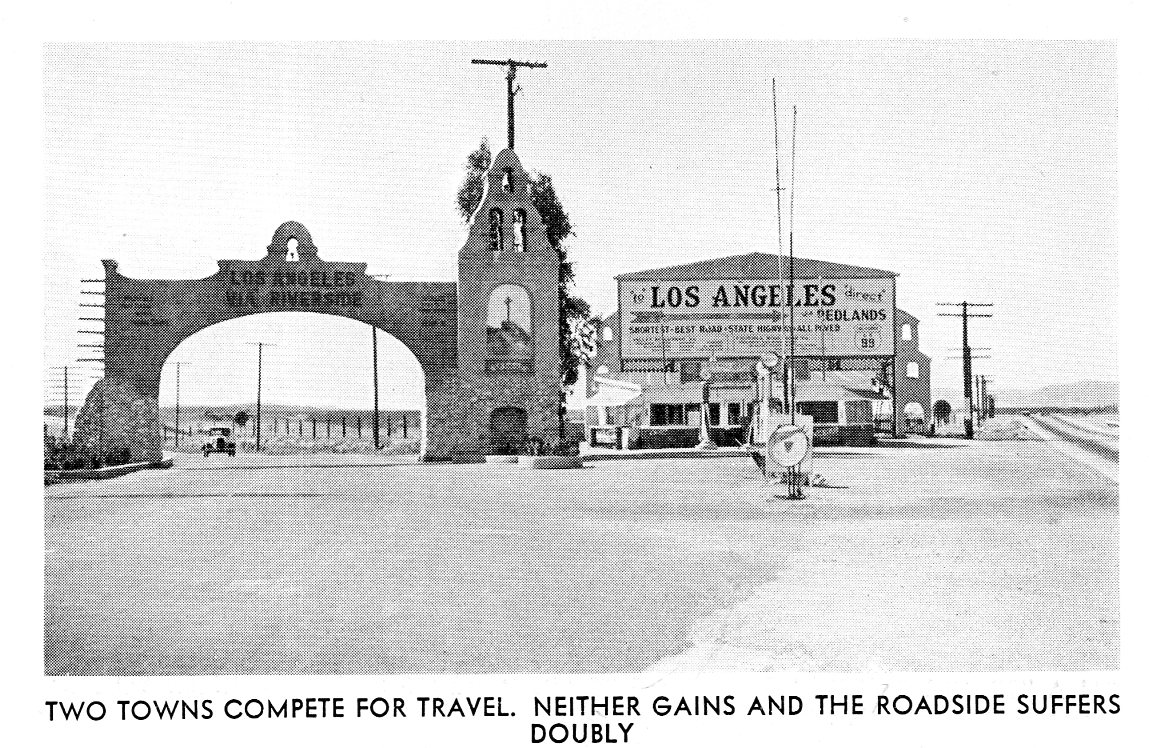
    [The captions for the images in this pamphlet are mostly facetious–the author/s were conservationists of sorts, interested in the landscape and visual culture of their state. They tried to make their case in some instances with sarcasm.]

    Bad ideas don’t so much go away as they get recycled. They can be replaced by good ideas or bad, but the ”original” bad ideas seem to linger on and on.  They are perhaps the indomitable inheritance of society, real and imagined.   

    Bad human-produced landscapes are an outgrowth of bad ideas, calamities large and small that come and go, the old replaced by something new that is good or bad or indifferent. With the landscape, the original landscape itself–apart from the idea that brought it about–is generally lost forever once it has been replaced.  There is no Bad Idea Spirit that brings it back whole again, unlike the generic Bad Idea, which can live on and on, unencumbered by history, like a Greek play or some deeper mythology.
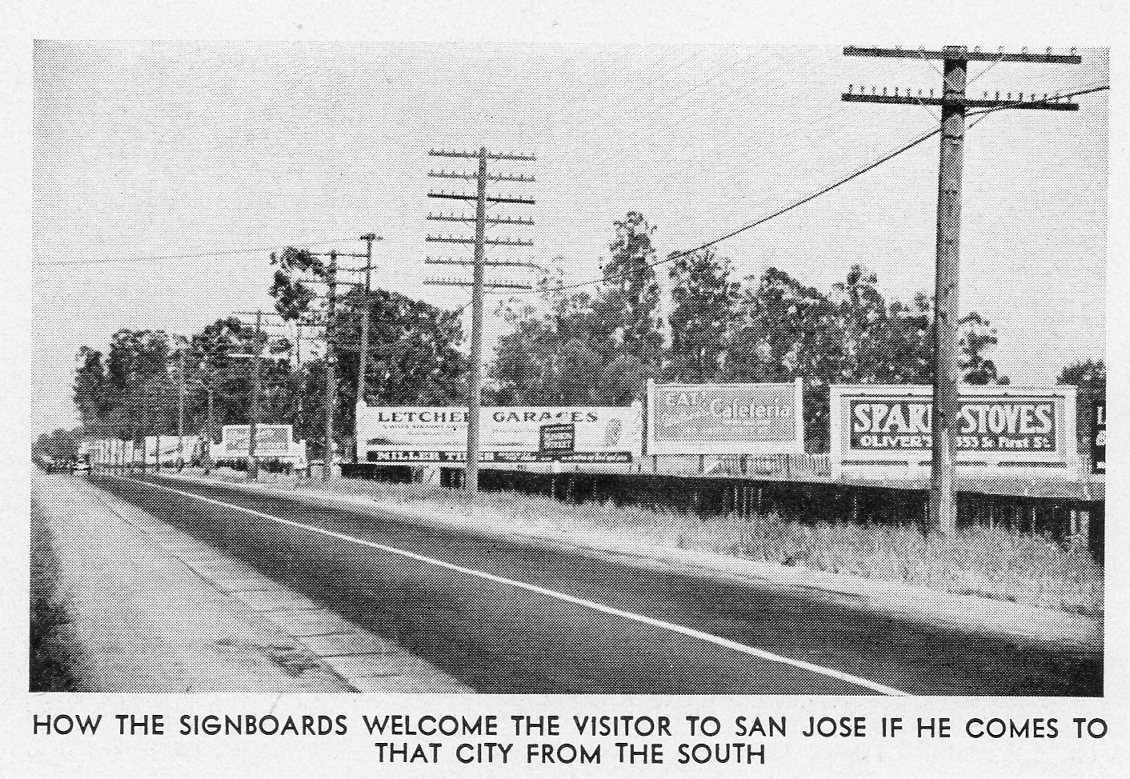
    California roadside b259

    Theoretically society is supposed to learn from recognized bad ideas, so as to not repeat them etc., which is one reason why we keep track of them, in the vain hope that someday someone somewhere in the history of our future will kill particular bad ideas off one by one. 
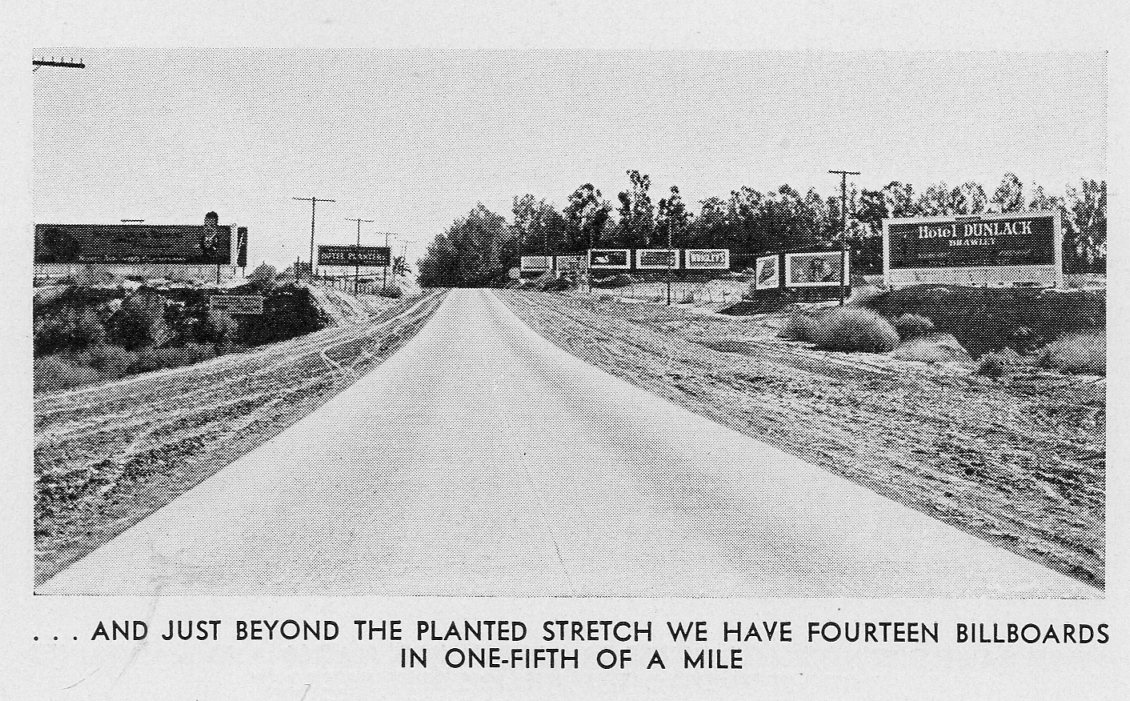
    California roadside c260


    California roadside a258

    In the meantime we can dwell on what we have, though with the removed bad idea landscape, it is more difficult.  That’s why it is important every now and then to familiarize ourselves with them when the opportunity arises, which is just what happened with this innocuous-sounding pamphlet, The Roadsides of California, a Survey1 (1932)  Its not like it’s Pandora’s box–we can open this one and just a few, limited baddies come out, and fall limply to the floor.  But what we see is interesting, a slice of our memory of the horizon–a part of our “progress” that we’ve tried to excise–and what we can see now are the removed and forgotten things. 
    California roadside F263


    California roadside G264


    California roadside H265


    California roadside I266


    California roadside I267


    California roadside E262


    Notes

    1. This is actually an interesting pamphlet, an early attempt at removing the quickly generated ugliness that was cluttering new roads for the explosion of automobile travelers.  As quickly as cars were made in the new decade of the automobile, billboards and roadside attractions followed.  This pamphlet identified this phenomenon as a problem.
  • The Business-End of a 120′-Tall Fall

    JF Ptak Science Books  Quick Post

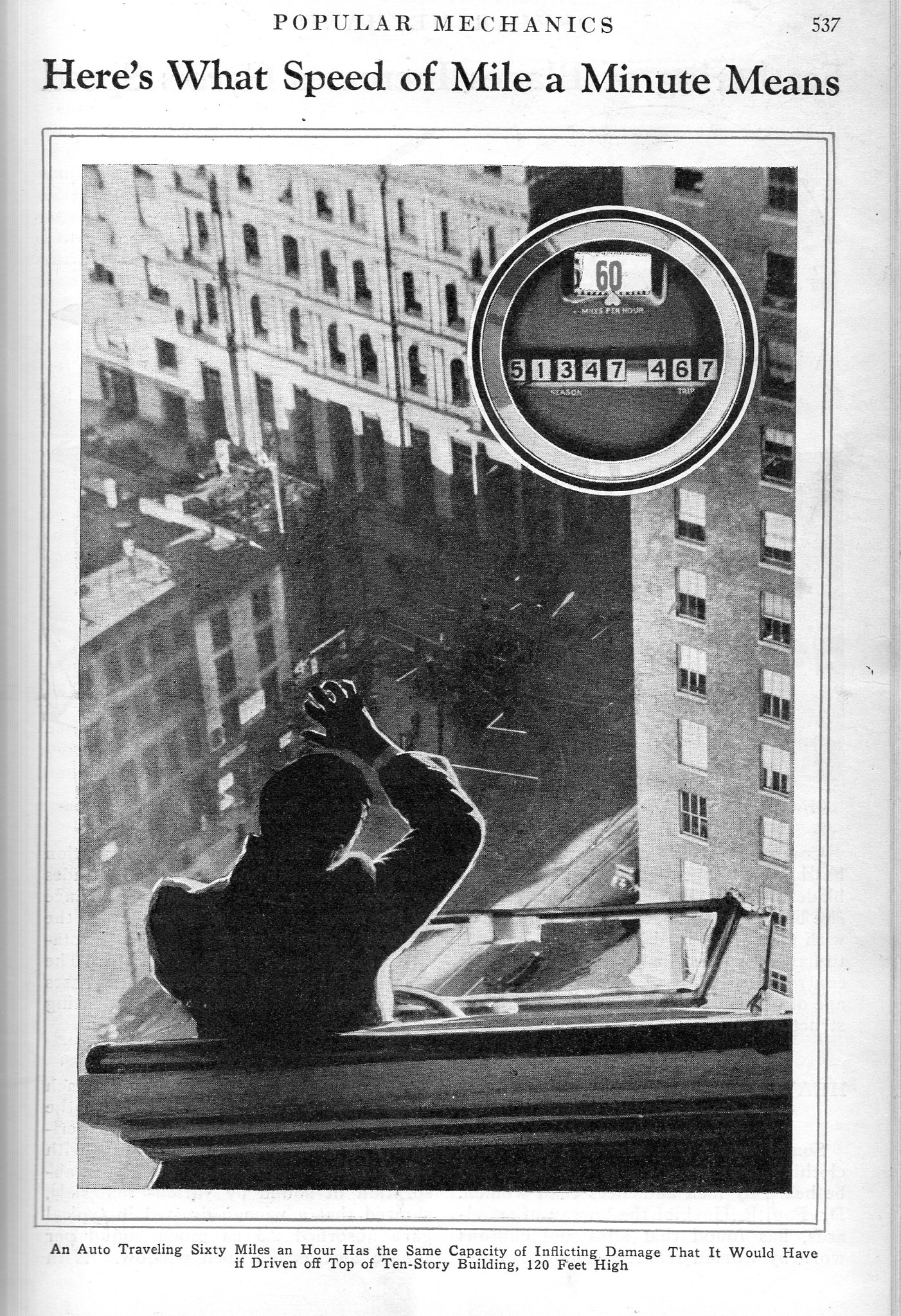
    It might have made it more exciting for the readers to know that the fall would’ve taken about 2.73 seconds from 120′–I think the results are pretty much exactly the same whether the 60mph man was in a car or not so far as the effects of the sudden stop at the bottom goes.  In any event, it was an effective way of relating the dangers of ultra-auto-speed in 1932.

    60 mph268

    [Source: Popular Mechanics, April, 1932, p. 537.]

  • Steam-Punk Tee-Shirt Rocket Ship Pilots (1932)

    JF Ptak Science Books  Quick Post

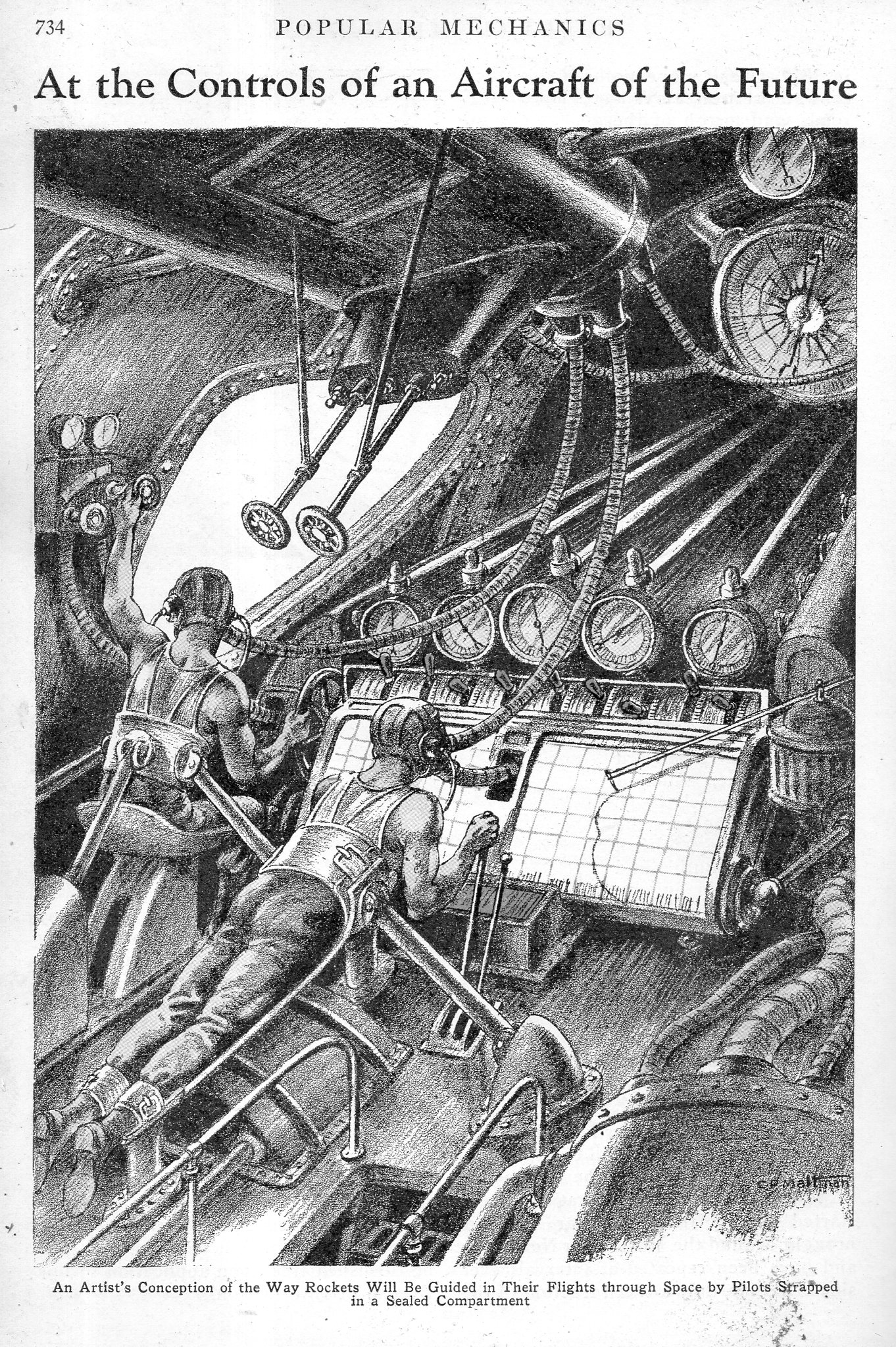
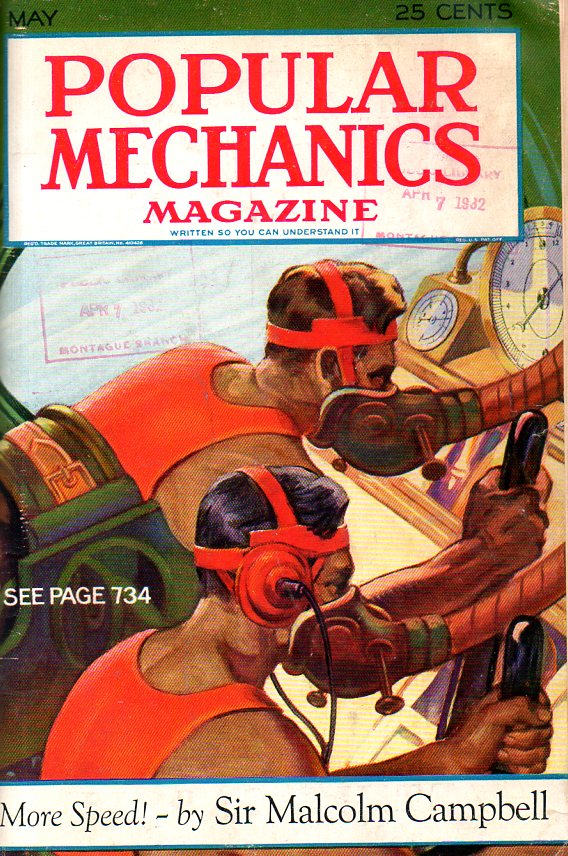
    This creative vision of the future appears in Popular Mechanics (May 1932) and while picturing zeppelin-like space ships with stubby retractable wings traveling at 15,000 mph, it also depicts pilots in a very informal attitude of dress…they’re also in a relatively cavernous command center with big gleaming instruments, including a very large compass and a very impressive graphical printout of some sort.  Anyway it looks like a lot of big and heavy stuff in a big and bulky command center, which means the ship would’ve been bigger and bulkier, and who knows what was going to get it to the desired altitude of 600 miles for it to make its 15-minute Paris-Chicago flight.  I think the sleeveless underwear deserved an explanation, but it found none.  

    Rocket ship 1932269


    Rocket ship 1932270


  • Neutrons, Positrons, & Hell–the Epic of the Fall of Man Suggested in the Physics of 1932

    JF Ptak Science Books   Post 2613

    Two days ago (or yesterday?) it seemed as if everything that I touched or read or researched involved the year 1932–and two of the blog posts were on things from that year. Over in the science bookstore side of what I do here, I was also working on the discovery of the positron by C.D. Anderson (announced in the Physical Review, and which showed that yes indeed there were things smaller than the atom)’ Chadwick’s discovery of the neutron, and Cockcroft1 and Walton’s splitting the lithium atom–all in that big year of 1932. And this all somehow put me in the mind of dots and circles, and then concentric circles, and then to Hell.  

    This was not the physical Hell of what was to come in 1945 and it wasn’t the future beckoning call of Armageddon that came as one of the results of decades of nuclear research–instead it was a stronger but make-believe Hell of infinite belief, brought to us via the development of numerous religions and then more beautifully described by Milton and Dante…and, in the case here, Caedmon.  

    Caedmon272

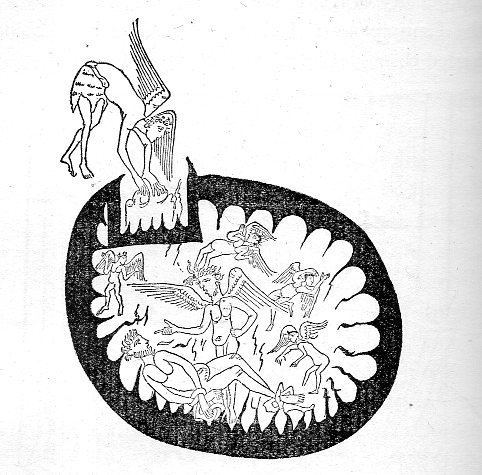
    All of this boils down to one picture that I had in mind when I was messing around with the 1932 stuff–the opening of the boundary of Hell into that of Chaos.  The image comes from a very early manuscript of Caedmon–who was a 7th century figure and the earliest English poet whose name is known. name is known–illustrating a part of the story of the fall of man. The image has stayed in the back of my mind for a long time, encountered in an interesting (and thickly spongey) book from 1896 by Stephen Gurteen (1840-1898) called The epic of the fall of man; a comparative study of Caedmon, Dante and Milton2. The striking picture is the third in the book (on page 108), though plenty of other images appear behind it through the course of the rest of the book, another 35 in all.  

    What we see is a circle within a circle, an atom of Hell, with Hell itself surrounded by Chaos, or the Abyss, and above this, there was Heaven, or the Empyrean; and in this case, an angel is reaching through the black surrounding region of Chaos and into Hell, where we see an example of the suffering of the mega-damned.  

    I know this isn’t quite a vision of an atomic model, but I associated it with our friends from 1932.  And yes there are other examples suggesting this structure springing from Dante and even Milton, but, really, it is just this one image that first comes to mind.  

    Notes:

    1. As it turns out in my experience John Cockcroft is a very rare photographic figure among physics Nobelists in that he is very frequently smiling in official photos. 

    2. Full text available here:  The epic of the fall of man; a comparative study of Caedmon, Dante and Milton, https://archive.org/details/epicoffallofmanc00gurtuoft   

    ·Posted by :

    ·in:

    —
  • Cover Design and Industrial Art (1941)

    JF Ptak Science Books   Quick Post

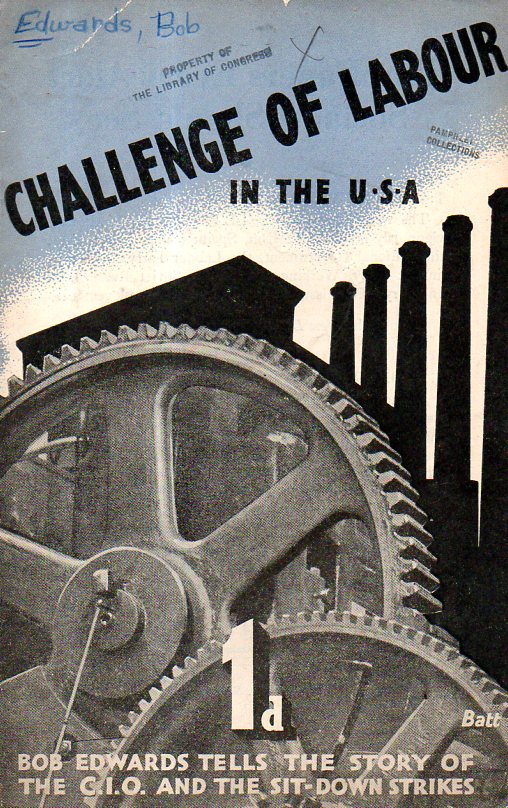
    I don’t mean to trivialize the contents of this pamphlet by focusing solely on its cover design, but I guess that is what I am doing, not having any real interest in the content. That said, the work is by Bob Edwards (1905-1990) who led a long and very interesting life as a union person, labor organizer, Socialist, MP, and a fighter against the Fascists in the Spanish Civil War. (He was also the author of another interesting pamphlet that appears elsewhere on this blog on the British chemical industry in 1944 and its “Nazi associates” https://historyofideasblog.com/thesciencebookstore/2014/09/superior-cover-design-chem-industry-nazism-and-race-suicide-1944.html).  In this present pamphlet Edwards looks at the history of the CIO “and the sit-down strikes” while concentrating on its role in the U.S. during WWII. This is pretty dicey stuff (as John Lewis would discover when his vehement pro-Union and non-interventionist/Isolationist policy proposals was defeated by his membership) and rubbed up the wrong way against U.S. defense and war policies. But Edwards was looking for something different, writing in this pamphlet well deep into (the U.K.’s) WWII about the need to change capitalist industry in the U.S. and a “REVOLUTIONARY OCCUPATION OF INDUSTRY” (caps in the original) to be achieved through “Workers Power and Socialism”, all of which would probably not play all that well int eh U.S. at this point. (It is unclear exactly when in 1941 this pamphlet was published, but I assume it is probably after the Nazis ended their cordial entente with the Soviet Union.) 

    Anyway, there is an interesting history of sit-downs in the pamphlet–I still like it more for its cover, though. 

    Challenge of labor273

  • Opposing Nativist Immigration Policies, 1910

    JF Ptak Science Books   Quick Post 

    I have a pamphlet here issued by a furrier union around 1930 which vehemently denounced immigrants coming from a particular country, and described them in racist and bigoted detail for a half-page before another general rant against immigration in general; it was only after turning the page that I found out who the furriers were attacking–the Greeks.  It could have been just about anyone–especially if the printing date was unknown.  There are a number of pamphlets like that here in a small “misguided social movements” collection–it would be interesting to post a collection of the statements to see how much havoc the entry of Poles and Irish and Catholics and Jews and Greeks and Quakers and Chinese and Japanese and Koreans and Vietnamese and Italians and so on has been caused to the greatness of the United States. It might be sobering for some Wall-Builder types and stop-all-Muslim-immigration folks to read the history of anti-immigration movement and legislation and see how much of that impacted the lives of their forebearers, It may be impossible for people to believe that in certain sections of NYC in the 1920s that there were movements afoot to restrict further settlement of Norwegians, but it is true. 

    And so the reason for this recollection: the appearance of the pamphlet, An Appeal to American Citizens, published by the National Liberal Immigration League in New York City in 1910). This group was in favor of equality and acceptance of immigrants at a time when there were many very active nativist, restrictive, racist, and anti-immigration groups (and legislation), and laid out their conviction and approach very simply in this six-page pamphlet. It discusses the “victim of…prejudice” at the hands of “persons who, disregarding the teachings of religion that men should love their neighbor and welcome the stranger”. They made good arguments, and given the brevity of the publication I reprint it in full:

    ·Posted by :

    ·in:

  • Hitler as Leviathan of the German People; a Map of the Threat to Germany (1936)

    JF Ptak Science Books   Post 2613

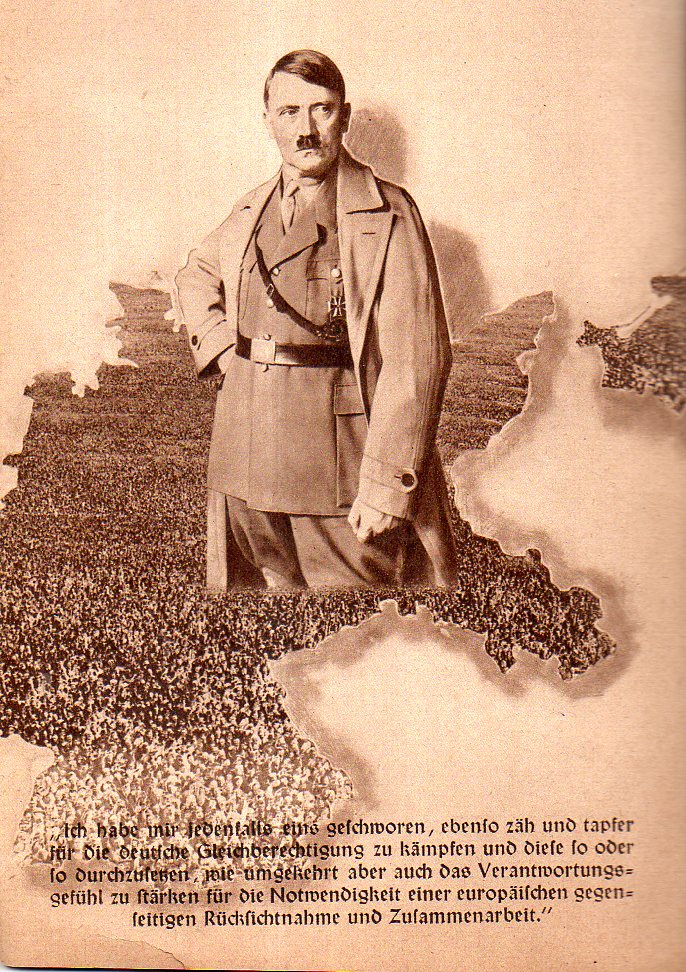
    the following two images are found in a small pamphlet on the general election and single-question referendum held in Germany on March 29, 1936 (Des Deutschen Volkes Schicksalswende am 29. Marx). as it turns out the small pamphlet accordion-folded oput to about 2.5 feet, which was printed on both sides.  Anyway the single question was whether the voter wanted a single-party representation by the NSDAP in the Reichstag–not surprisingly whatsoever the German population voted/”voted” 99% in favor of the proposal.  The pamphlet was a gross propaganda instrument, as was the “election/referendum”, and it contained a number of striking images, though perhaps none so as near-unforgettable as that showing Hitler arising from a living-person map of Germany:

    Hitler map of people303


    Hitler came to power via a number of elections–he didn’t just take it, or at least not until 1933; 44 million people voted in March 1933 (an 88% turnout), and 17 million voted for the NSDAP and Hitler giving him the popular vote and the most seats in the Reichstag. In the November 1933 (“Ein Volk, Ein Fuhrer, Ein Ja”) elections, 39 million/92% voted for Hitler, which was another story.  And here he is, rising from a sea of Germans, three years later, a leader restrictive of enemies and opposition, the whole thing looking horrible. 

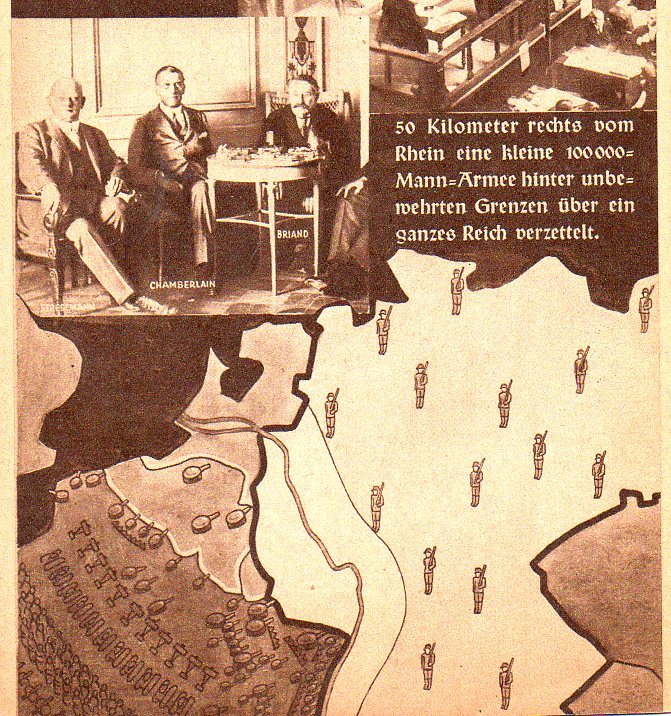
    Here’s another bit from the same 12-panel accordion-fold pamphlet, a propaganda map showing the possibly-invasive weaknesses of the Versailles-dictated German army.  AS in the case of several other maps posted to this blog on this 1934-1939 geographic creation of risk and threat, this one depicts a heavily-armed and populated French army looking at Germany, while the relatively-meagre 100,000-man German army quietly protects itself on the borders 50km away from the Rhine.  I guess it might have been effective if people were actually voting in this election, for scared people to vote their scared conscience for the man who scared them. The writing however was on the proverbial wall, and the only thing left to do with the Versailles treaty at that point would be to scrap it.  About four years later the Nazis would come sweeping down on France and by June 22 the French would be signing a humiliating surrender instrument.

    Hitler map of people304

  • History of Heavy: German Graphical Design, 1925

    JF Ptak Science Books   Quick Post

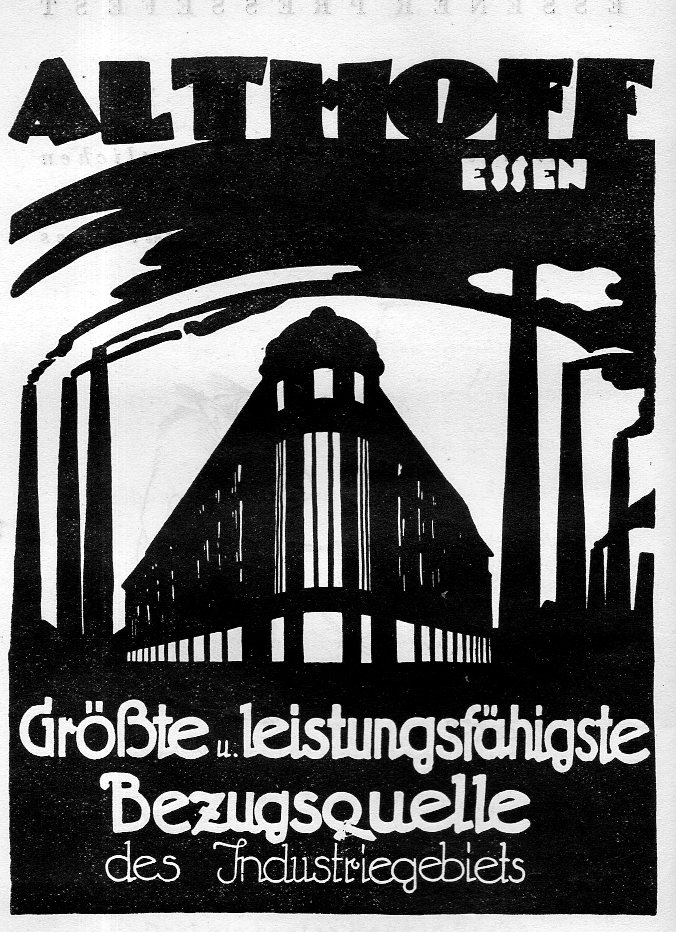
    I’ve posted before under this title (just scout under “German design” in the google box) and decided to add this one because of its heavy-obviousness, and also because of a heavy-missing element.  The image in question is from an ad in an odd publication celebrating/promoting Essen businesses, Essener Pressefest, 1925–at least that is what I think it is. The pamphlet has a lot of advertising from what looks to be small firms, but there is nothing there whatsoever regarding Krupp, which had been established in Essen for two centuries at least. Nor were there any other ads for anything else in the heavy department or what could have led to the city being called the Armament Maker of the Reich, and which would ultimately lead to Essen being mainly totally razed after 270-odd Allied bombing raids on the city during WWII.  So, no Krupp, but there was a two-page illustrated something-or-other on marionette theaters–marionettes, puppets, paper theater all have their place in the world, but I wonder what the place was when Krupp et alia are nowhere to be found?  No doubt I’m missing something, or everything–perhaps it had to do with Versailles and the focus was beyond iron works? I don’t know. Anyway, here’s the ad:

    Althoff324


    ·Posted by :

    ·in:

  • Germany/Czechoslovakia, 1932

    JF Ptak Science Books   Quick Post

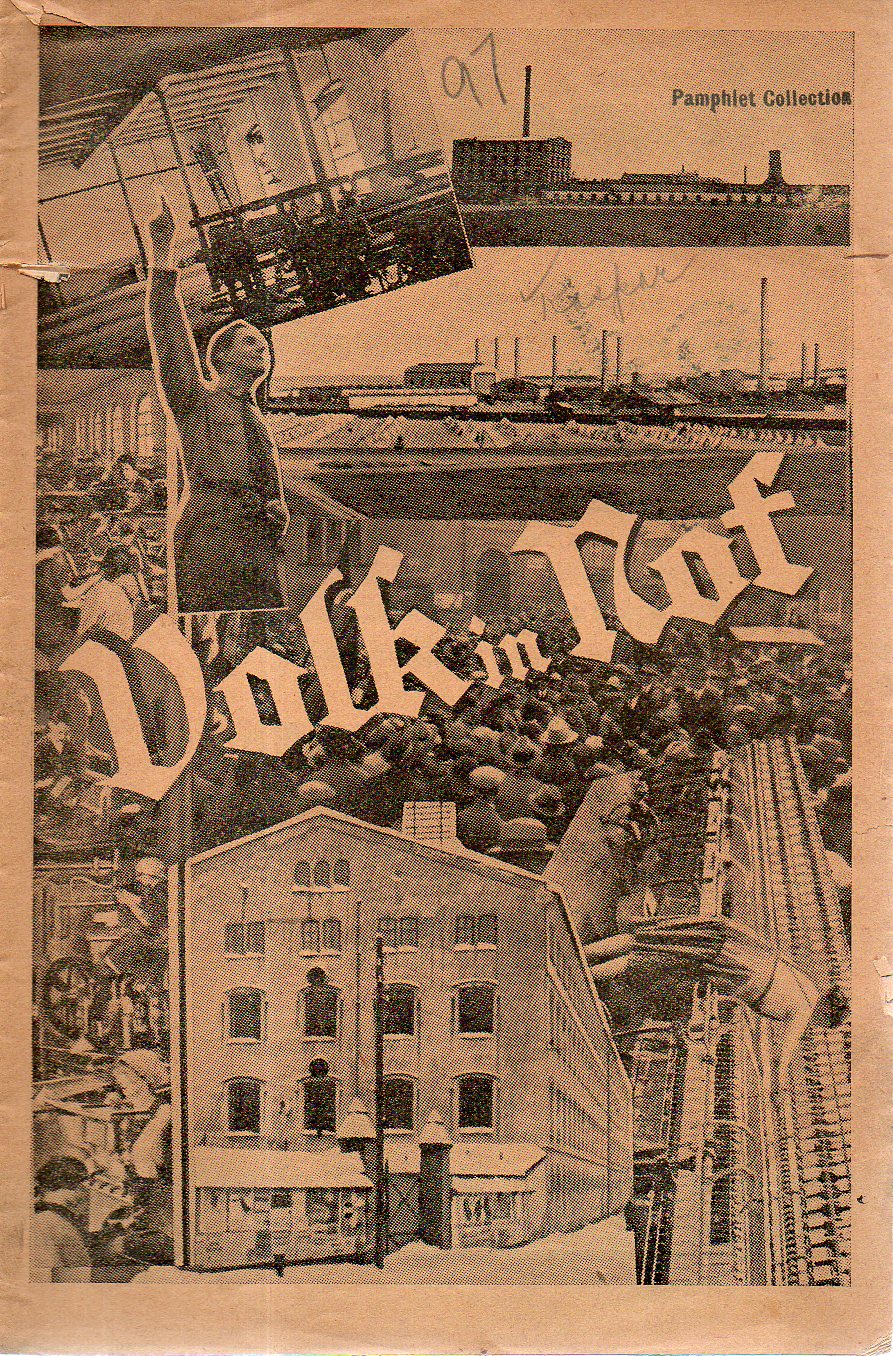
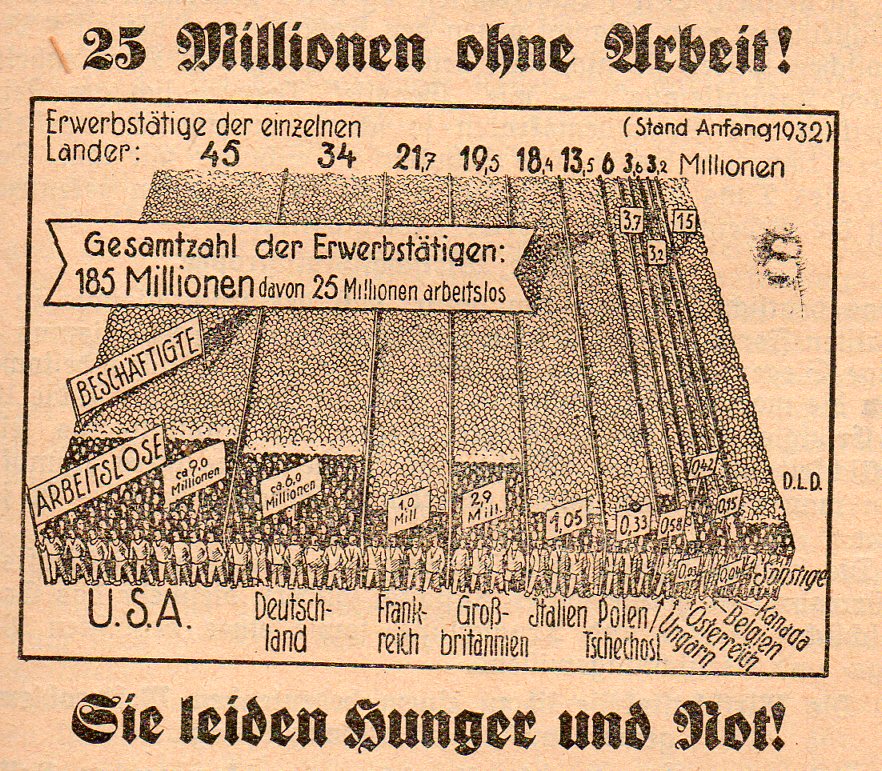
    The quick post this morning centers on design and the presentation of information–and it comes from a very uncommon and unsavory source. The pamphlet is by Rudolf Kasper, Sudetendeutsche Wirtschaftsnot! : Der Niedergang der sudetendeutschen.Wirtschaft seine Ursachen und der neue Weg zu Arbeit, Freiheit und Brot which on the cover of the publication becomes  Volk in Not. It was published in 1932 by DNSAP (German National Socialist Workers’ Party), which was an anti-Communist, anti-Capitalist, anti-Semitic, and other anti- things, and written by the German Nationalist Kasper, who after the Czech sell-out and invasion of 1938 became a Nazi and ultimately a Waffen SS.  Well, penultimately he became a prisoner of the Soviets and then ultimately dead at their hands, somehow, in 1947, under unknown conditions. (As Mr. Vonnegut would say, “so it goes”.)  The pamphlet is an appeal to the Sudeten Germans, offering an explanation for their failure at teh hands of the Czechs as well as a broad determination of how to fix things for the future, fixing the unemployment situation (there and so far as I can tell worldwide) for people to have a chance at “Work, Freedom, and Bread” (“zu Arbeit, Freiheit und Brot”).  Ah, yes.  Once the Nazis took control in Czechoslovakia, the DNSAP disappeared, outlawed–of course Kasper didn’t and simply moved on to his new Nazisness.  
    I’m posting about this because the pamphlet just doesn’t appear anywhere–there is only one copy of it located in libraries worldwide (Bayerische Staatsbibliothek) according to WorldCat/OCLC–and I just wanted to surface the thing.  

    The montage cover (8″x 5″):

    Weimar pamphlet Volk in Rot325

    And the display of the unemployed  (2″x 2.5″):

    Weimar pamphlet Volk in Rot326(“You are Suffering Famine and Distress!”) 

    So, there you have it. There’s a lot of unpleasant stuff in this pamphlet that would be fervent feed for the developing downfall of Czechoslovakia six years hence, though we don’t need to get into that where–as I said, I just wanted to surface this pamphlet and bring some notice to its existence. 


  • Gigantic and Unbuildable Architecture: Buckminster Fuller’s Midtown Manhattan Dome, 1968

    JF Ptak Science Books LLC  Post #115 (from 2008, extended a little)

    Big_arch_city_fuller139
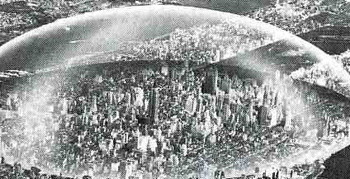
    Buckminster Fuller had a lot of good ideas but I’m not so sure that this is one of them.  I don’t have much doubt that versions of domed cities will exist in the not-dim future, though I do have doubts that they would be constructed to preserve the bones of antiquated ideas.  It seems logical to me that the retrofit of untold millions of cubic feet of city life just couldn’t make sense, even if the square footage was in Manhattan.

    Domed cities pop up here and there in speculative/science fiction in the 1960’s (though there is a far-deep reference to one from the 1860’s, though that one is under water), and there are many that are sprinkled like seasoning here and there in more modern formats, as with Stephen King’s Under the Dome made into a slappingly-silly tv show of the same name and The Simpson’s movie that Borrows Very Heavily from King.  There are others to be sure, though I am more interested in miniature domed underground cities or Lego-made Dyson sphere within a Domed Galaxy. 

    Fuller’s idea (working with Shoji Sadao) is multiple orders of magnitude removed from the original idea of the arcade (like the passage Choiseul, located in the second arrondissement of Paris), envisioning the construction of a dome to encapsulate NYC from the East River to the Hudson along 42nd St, and from 64th to 22nd St:  that is two miles in diameter and, plus at least a half-mile high (or about 2.5 Empire State Buildings pile one on top of the other at zenith sector).  I’m not so sure how this would be built, or how things would be heated or (especially) cooled, or what the construction material was for the skin of the dome, or how people get in and out, or how you deal with heating and cooling, or how any noxious chemicals are expelled—but Mr. Fuller thought that the savings alone from snow removal from NYC streets would pay for the dome in ten years.  (That would maybe work out–the snow-removal analogy–if someone had asked Mr. Fuller exactly how much snow he was talking about…)  
    Big_archfuller_detail141

    Mr. Fuller also thought that the dome would protect the city (or this part f the city) from radiation fallout.  That could be true, assuming that of all the hundreds of nuclear warheads that the Soviets would’ve launched against NYC alone none of them would’ve found their target, except perhaps for the Ridgways or Staten Island, where the shock wave or winds produced by ensuing firestorms would not have disturbed the dome.  Of course if a warhead actually came close—or actually hit—the dome, the protection from radiation would be moot. 

    Source:  Buckminster Fuller in Think magazine, vol 34, Jan/Feb 1968.  AND of course the lovely work by Alison and Sky Michele Stone, Unbuilt America, McGraw Hill, 1976, pg. 99.

  • The “Endless Immensity” of Thomas Wright, 1750

    JF Ptak Science Books  

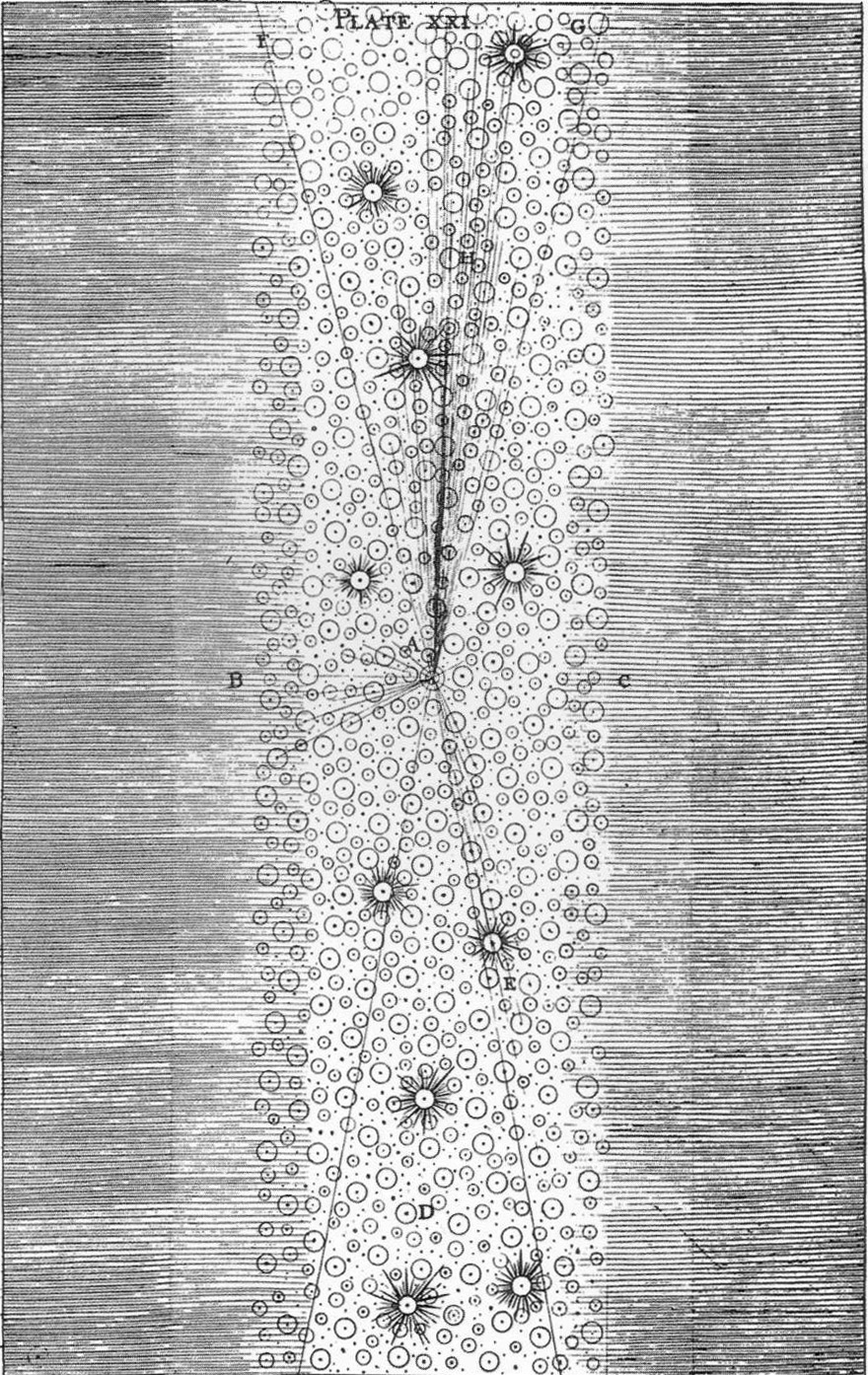
    Thomas Wright (1711-1786) saw about as deeply into the deep as just about anyone else–he looked into the night sky and pretty much saw all of it. In his book, An Original Theory or New Hypothesis of the Universe, Founded upon the Laws of Nature1, he described a version of the universe that was influential in the thinking of Kant and Herschel, finding a rectangular/squashed “finite infinity” of stars, “a vast infinite Gulph, or Medium, every Way extended like a Plane, and inclosed between two Surfaces”.

     Wright thomas [plate 23

    Our Milky Way, which at the time was thought to be the entire universe rather than a galaxy as it was later discovered to be–one galaxy in a seemingly endless sea of galaxies–was presciently seen by Wilkins as being but one assembly of stars in an “endless immensity” of stars:

    “And farther since without any impiety; since
    as the creation is, so is the Creator also magni-
    fied, we may conclude in consequence of an in-
    finity, and an infinite all-active power; that is
    the visible creation is supposed to be full of si-
    derial systems and planetay worlds, so on, in
    like similar manner, the endless immensity is an
    unlimited plenum of creations not unlike the
    known Universe.”–page 143. (Again, the “Universe” referred to here is the Milky Way galaxy.)

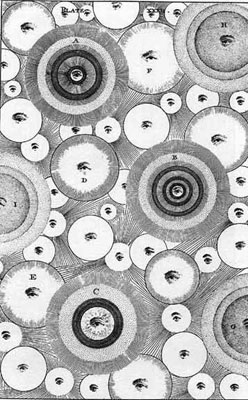
    Wright’s vision of this plethora of universes, in which each creation is one like the Milky Way–a radical thought in 1750:

    Wright 32


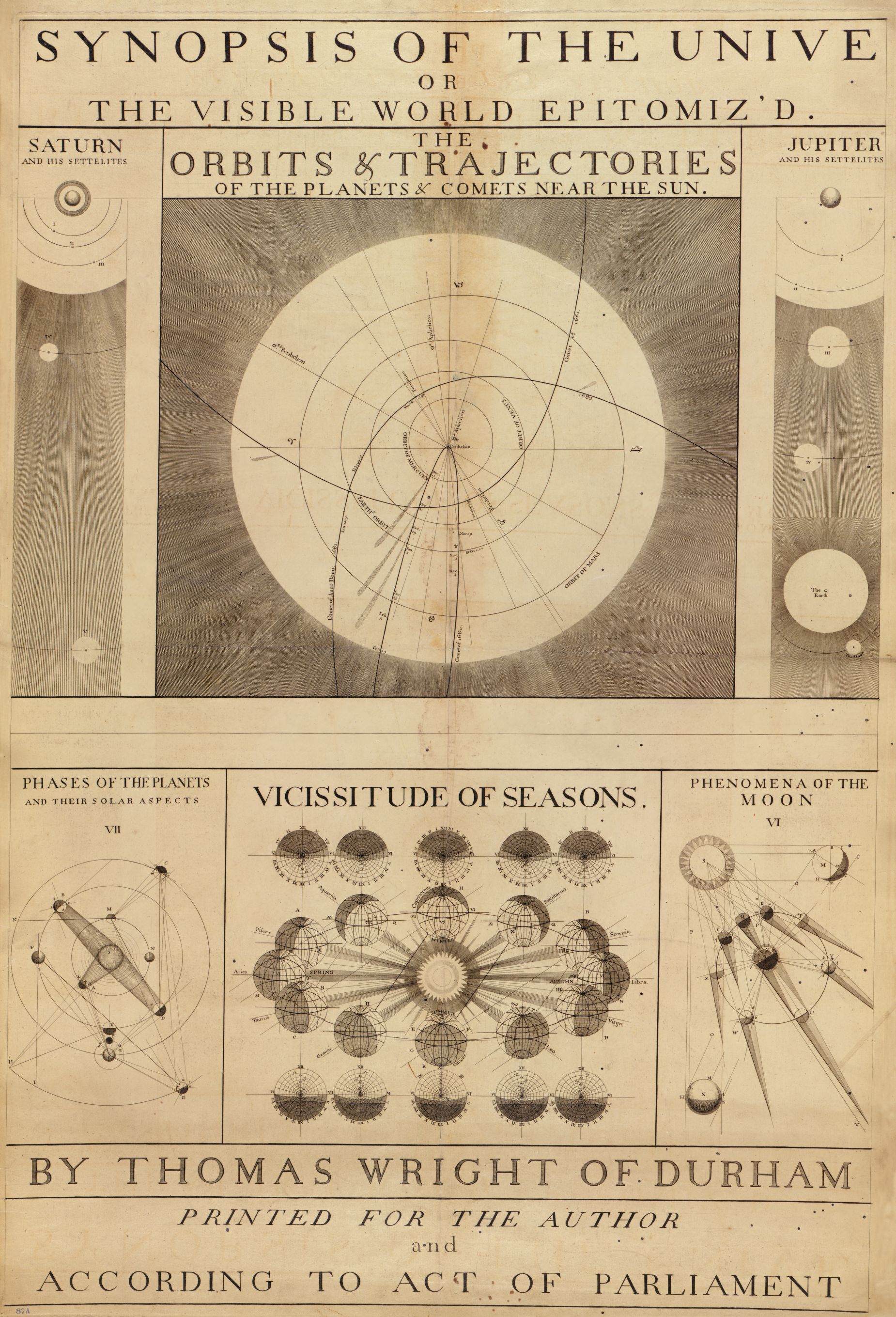
    And another view of this idea, from Wright’s  A synopsis of the universe, or, the visible world epitomiz’d (1742, being 13 maps on 3 sheets):

    Map celestial


    [Source: the Library of Congress.  https://www.loc.gov/item/2008621668/   Part of me wants to include the first Wright engraving in this blog’s series on the History of Lines, seeing as how they represent the great Something that seem to be infinitely binding the infinity of universes…]

    And another from these sheets:

    Maps Wright synopsis of the universe

    [Source: the Library of Congress.  https://www.loc.gov/item/2008621668/]

    Wright on the “plurality of systems” ( from his An Original Theory or New Hypothesis of the Universe … 1750)

    Wright also writes on the minuteness of the human condition, of the perfect sense of nothingness that is the Earth in a sea of infinite possibilities of other earths and earthy creations, which was definitely an outpost of thinking in 1750:

    “In this great celestial creation, the catastro-
    phe of a world, such as ours, or even the to-
    tal dissolution of a system of Worlds, may pos-
    sibly be no more to the great author of nature,
    than the most common accident in life with us,
    and in all probability such final and general
    doom-days may be as frequent there, as even
    birth-days, or mortality with us upon the Earth.
    This idea has something so cheerful in it, that
    I own I can never look upon the Stars without
    wondering why the whole world does not be-
    come Astronomers; and that men endowed with
    sense and reason, should neglect a science they
    are naturally so much interested in, and so ca-
    pable of enlarging the understanding, as next to
    a demonstration, must convince them of their
    immortality, and reconcile them to all those lit-
    tle difficulties incident to human nature, with-
    out the least anxiety.”–page 132

    Notes

    1.  The full title:  An Original Theory or New Hypothesis of the Universe, Founded upon the Laws of Nature, and solving by Mathematical Principles the General Phenomena of the Visible Creation ; and particularly the Via Lactea. Comprised in Nine Familiar Letters from the Author to his Friend. And illustrated with upwards of thirty graven and mezzo-tinted Plates by the best Masters. London, MDCCL.” Full test, here.

     2. An odd note about Thomas Wright’s personal history, from Science, 1902: “A word, in passing, about Wright. Like many another, so unfortunate as to live ere the times were ripe, he has been consigned to unmerited oblivion. Even the writer of the entry upon him in the ‘ Dictionary of National Biography ‘—a work so uniformly accurate — is unaware of the sources from which information could have been obtained, and so has nothing to tell, — does not even know the dates of his birth and death, or why he was called ‘of Durham.”–[Science, N. S. Vol. XIII. No. 321. 2-22-1902

    An interesting poem by Rafinesque to start of his edition of Wilkins:

    “Where ends the range and limits have been set
    To mortal eyes, there mental sight begins
    To fathom space, and worlds invisible
    Surveys, admires
    The mind must feel that space can have no bound*,
    Whatever number be of things or thoughts
    Others may be beyond—and thus behind
    The Nebulas and Belts, our Galaxies
    Of stormy clouds and oceans
    There stands the central land and throne
    Of our wide Universe, the home of Angels,
    The seat of Love Divine”
    Rafinesque, Poem on Instability, found at the beginning of Rafinesque’s 1837 American edition of Wright’s 1750 work. 


Recent Posts

Archives

Categories