JF Ptak Science Books Quick Post
This does for a moment look like a piece of Found Scientific Art–and I guess it is–reminding me of a multiply-layered steely jaw of some creature, which you can see if you look hard enough. In reality, it was the tonal guts of a wonderful scientific apparatus constructed by Rudolph Koenig, reported in the July 14, 1881 issue of Nature:
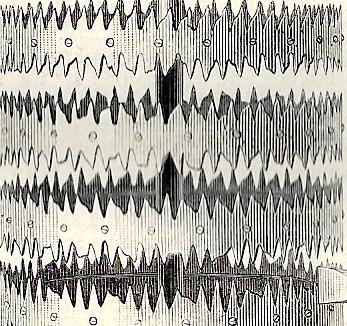
And the full version of the original 3×3″ image
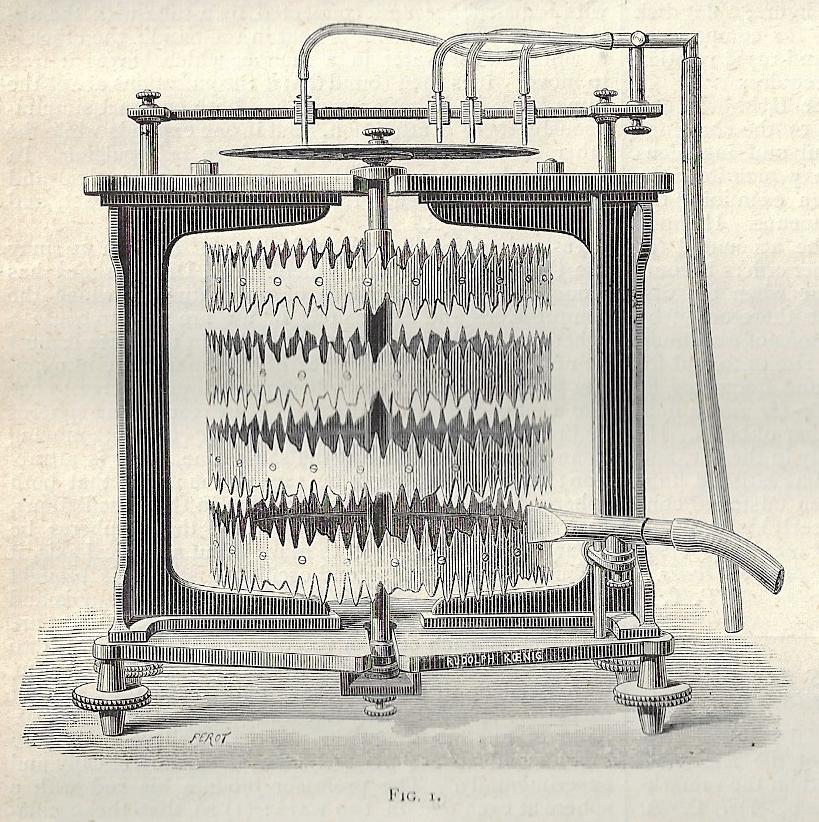
“Prior to the advent of oscilloscopes and other electronic sound-analysis tools, even seemingly rudimentary tasks of acoustic analysis – determining the frequency of a musical tone, for instance, or making waveforms observable – were not simple jobs with obvious solutions. It fell to researchers of the time to come up with mechanical devices, often quite clever and sometimes rather complex, to make these investigations possible.” “Though oriented differently [the wave siren]… is similar to the other wave siren shown in this collection, but with more complex wave forms in the undulating rims…”–Bart Hopkin, Instrument Maker, “Engravings of early Acoustical Apparatus”, from his website
Rudolph Konig (1832-1901) “far and away the most accomplished among makers of [acoustical devices]” (Hopkin, above) was a very highly accomplished and discriminating instrumentalist, scientific instrument maker, and experimentalist. “Koenig will also be remembered as the inventor and constructor of many other beautiful pieces of apparatus for the investigation of acoustical problems, among which may be mentioned his wave-sirens, the first of which was shown at Philadelphia in 1876. His original work dealt, among other things, with Wheatstone’s sound-figures, the characteristic notes of the different vowels, a manometric flame apparatus, a vibration microscope, among others; but perhaps the most important of his researches are those devoted to the phenomena produced by the interference of two tones, in which he disputed the views of Helmholtz as to the existence of summation and difference tones.”–Wikipedia
“Prior to the advent of oscilloscopes and other electronic sound-analysis tools, even seemingly rudimentary tasks of acoustic analysis – determining the frequency of a musical tone, for instance, or making waveforms observable – were not simple jobs with obvious solutions. It fell to researchers of the time to come up with mechanical devices, often quite clever and sometimes rather complex, to make these investigations possible.” “Though oriented differently [the wave siren]… is similar to the other wave siren shown in this collection, but with more complex wave forms in the undulating rims…”–Bart Hopkin, Instrument Maker, “Engravings of early Acoustical Apparatus”, from his website