JF Ptak Science Books Quick Post
When I saw this series of tables in a volume of the Journal of the Franklin Institute1 it struck me that I really didn’t recall very many instance at all of seeing chronological history of science (etc.) displays of info in antiquarian scientific texts. The practice was not terribly uncommon in atlases that would occasionally (as in Lavoisne’s Complete Genealogical, Historical, Chronological and Geographical Atlas of 1822) be illustrated with chronological historical tables. This one was a tabular presentation of 34 metals, listed alphabetically, and listing the year of discovery and discovery first—that was the unusual part. I recall that Thomas Young’s (1773-1829) A course of lectures on natural philosophy and the mechanical arts contained a series of timelines for the different disciplines (a sample of which is below)–including an unexpected entry for optics.
In any event, I’ll save a longer post on this subject for later—for right now I’m going to share the entire article from the JFI:
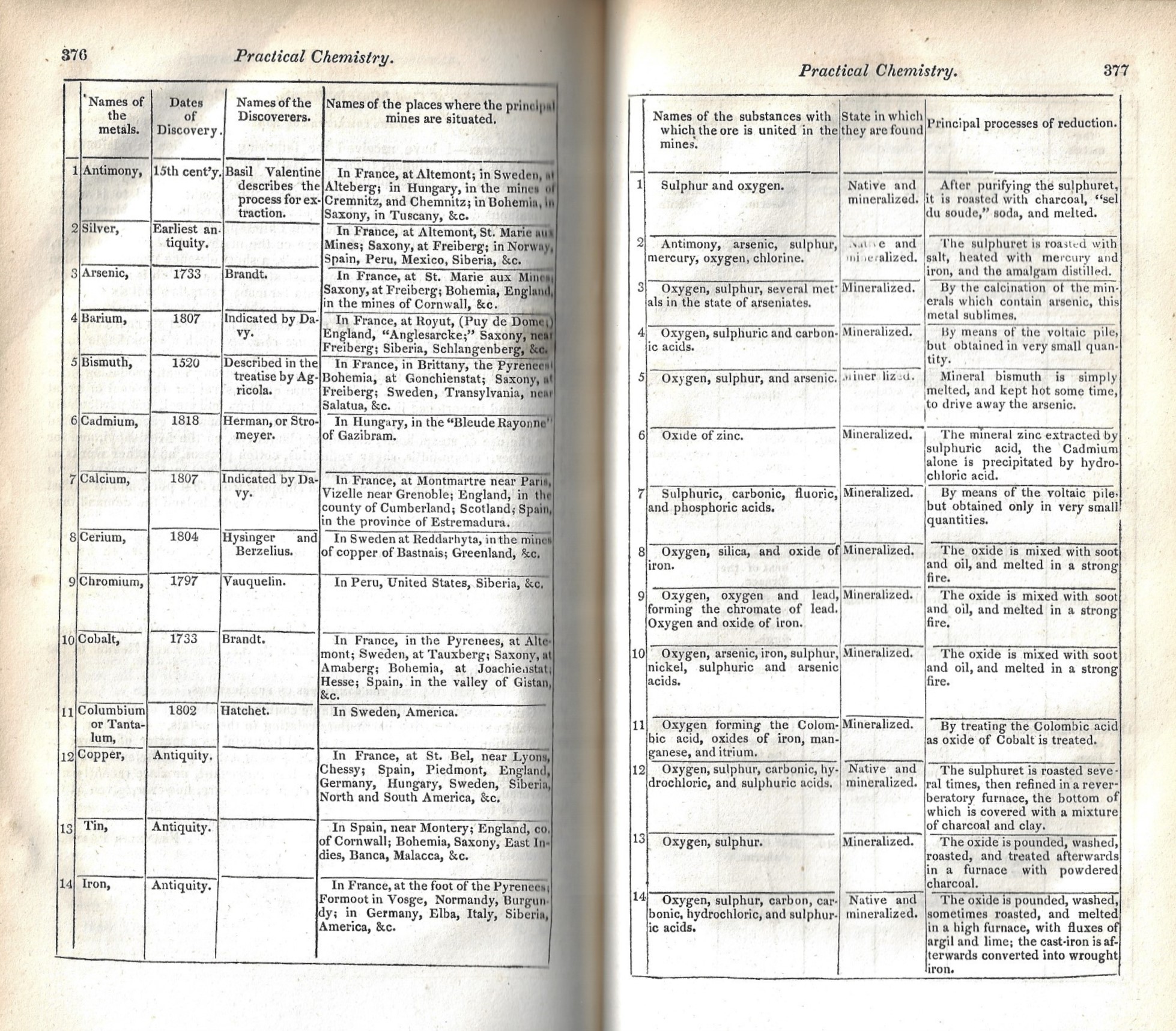
The article is continued below; also find following a sample from the Thomas Young with a link to the full work:
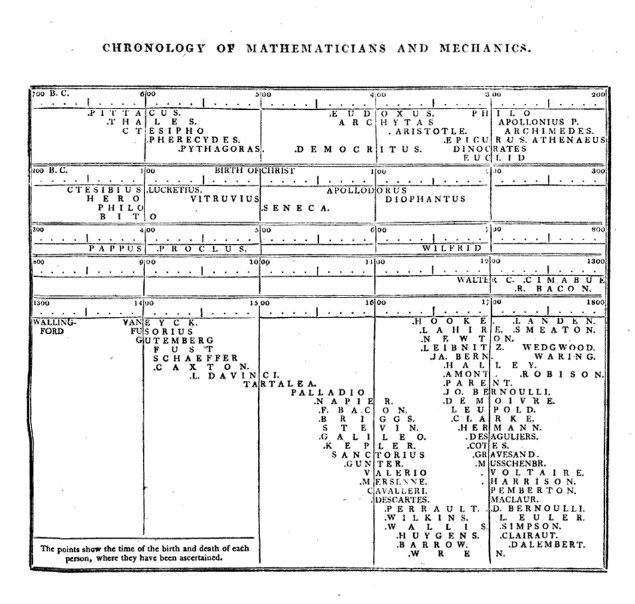
The link to the Young:
https://archive.org/details/lecturescourseof02younrich/page/n6
Notes:
Franklin Peale, “Table of Properties &c., of the Metals, taken from a table by M. Chaudet of the Paris Mint”, pp 375-385. This is basically a tabular report on 34 metals, listed alphabetically, and including dates of discovery and the names of discoverers, plus the names and locations of the principle mines, plus color, character, stability, specific gravity, state in which the metals are found, and several other properties. Journal of the Franklin Institute, Philadelphia, 1836; volume 17 (new series) and volume 21 overall, with text illustrations and four plates, 440 pp