JF Ptak Science Books Quick Post
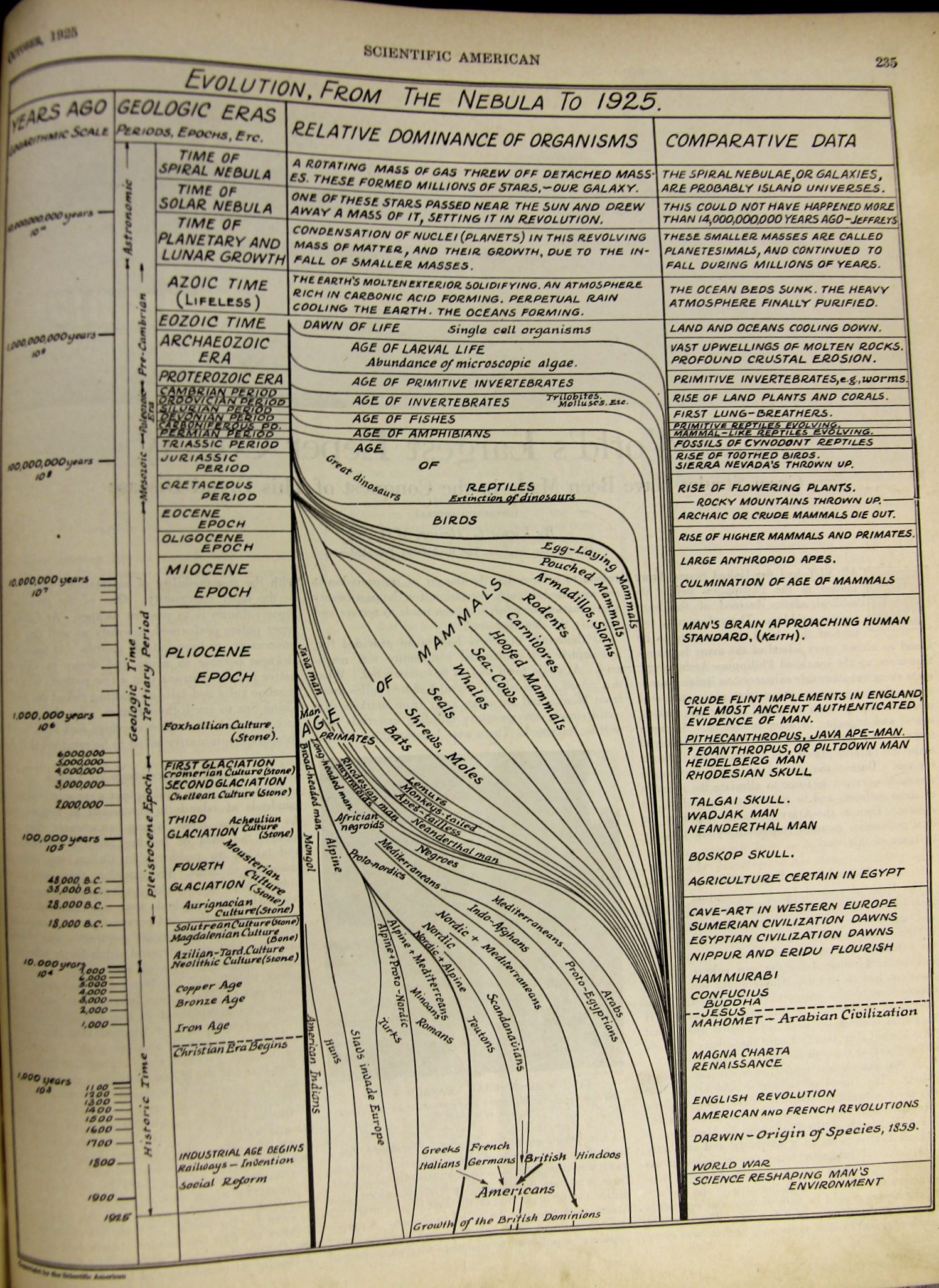
Here’s and interesting and swerve-y chart of all of history, featured in the pages of the Scientific American for October, 1925 (pg 235). It has that certain attractiveness that is so welcomed in the artistic display of information–and it also features an old word used (I think) in both it older and newer ways. That word is “nebula”, and it appears to have been used in English1 as far back as Edmund Halley in 1718 in the sense of “…an indistinct cloud-like, luminous object seen in the night sky, such as a cluster of distant stars, a galaxy, or a cloud of gas or dust”, the star clouds all bound within our own galaxy which was seen (until just a few years before this article) as the entire universe. Things began to shift to the impossibly large in the Great Debate (1920-1923) period (between Shapley and Curtis) on whether the nebulae were “local” (Shapley) or extragalactic2 (Curtis). There were early people who believed in the nebulae being outside our galaxy (like Kant) but the empirical evidence didn’t present until the 20’s, mostly in the work of Edwin Hubble. He would find that variable stars in Andromeda were an order of magnitude further away than the greatest dist ant of the furthest star in the Milky Way, and so determined that Andromedia was a galaxy unto itself, and not within our own. (His results on these investigations were published popularly though they were printed in a professional journal until 19293.) Hubble did publish on the great new vastness in another paper in 19294.
And so “nebula” in this Sci Am article seems to have a foot in both “worlds” (sorry!) so to speak. And that’s interesting.
Notes:
1. From the Oxford English Dictionary, defining “nebula”:
- “Originally: an indistinct cloud-like, luminous object seen in the night sky, such as a cluster of distant stars, a galaxy, or a cloud of gas or dust. Now (usually): spec. a mass of gas or dust within a galaxy, typically visible either as a luminous patch or as a dark silhouette against a brighter background. Cf. nubecula n. 1b.dumb-bell, emission, planetary, reflection, ring, spiral nebula: see the first element.”
- 1718 E. Halley in Philos. Trans. 1717–19 (Royal Soc.) 30 723 The slowness of its motion made us at that time conclude that it had none, and that it was rather a Nebula than a Comet
- 1781 Gentleman’s Mag. 51 526 This..nebula was discovered March 23, 1779.
- 1802 W. Herschel in Philos. Trans. (Royal Soc.) 92 499 A stellar nebula..may be a real cluster of stars.
- 1841 D. Brewster Martyrs of Sci. i. ii. 31 Upon directing his telescope to nebulæ and clusters of stars.
- 1873 J. W. Dawson Story Earth & Man i. 8 The spectroscope has..shown that some nebulæ are actually gaseous.
- 1891 Internat. Ann. Anthonys Photogr. Bull. 363 His primary object was to use it for nebula photography.
- 1924 H. Dingle Mod. Astrophysics xvi. 302 A dark nebula is really dark, and not merely too faint for its light to be seen on account of its great distance from us.
- 1930 R. H. Baker Astron. xi. 465 Modern investigations have shown that nebulae, as distinguished from ordinary star-clusters, fall into two classes having entirely different characteristics, namely, the galactic nebulae and the extra-galactic nebulae.
- 1971 D. W. Sciama Mod. Cosmol. iii. 39 In this way he [sc. E. P. Hubble] obtained a distance of 800,000 light-years for the Andromeda nebula, and similar values for other spiral nebulae. Now that these nebulae are well established as stellar systems outside our own, we shall henceforth call them galaxies.
2. Again, the definition of “extra-galactic” from the OED: “extra-gaˈlactic adj. Astronomy outside the galaxy or Milky-way.
- 1851 J. P. Nichol Archit. Heavens (ed. 9) 110 An extra-galactic phenomenon.
- 1870 R. A. Proctor Other Worlds than Ours xi. 264 The scattered stars of very low magnitudes in the extragalactic heavens.
3. Hubble, Edwin, “A spiral nebula as a stellar system, Messier 31”. The Astrophysical Journal. 69: 103, 1929. This is the same year of his revolutionary red shift paper, “A relation between distance and radial velocity among extra-galactic nebulae”. PNAS. 15 (3): 168–173.
4. Hubble, Edwin (December 1926). “Extragalactic nebulae”. Astrophysical Journal. 64 (64): 321–369.