JF Ptak Science Books Post 2758
[For Jeff Donlan, Extreme Answer Lad of Answers!]
This article was just a small 4″ or so notice in the Scientific American on 2 August 1879, written for a new sort of apparatus to make bubble-blowing easier, or more effective, or “rounder”, or less anti-bubbly. (Actually that last would be a trick though I guess you could rig something like this up in an anti-air-breathing way, to create a bubble of liquid encapsulated by a layer of gas surrounded by a liquid. This is actually pretty easy to do standing around and would probably be a much harder thing to accomplish if you needed an apparatus for it. By the way “anti-bubble” should not be associated with the “Dirty Bubble”, which is a character from SpongeBob SquarePants.)
Back to the illustration: it is only about 2″ tall and a bit of a “filler”, but enough care is given it that it displays something which you never really see on bubbles in artwork: a reflection of an image!
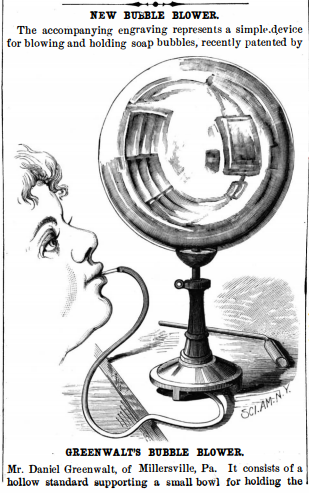
If you go to Google and search out Renaissance/Bubble/painting or some such, you will find a number of examples of fine-looking bubbles: Gerrit Dou’s young boy blowing bubbles has life to the boy but not so much to the bubbles he’s blowing; J.E. Mallais bubble boy also has some somber fun but little exclusivity is paid to the bubble, same to for Naiveau, and de Gheyn; David Bailly’s self portrait has three happy bubbles with flair and color, and Desjardin’s allegory’s bubble maker is standing on a bubble with a fair amount of color and light to it. Even the much-reproduced “Soap Bubbles” (ca. 1733-4) painting by Jean Siméon Chardin (1699–1779)–which is perhaps one of the most famous antiquarian paintings involving bubbles–finds us with a bubble that is not very bubbly, without much reflection and optical interest…a too-subtle bubble. Not so in this image above, the anonymous artist collecting the 25-cent fee and giving the bubble some of the greatest bubble-life that I’ve noticed.
One thing those older artists do have a feel for more so than this piece above is the thinness of the wall of a bubble–here it looks pretty defined whereas with the others you get a real sense of lightness and fragility (though hardly knowing the thickness in terms of ^…as a matter of fact some of the artists mentioned were active before Newton, others before Huygens, and all before Young.) Anyway even though the business of bubbles seems to be kids’ stuff, with children playing at making bubbles in the artwork mentioned above, bubbles are worthy of some real thinking–if you understand bubbles (and anti-bubbles), you can address a fair amount more than that.
[I can’t really tell what the bubble-blower is seeing, what is being reflected, though one of the objects definitely seems to be a painting…]