JF Ptak Science Books
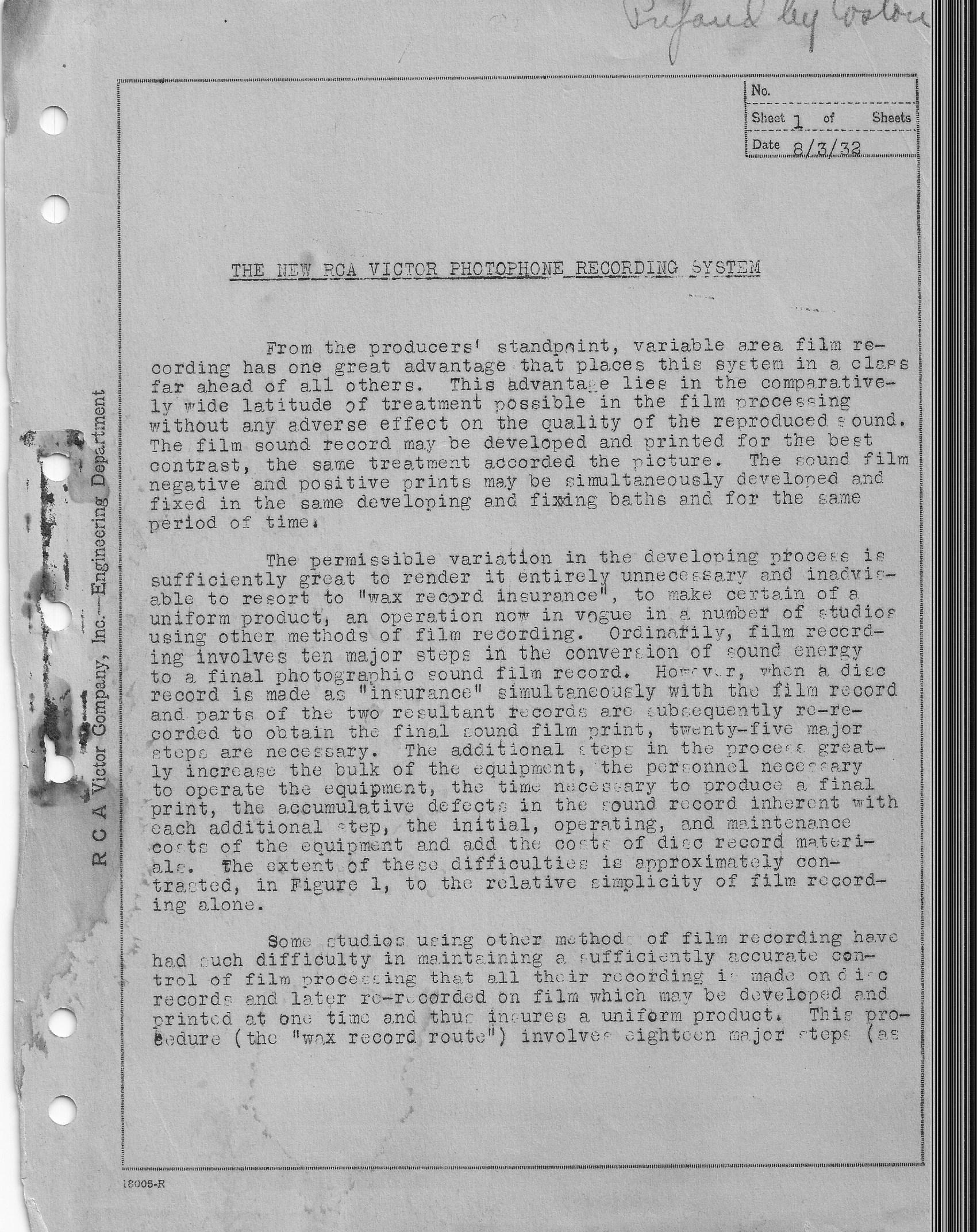
The New RCA Victor Photophone Recording System. 11×8.5″, 44 typed mimeo leaves, with 24 leaves of blue-line photographs and schematics of the equipment. Punch-bound at one time, though metallic binding element is not present. Printed on the stationery of “R.C.A. Victor Company, Inc., Engineering Department”. Very good condition. Document pp 1-44, lacking 26 and 27 (which seems to be a two-page section); images/blueprints 1-28, lacks 17,18, and 22.
The text includes: General introduction (1-7, 4 illustrations), the Ribbon Microphone (8-12, 3 illustrations); Microphone Distribution Panel, (13-14pp, 2 illustrations); Microphone Mixing Panel (15-17, 2 illustrations); Compensator Panel (18-21, 2 illustrations); Recording Amplifier (22-25pp, 2 illustrations); Ground Noise reduction Amplifier (28-30, 2 illustrations); 35mm Film Recorder (31-34, 2 illustrations); 16mm Film recorder (page 35, 2 illustrations); Film Phonograph Reproducing Equipment (36-39 pages, 2 illustrations); Phototube Amplifier (40-41pp, 1 illustration); 35mm to 16mm Film Re-recorder, 42-44pp, 2 illustrations).
This a sound-on-film incunable. This means the pamphlet was printed within the first few years of the first “talking” (synchronized sound, or sound technologically coupled to image) motion picture. The first feature length film using sound throughout1 the length of the movie was The Jazz Singer, which was released in 1927 and used a sound-on-disc2system of recording. That means that the audio portion of the film was recorded onto records, and then synchronized in playback with the film to match up the audio and video–this technology was obviously not the future.
The technology of sound-on-film would take the day, and in very short order, leading to four different systems, of which the Photophone was one. Photophone’s share of the prospective studio users was pretty good: the earliest major producers/licensees included Walt Disney Productions (after 1932), RKO Radio Pictures, republic Pictures, Warner Borthers, and Pathe.
And on the Film Phonograph Reproducing Equipment: “the need for combining two or more sound tracks, the adding of sound effects to an original recording, or matching around levels of scenes in the final editing of a picture has brought re-recording into an increasingly important position in sound picture production”.
The work is in general a technical report and sales pitch for the new system. It includes the following sections:
Notes:
1. Earlier on in the mid-1920’s there were efforts of using sound in film but limited to music or very specific areas of the film, most of which in the end was silent.
2. The movie was made with the Vitaphone system, which was not long for this world, soon to be replaced by the more sophisticated sound-on-film systems.
“In 1925 GE started a program to develop commercial sound-on-film equipment based on Hoxie’s work. Unlike the Phonofilm and Movietone systems in which the audio modulated the intensity of a recording lamp which exposed the soundtrack, thus creating a variable-density track, the GE system employed a fast-acting mirror galvanoemter to create a variable-area soundtrack. A number of demonstrations of this system, now known as Photophone, were given in 1926 and 1927. The first public screenings with this system were of a sound version (music plus sound effects only) of the silent film Wings which was exhibited as a road-show in around a dozen specially equipped theatres during 1927.”–Wiki
First page of the document, followed by the remained (44pp+26pp):