JF Ptak Science Books Quick Post
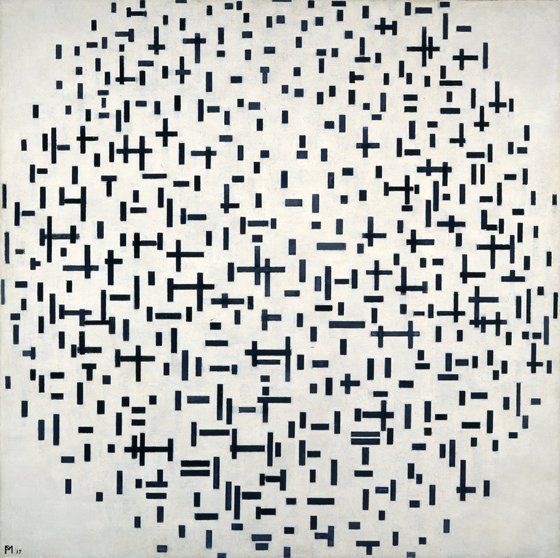
[Source: illustration from Piet Mondrian, Life and Work, edited by Cees W. de Jong, Abrams, 2015.]
I just wanted to open up this idea–I mean, I’m not an art historian, and the title doesn’t intend to insert this speculation in Mondrian’s mind as he painted this, but his Composition in Line (1916, oil on canvas, 42×42″) does to me look like a military graveyard. After he got stuck in the Netherlands following the beginning of WWI he entered into a very creative and morphing phase of his creative artistic life. His very recognizable primary color geometries of art start to appear in his notebooks in 1909, and geometric forms begin to appear in the skies and backgrounds of his representational landscapes and portraits (outside his Cubist mode) beginning at least in 1908, so to say that the war influenced very much in his creative spirit directly is probably wrong–but it doesn’t stop me from seeing The End of the Battle in these works.
Keeping to this theme, his Composition 10 in Black and White (1915, oil on canvas, 32×42″) looks a little like a trench map:
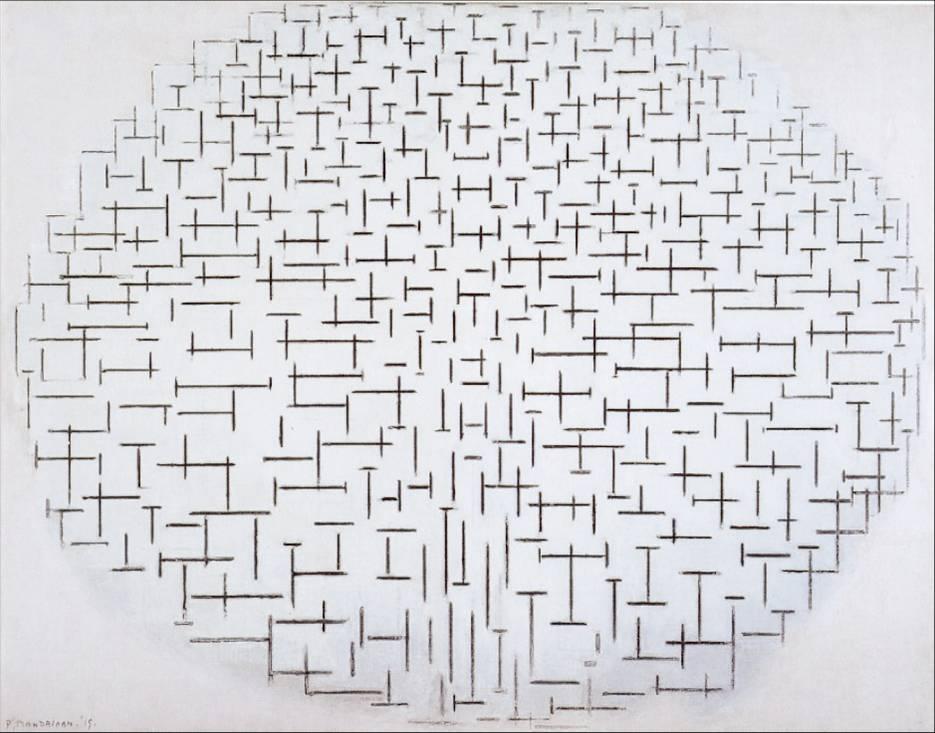
[Source: illustration from Piet Mondrian, Life and Work, edited by Cees W. de Jong, Abrams, 2015.]
Again, there’s no evidence to support these work as having anything to do with the war–they just suggest themselves to me, especially given the date.