JF Ptak Science Books Quick Post
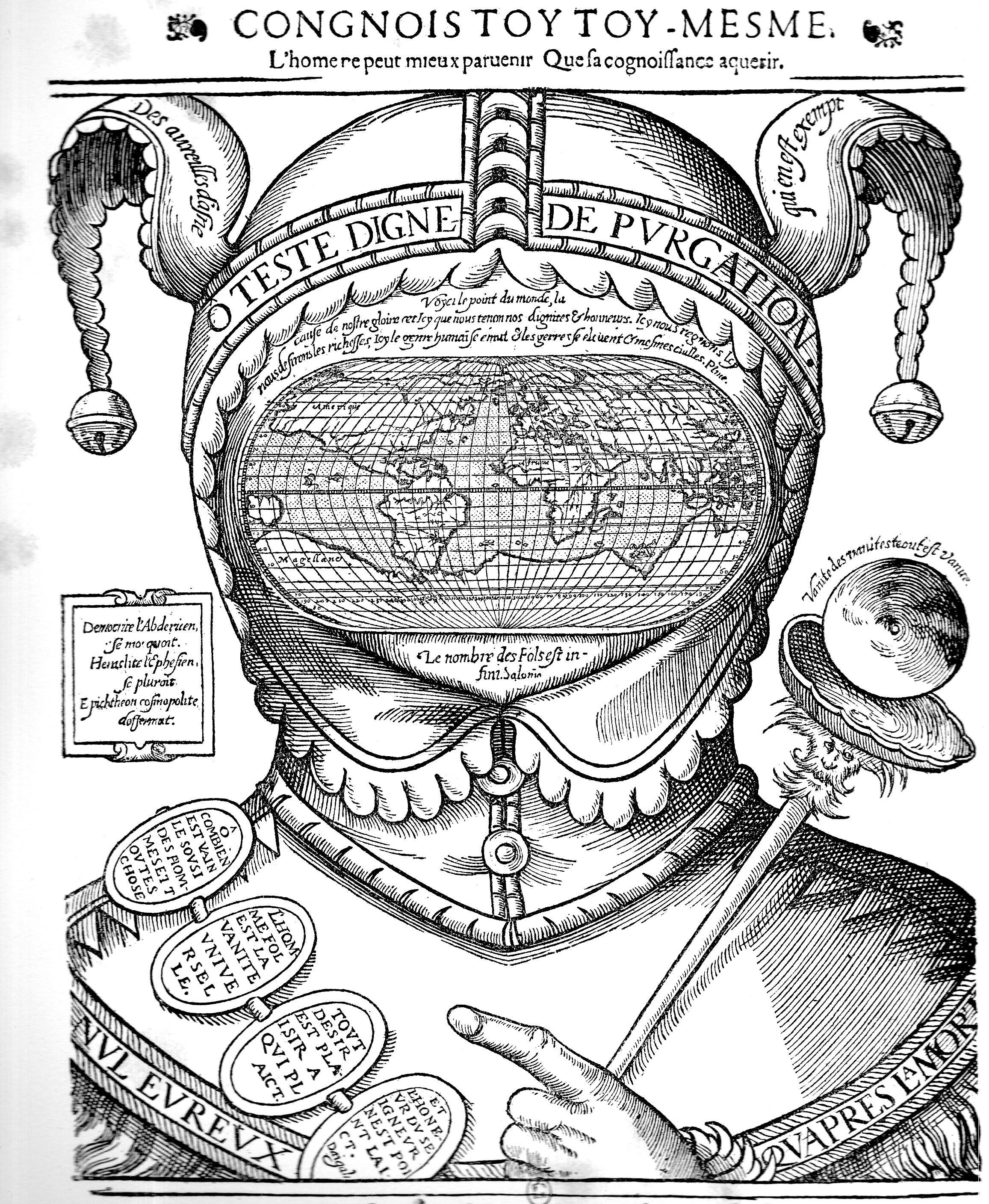
I’ve known about this famous map/curiosity by Jean de Gourmont (ca. 1570) for some time, though I never seem to meet it out there in the world very often. Yesterday though I discovered that there was a fine 19th century reproduction of it in the studio, and so I thought I had a closer look now that I had a good copy in my hands.
And then when I looked the map up I found a number of good descriptions of it that pretty much took care of its description and interpretation. The baseline description is that it is mostly an allegory on the pursuit of knowledge, and of knowing, and thinking about the nature of knowledge–my read is that in the end, only a fool would think that the more they knew the less there was to know. The famous Ortelius map (“Typus Orbis Terrarum”) in the face of the jester could represent a gridwork of what we think we know, though across the top of the image is the dictum from Socrates, “Know Thyself” (“Congnois toy [‘toi’] toy-meme”), which prepares us for what might be the dry hole in our soul if we spend too much time in the pursuit of knowledge of the world.
One of the most interesting reads on this image can be found in Literature, Mapping, and the Politics of Space in Early Modern Britain, by Andrew Gordon, Bernhard Klein, where the authors discus the mind-as-a-map, and bring into play a great passage from the immortal great-book-that-is-semi-unreadable Anatomy of Melancholy, by Robert Burton. They refer to the great map set in the motley, order set against “the spirit of disorder” and “the enemy of boundaries”, with Burton declaring on the essence of folly.