JF Ptak Science Books Post 2579
Over time I’ve encountered a number of ventures into the future of the future in which writing has become an automated or semi-automated activity, in their antiquarian constructions being made of wood and metal rather than nanobots and biological bits. A famous example is viewed by Jonathan Swift’s Lemuel Gulliver in Laputa, where he finds a conversation machine, a vast assembly of word cubes set in a 400 square foot frame manipulated by 40 cranks and 40 handles and run by 40 philosophical operators. There was also the thinking machine of Raymond Lull (of many different spellings) that was so beautifully address by Jorges Borges (“‘Ramon Lull’s Thinking Machine’ in The total library: non-fiction 1922-1986, on pp 155-160), and numerous others, some becoming steam-driven by the time of the early 19th century, and them others computer-inspired as we get into the Asimov-age.
I was moved to comment on this by a good reference made by Jennifer Ouellette (senior science editor at Gizmodo) to an article by a Gizmodo writer, Anna Green, on Arthur F. Blanchard’s (1865-1953) random story generator patent of 1916. It is an interesting and lovely thing, lots of words of lots of rollers all working in combination to help formulate a struggling idea in the mind of a writer. Well, actually, Blanchard writes in his patent description that it was an aid to movie writers, specifically, a kind of idea machine that would help folks with insight into creating a story for a 16-minute tale. Of course the story might have been a little more interesting had Blanchard made the claim that his ideas for this machine were the product of a similar machine that was lashed together for the production of technical ideas.
In this same line of roller-and-paper idea generator I formulated a simple but distinctive device for creating the More Deconstructionist You in “Greasing the Turtle Stack: Derrida’s 10-Second Sentence-Generating Machine” (here)–this would be a fun little generator to make if the outcome wasn’t so useless and pointless, so best leave it as a two-beer bar stool idea.
Blanchard’s idea seems to be one of the early appearances of word-generators on rollers/cards found in the collection of the U.S. Patent Office. And so the “Movie Writer” of Albert Blanchard:
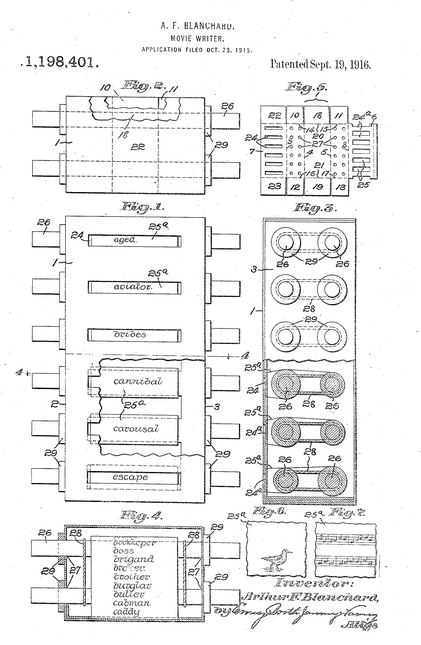 [Source: U.S. patent US1198401, 23 October 1915, 19 Sep 1916, Arthur F Blanchard, Movie-writer at Google Patents ]
Later on, the idea–still tried and true, or at least so on paper–came this for the “Educational Game Apparatus”, which was intended again as a spark for creative writing:
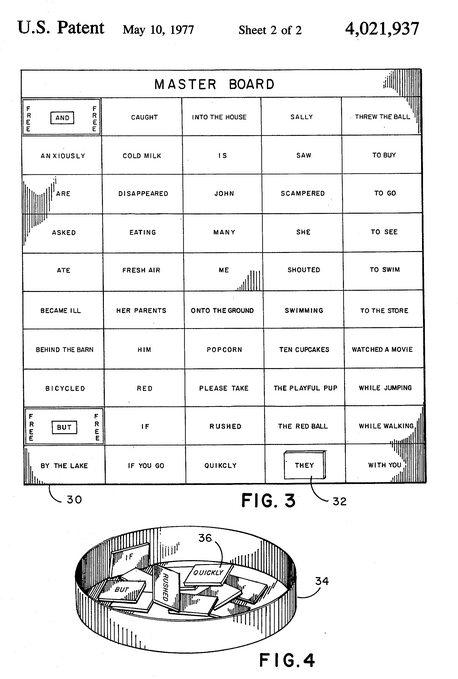
[Source: U.S. Patent US4021937, 2 Sep 1973, 10 May1977, Margery Dena Kravitz, “Educational game apparatus”]
Still later was this word-o-paper-arranger “Teaching method apparatus”, a card-based bit that helps jostle ideas by presenting semi-random words to help the student create stories around them:
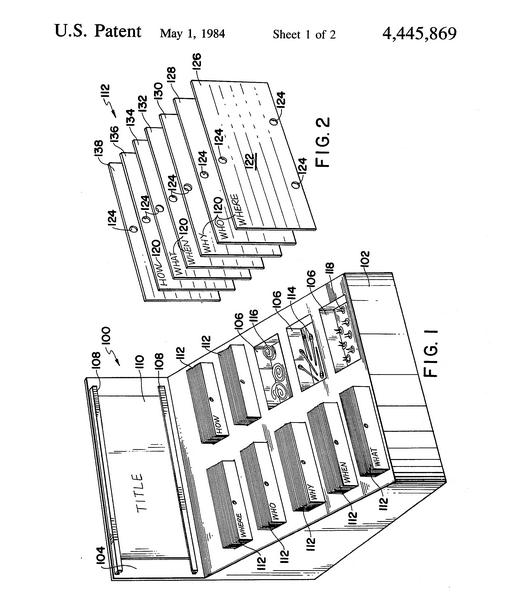
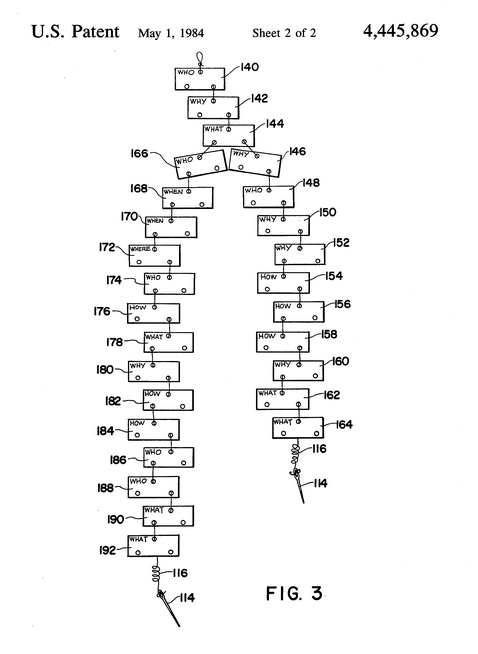 [ Source: U.S. patent US4445869 Nov 9, 1981 May 1, 1984, Wasserman Myrna D., “Teaching method and apparatus”.]
The “Name Selector” is a simple version of some of what we see above:
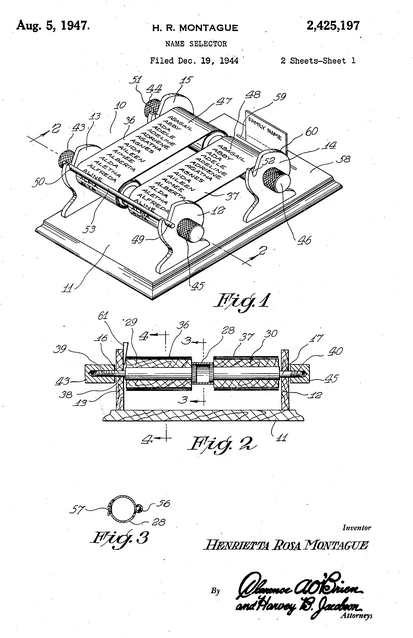 [Source: U.S. Patent, US2425197 A Aug 5, 1947, Rosa Montague Henrietta, Aug 5, 1947 Name selector]
No doubt there are more of these patents using this idea of single-words-on-bit-of-paper, but this should do for now..