JF Ptak Science Books Quick Post The History of Lines series
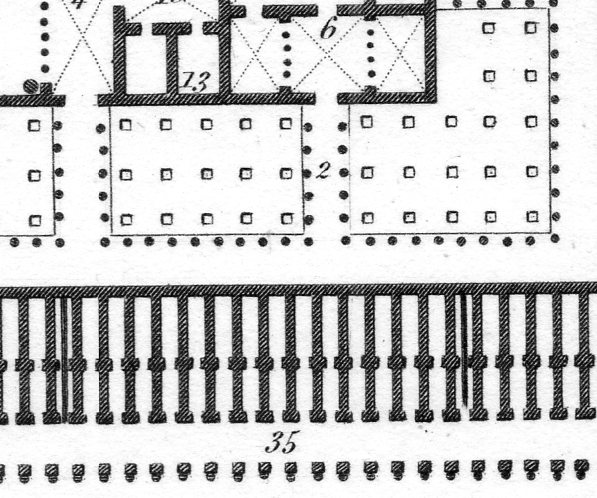
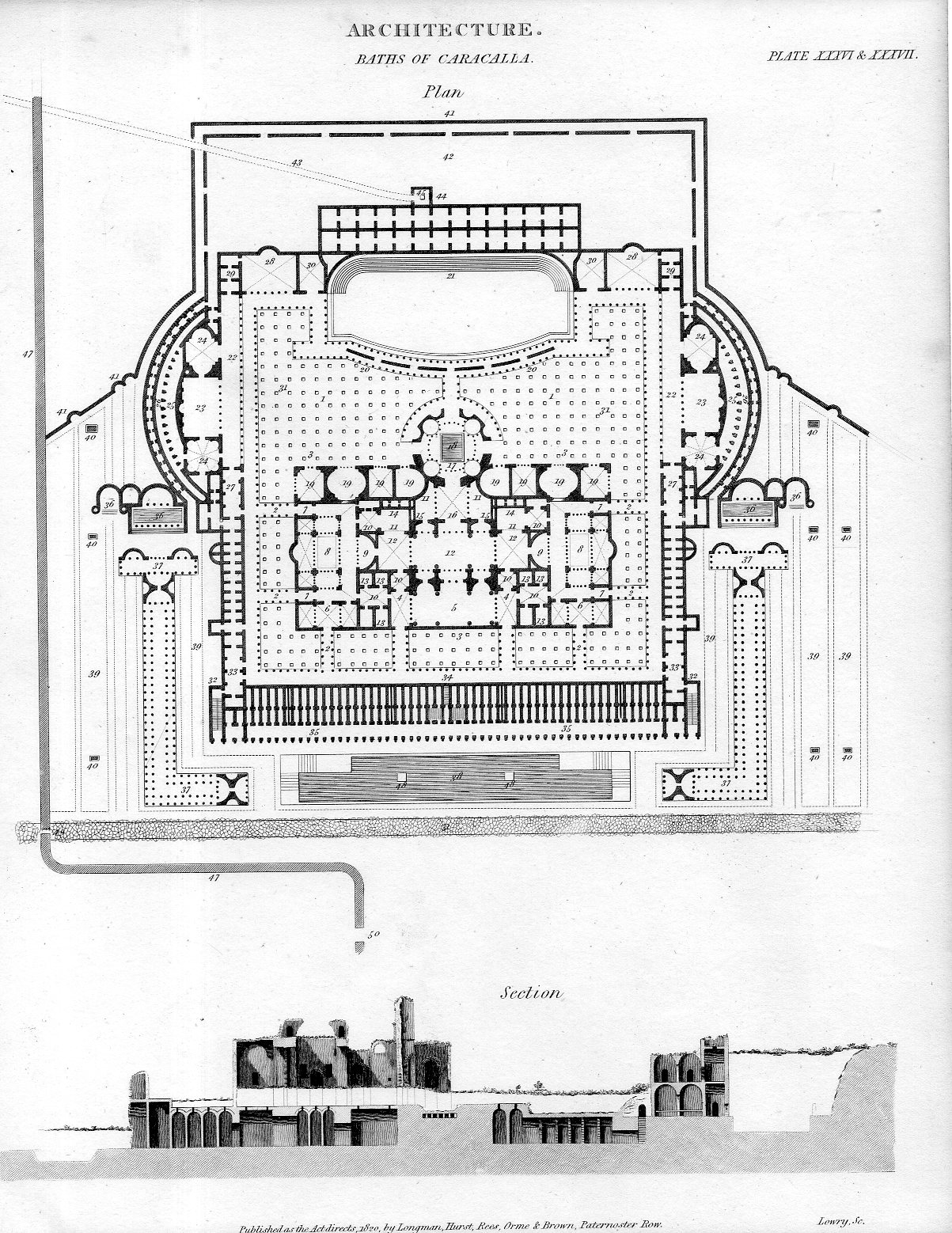
The public baths of Caracalla served Romans for about 400 years–the complex was complex, and massive. I’ve long liked this architectural plan of the place–it is necessarily neat and orderly, and fits a lot of data and detail on a 11×8″ sheet of paper while at the same time still having a lot of white breathable space on the page. Here’s a sample of the detail, which in real life is less than one square inch:
And the full engraved sheet (printed in 1820 for Rees’ Dictionary):
The following quote is from the great work by Rodolfo Lanciani, Ancient Rome in the Light of Recent Discoveries, Boston/New York, Houghton, Miflin & Company, 1898, pp 91-2, on the Caracalla baths (http://penelope.uchicago.edu/Thayer/E/Gazetteer/Places/Europe/Italy/Lazio/Roma/Rome/_Texts/Lanciani/LANARD/4*.html):
“Next to forums I must speak of the baths as places of public resort. At the end of the third century after Christ, Rome numbered 11 large public thermae, and 926 smaller ones conducted under private enterprise. The baths of Caracalla alone could accommodate, at one time, 1,600 people; the baths of Diocletian, 3,600. Taking 1,500 as the average accommodation of each of the public thermae, and 50 as that of each of the private baths, we learn that in ancient Rome, at any minute, 62,800 citizens could restore their strength in baths of every nature and description; and this, without bringing into the calculation the Tiber, the Anio, the Lake of Agrippa, and the bathing accommodations with which every Roman house was abundantly furnished…”