JF Ptak Science Books Post 2569
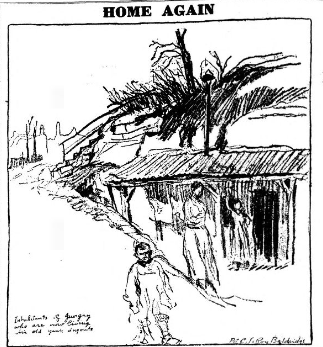
I came across this field drawing in the September 21, 1919 issue of Stars and Stripes. It is called “Home Again”, and depicts the conditions of the homeless in post-WWI Europe…unfortunately I cannot decipher the name of the town, though I suspect it is either Belgian or French (not too much of a leap of faith with that). For the dozens of millions of casualties in WWI, there were also many millions of people left destitute and homeless. This small illustration shows one case, the residents of this town forced to take shelter in the dugouts1 (see below for the OED definitions and history of the word) of an old U.S. Army trench.
Dugouts are more-or-less what the name implies, a shelter dug into the side of a trench to offer cover from shrapnel and the elements; these could be a hidey-hole the size of a soldier, or could be larger to house several soldiers at a time, though in general they were small, cramped affairs, meant to be sat rather than stood in. The design was also governed by the amount of trench depth that you had to work with. Sometimes the dugout would be attached to a tunnel leading deep under the trenches that would house headquarters and such and accompany man more men than the usual occupancy of, say, 1-4 soldiers. These seem to be more expansive than normal, being fully the height of a person, with more enclosure, and an awning.
This strikes me as a particularly difficult image of the post-war situation
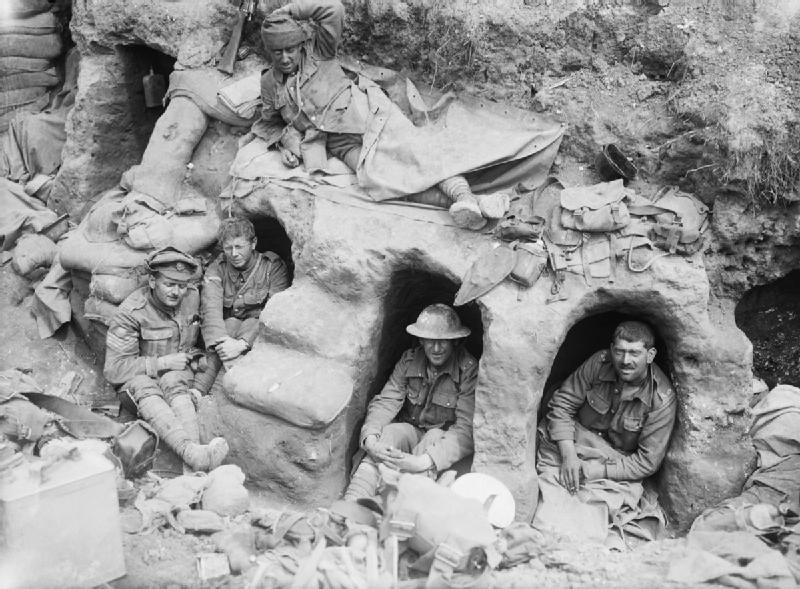
The following images are found at the Imperial War Museum, here: http://www.iwm.org.uk/history/podcasts/voices-of-the-first-world-war/podcast-20-trench-life
A simple dugout, no doubt fashioned in necessity according to what was available:
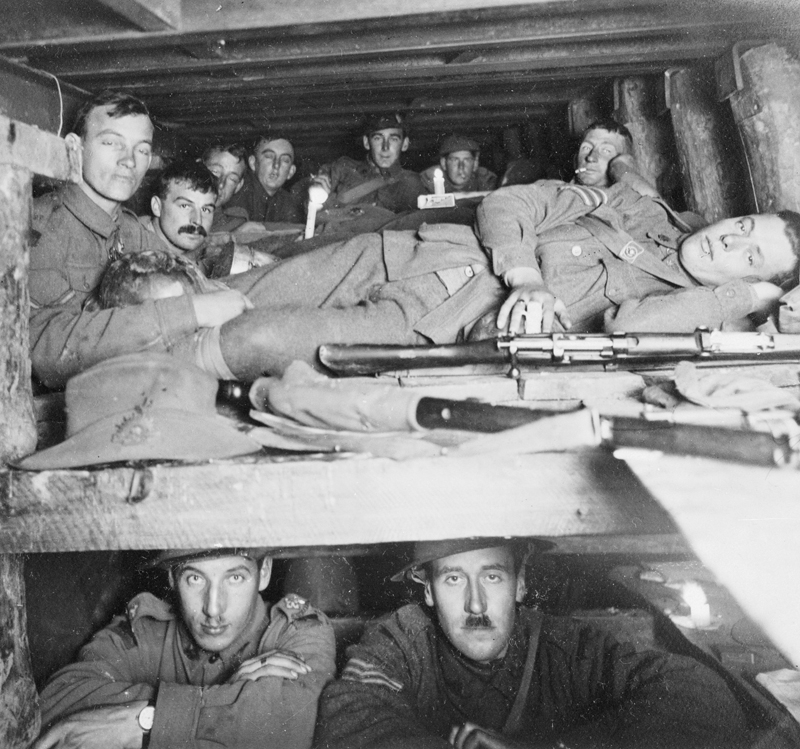
Here’s an example of a more deeply dug dugout (“fifteen feet underground”):
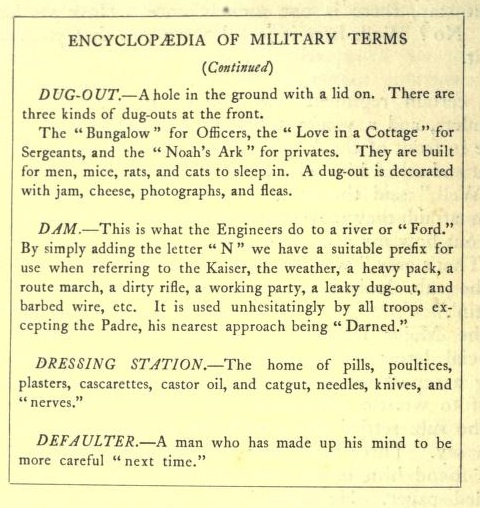
Also, via a find by Public Domain Review, this 1916 soldier’s definition of “dugout”:
Source: http://publicdomainreview.org/collections/made-in-the-trenches-a-ww1-magazine-created-by-soldiers-1916/ Original source: Made in the Trenches, composed entirely from articles & sketches contributed by soldiers, edited by Sir Frederick Treves and George Goodchild; 1916; George Allen and Unwin , London.