JF Ptak Science Books Expanded Post 636 (from 2009) Blog Bookstore
The History of Blank, Missing and Empty Things (Thread, #45)
“Heaven and earth were one form…. (then they were separated from one another…)”
“The mind is its own place, and in itself can make a heaven of hell, a hell of heaven..”
–John Milton, Paradise Lost
In ancient times the representation of the gods and beliefs was handed from one writer or storyteller to the next, on and on, changes here and deletions there, for many generations. This practice was possible (necessary?) because there really wasn’t a solitary scripture to follow (as in the Koran or the Bible) and no priestly class to guard and cherish a particular strong story line in all of its barbed details.
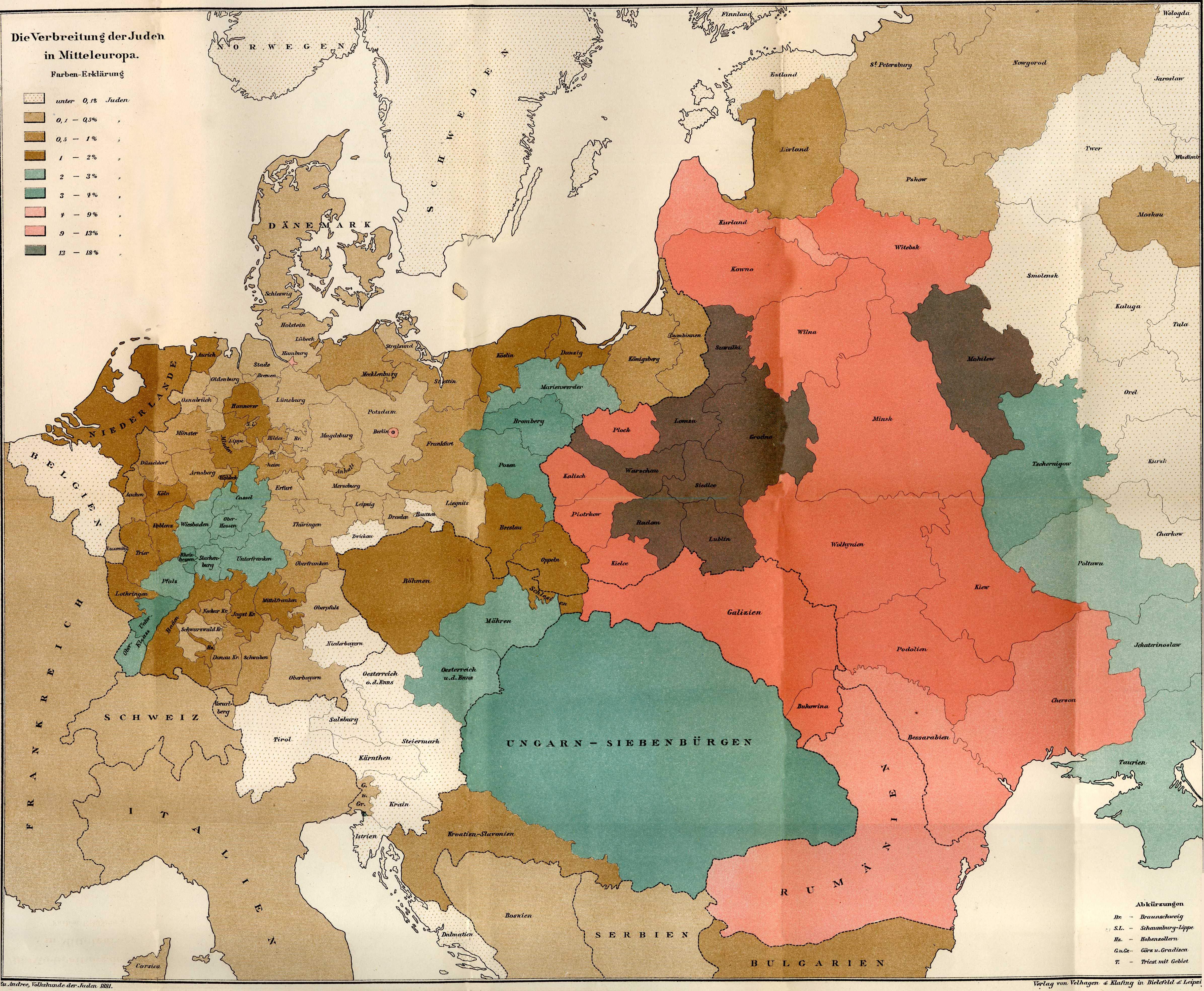 [Image source: wikicommons, https://commons.wikimedia.org/wiki/File:Juden_1881.JPG The image is greatly expandable.]
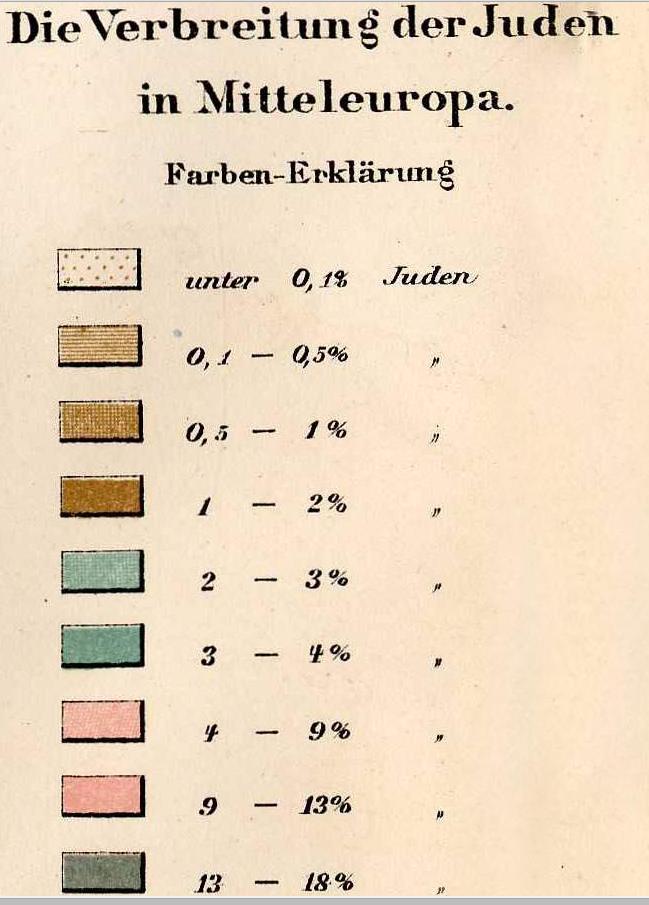
And the key to the map:
There are of course bits that have survived intact for millennia. One of these is this fragment from one of Euripides’ lost plays (only 20% or so are complete), The Wise Melanippe, and begins a statement of cosmogony that states the creation of all things. The separation of heaven and earth has always stuck with me, because this separation begins with Euripides with the creation of the world seems to continue on its way with mini-separations of all things over the course of time—like the cosmological world-bearing turtles—all the way down.
I’m not sure how or who exactly did this heaven-rending, or to what force it owed its being: evidently the Presocratics tended to depersonalize the actions of the gods and grant their actions to natural forces, so the issue with the heaven-separation business may well have been a motive force rather than a god. Anyway it’s the tearing apart, the removal, the separation phenomena that got my attention to begin with, and one which has stayed with me, though I’m sure that Euripides didn’t have that sort of violent rending in mind while describing the birth of the earth.
And so it is with this map1 showing the concentrations of the Jewish people in Europe in the late 19th century. Between the time of the publication of this map—1881—and the beginning of the Nazi regime in Germany in 1933, there were many persecutions and Pogroms and deportations of the Jewish people. Nothing prepared anyone for the concentration camps and the systematic extermination of that people between 1935 and 1945. What this map shows is the distribution of the Jewish people (by percentage of the total population) before they were eviscerated: the difference between this map in 1881 and the map of 1945 would be completely different. The Jews were gone: killed. Some deported. Others escaped. But they were basically torn from Europe in the cruelest manner so that in almost every case the only indicators of their existence were shadows.
There are large-scale maps of this sort of evidence for other groups of people in their pre-Euripidean tearing from their home: maps showing the locations of Indian tribes in North America (pre-Columbian, 17th century, 19th century, they’re all telling pretty much the same devastating story) is one good example of a slender category. There aren’t maps for the mass extermination by starvation created by Joe Stalin, or the millions murdered by Pol Pot or Mao. There are of course more small-scale, localized maps depicting the results of forced relocations or devastating war or drought or hunger or floods. But few, I think, take such a compelling x-ray of a people’s past on a continental scales such as this.
Notes:
1. “Die Verbreitung der Juden in Mitteleurope” found in Richard Andree’s , Volkskunde der Juden…, Verlag von Velhagen & Klefirg in Bielfeld und Leipzig: 1881.