JF Ptak Science Books
This is sort of what the future of tabulation looked like in 1902–except that the people in this year were already living in this tabulating future, surprisingly already a dozen years old at this point. The cover illustrates an article on the machinery used in the production of statistics and tables and general data organization by the great work by Herman Hollerith, who had already performed this function for the U.S. Census of 1890. (Hollerith had offices at Wisconsin Avenue and the C & O Canal, in Georgetown, D.C., about ten blocks from where my old store used to be at Volta & 33rd.)
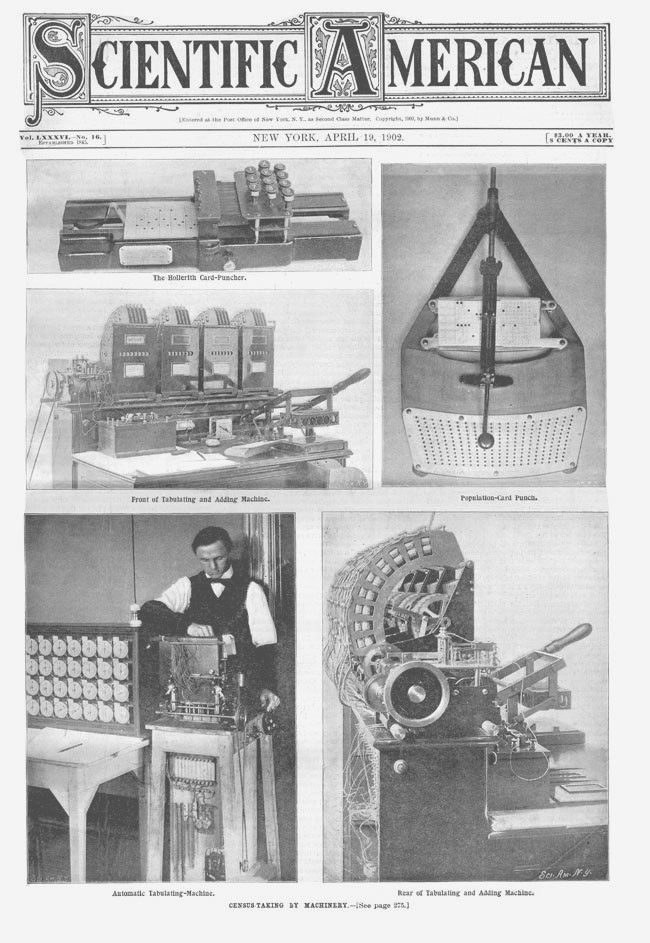
The 1880 census had cost about $6 million and took 9 years to tabulate; the 1890 census using the Hollerith machines cost $10 million and took seven years. The main focus of many in government was the cost differential—not the incredible amounts of new controllable information. The rent of the Hollerith machines was only $750,000 for the conduct of the entire census, so the differential must’ve been in the extra utility costs (for electricity, for example, which was used for the first time to run the tabulators) and for the small army of statisticians and data entry people. Be that as it may, the government was not amused, particularly when Hollerith figured that he had actually saved the government $5 million. The two parties left each other grumbling, though the roar of the trickle down from the Hollerith success drowned it out. The tabulating system was quickly exported, and large private concerns in the U.S. saw a savior in the system that would soon rescue them from the sea of paper in which they were beginning to drown. The Hollerith company did very, very well for itself, and soon merged with three other companies (in 1911) to ease the burden of success. The resulting company was called the Computing-Tabulating-Research Company (CTR), which after a short while became the International Business Machine Corporation (IBM).
[Source of abstract: Publications Indexed for Engineering, PIE, volume 4.]
And the article from the Scientific American, as follows. (It is worth pointing out that a few hundred pages following is an article about William Terrel’s fantastic tide-predicting machine, a beast of a sicentific instrument that weighed in at 2,500 pounds and functioned slendidly for 30+ years…)