JF Ptak Science Books Quick Post
The mathematician Hermann Schubert wrote in his 1889 text on the uselessness of calculating pi past 500 digits–I haven’t located a copy of the original 1889 publication though the story is often repeated: I’ve seen in in Petr Beckmann’s A History of Pi (1993 edition) on page 101 and also in Cliff Pickover’s Keys to Infinity (John Wiley, 1995).
“Conceive a sphere constructed with the earth at its center, and imagine its surface to pass through Sirius, whis is 8.8 light years distant from the earth [that is, light, traveling at a velocity of 186,000 miles per second, takes 8.8 years to cover this distance]. Then imagine this enormous sphere to be so packed with microbes that in every cubic millimeter millions of millions of these diminuitive animalcula are present. Now conceive these microbes to be unpacked and so distributed singly along a straight line that every two microbes are as far distant from each other as Sirius from us, 8.8 light years. Conceive the long line thus fixed by all the microbes as the diameter of a circle, and imagine its circumference to be calculated by multiplying its diameter by to 100 decimal places. Then, in the case of a circle of this enormous magnitude even, the circumference so calculated would not vary from the real circumference by a millionth part of a millimeter.”
“This example will suffice to show that the calculation of to 100 or 500 decimal places is wholly useless.”
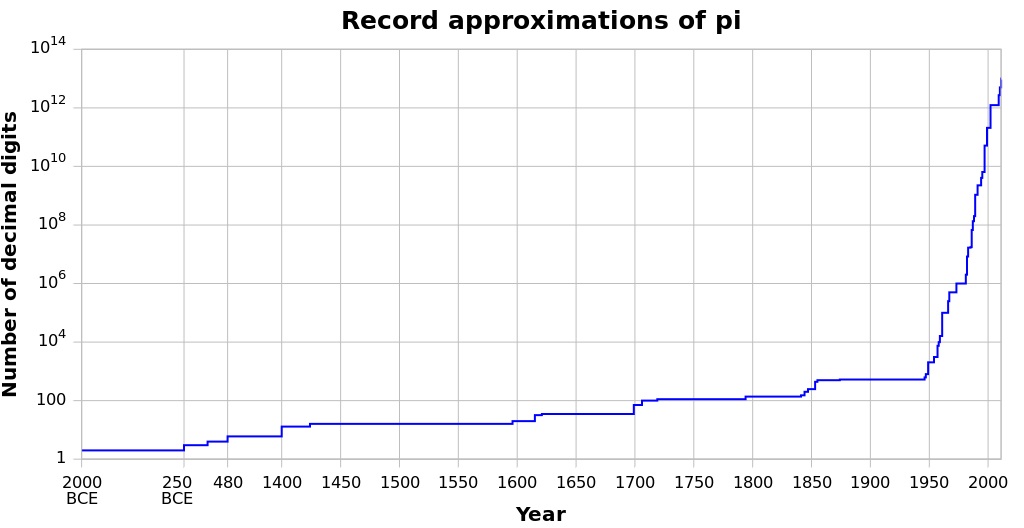
Long before Schbert pi was being calculated to quite a degree: it was computed to 9 places by Francoise Viete in 1579; 15 places by Adriaan van Roonan, 1593; 32 by Ludolph van Ceulen in 1596; 35 by Willebrord Snell in 1621; 38 by Christoph Grienberger; 75 by Abraham Sharp in 1699; 100 by John Machin in 1706; 137 by Jurj Vega in 1794; and 152 by Legendre in 1794, which is nearly 100 years before Schubert. William Rutherford came in with 248 in 1847, and then William Shanks with 527 places in 1874. D.F. Fergusson would break 1000 places in 1949, followed by F. Genuys (using the IBM 704) breaking 10,000 i 1958. Daniel Shanks reached 100,000 in 1961, Jean Guillyud finding 1 million in 1967, and then many others, right up to the 12 trillion mark by Shigeru Kondo in 2013.
All of which leave Dr. Schubert without very much crust.