JF Ptak Science Books Post 2254
Dorothea L(ynde) Dix (1802-1887) was an nurse and ultratrian, a very-much-practiced humanitarian who for years fought for the stabilized and just treatment of people with disabilities, mainly and for extended periods of time and travel for those suffering from mental diseases and development. The pamphlet that I’ve reproduced below is a generalized statement for her appeal before the U.S. Congress based on her 30,000 miles of travels throughout the country, visiting nine states and inspecting the ways in which “the indigent curable and incurable insane” were treated. She gathered data on how these people were kept–state by state–and also the reasons for their being admitted to whatever facility they found themselves in. This is pioneering work on behalf of a class of people who really needed the help, and her report in general is not pretty story, a version of the Willowbrook story without the cameras, 120 years earlier.
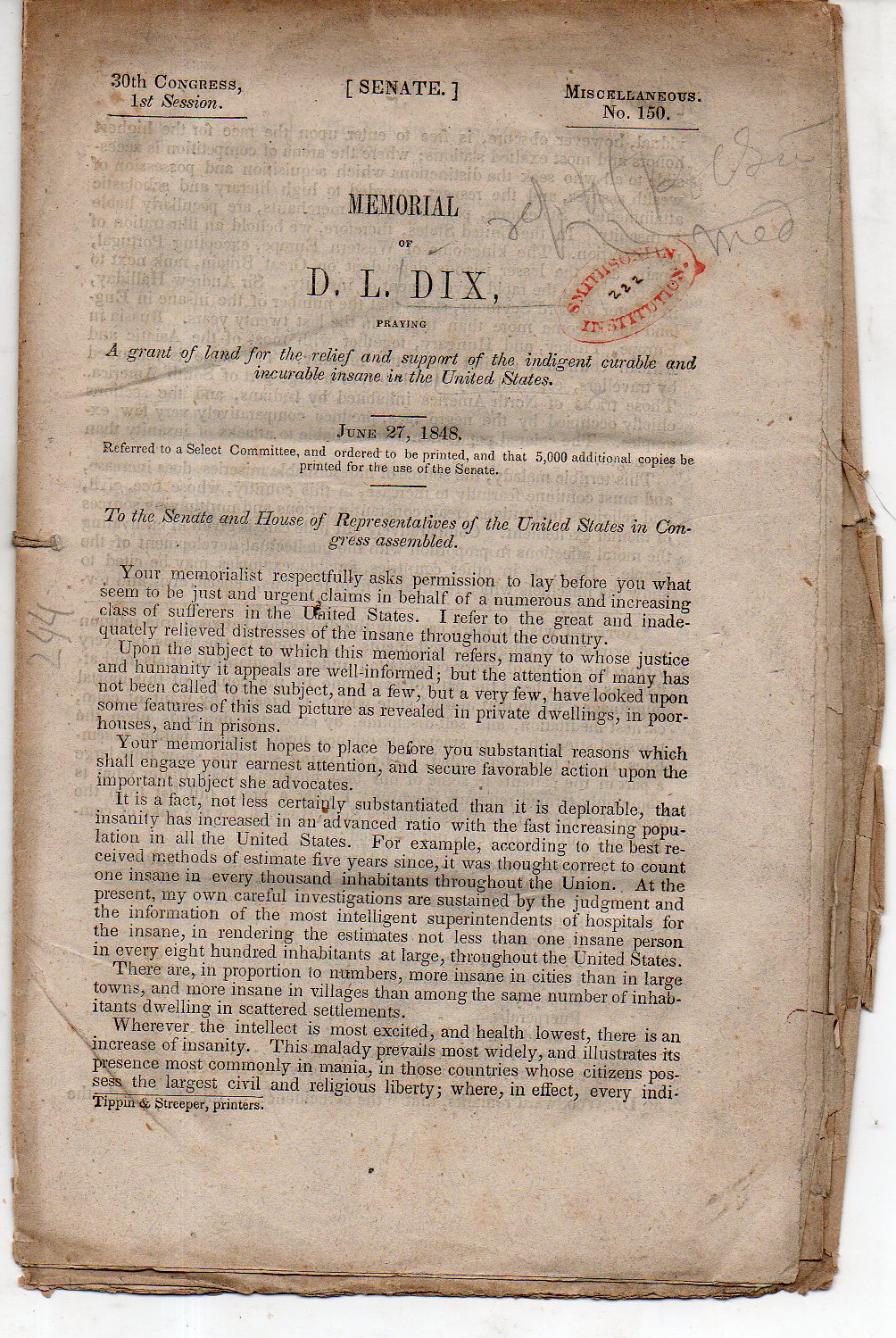
I’ve linked the text from the copy from the National Medical Library (located here, though the front page above is from right here) which has a very elegant access to the 32-page document. My own copy (available for sale via this blog’s bookstore, here) is a decent copy that was once in the library of the Smithsonian Institution before being sent to the Library of Congress, where it slept in a very dusty and unused assembly of odd and odder pamphlets (called The Pamphlet Collection) before coming to me.
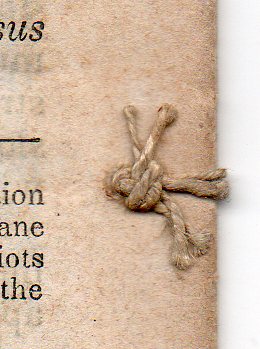
I’m including an unlikely image from my copy–the bit of string and the knot that held the pages of this document together. Rather than the stitching normally found in these pamphlets issued by U.S. goverment printers Tippin & Streeper (identified in tiny 3-point print at the bottom of the front page) this one has only a single side-saddled stitch, with a tenuous double knot, holding the sheets of paper together. It was almost as though the thing was constructed for impermanence–it wasn’t, of course; it was just bound quickly and with little thought. Somehow it kept itself together.
Dix’s plea before Congress outlines very harsh conditions, as well as some of the semi-standards of the day for how a person could find their way into such a state to begin with, listing in the third page of teh work some of the reasons for commitment (in 1843) to the Massachusetts State Hospital (followed by the number admitted)
         Intemperance        239
         Ill  health       279
         Domestic  afflictions   179
         Religious   148
         Property  98
         Disappointed affections  64
         Disappointed ambition  33
         Epilepsy     45
         Puerperal      47
         Wounds on the  head    21
         Abuse of  snuff and tobacco     8
And here an extract by Dix on some of what she found in Georgia (from page 22):
  "Georgia has, so far as I  have  been able to  ascertain, fewer insane, in
proportion to population, than either North or South Carolina, but there
is not less injudicious or cruel management of the violent cases through-
out the State; chains and ropes are employed to increase  security  from
escapes, in addition  to closed doors,  and the bolts and bars which shut
the dreary cells and dungeons of jails and other receptacles.   I have
seen the deep scars of former wounds produced by chains and blows ;
and  those who have received patients  transported to  the State hospitals,
are as  much at a loss for any decent language for describing  the condition
of these unfortunate beings as myself.  Their condition is indeed inde-
scribable.   Patients have not seldom been transported to the hospital in
'open carts, chained and bound  with heavy cords..."

The whole document is fascinating, and well worth a quick read.
Notes:
The document: Memorial of D.L. Dix, Praying a grant of land for teh relief and support of the indigent curable and incurable insane in the United States, June 27, 1848, 30th Congress, 1st Session, Miscellaneous Document No. 150, 32pp.