JF Ptak Science Books Quick Post
 [Image source: Lily Library, here.]
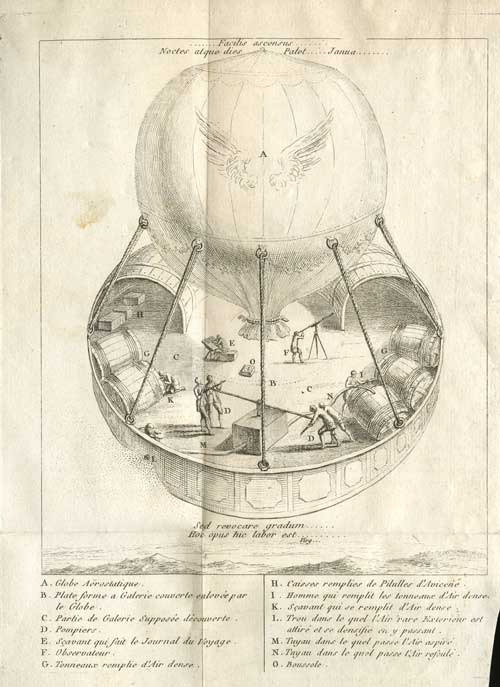
This is perhaps the earliest image of a flying observatory, appearing rapidly in print in the same year as the revolutionary first flight by the Montgolfier brothers. It isn’t a “space” station, of course, but it was close to being one in the 18th century. (The title of the work:Lettre à M. de ***. Sur son projet de voyager avec la sphere aërostatique de M. de Montgolfier. Avec figure, which was printed in Paris by Marchands de Feuilles Volantes in 1783.) From what we can see of the platform there is an astronomer, someone taking notes, barrels of provisions, and five crew members operating an air pump, as well as two sheds.
The interesting quote at the bottom from Virgil’s (Aeneid vi) “sed revocure gradum hoc opus hic labor est” and in English, “It is easy into Hell to fall, but to get back from thence is all”.
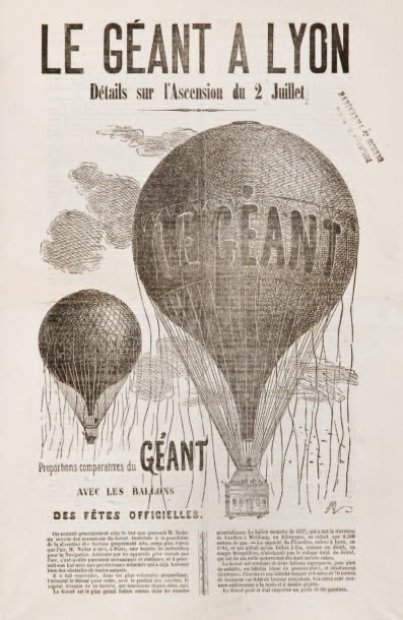
It does remind me some of the Nadar “le Geant” balloon, which was a six-bedroom monster that saw only two flights before crashing–it was however the largest thing ever to fly up to that point. (Nadar was the first person to make aerial photographs among many other photo-firsts–and outside that he was the first to host an Impressionist exhibit of art.)
 [Source, Druot catalog, here.]