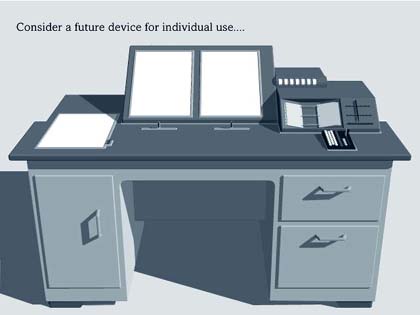
[Image: work station for Vannevar Bush’s visionary Memex machine, the grandfather of the intertubeweba nd hypertext. Source: http://etec.ctlt.ubc.ca/510wiki/Hypertext]
Many have considered books and paradise and the ways to a great library and the correct books to read (and not read). Seneca was convinced of the efficacy of book on a shelf and their being much like a family, and Erasmus and others believing in books as libraries within themselves but without walls, and of course Borges and the infinity of books exceeding the size of the universe, perhaps having him come to the conclusion that hi sheaven would be a book. Thee are jusst a few examples of many–very few of all o fthese writers looked into the future at the book and the library. There was Kurt Lasswitz’s 1901 novel The Universal Library (a source of inspiration for Borges’ later work, The Library of Babel which was written in 1941); there was H.G. Wells’ The Idea of a Permanent World Encyclopaedia and then the great Memex idea by the grandfather of the internet, Vannevar Bush, in As We May Think which was published in The Atlantic in 1945. And of course Ray Bradbury’s Fahrenheit 451 and Libraries of the Future by J.C.R. Licklider (1965) are also standouts. Perhaps though the tandout in the practical and possible vision of teh future library was painted by Charles Cutter in 1883.