JF Ptak Science Books Post 2169
- Did I request thee, Maker, from my clay
- To mould Me man? Did I solicit thee
- From darkness to promote me? John Milton, Paradise Lost (X.743–5)
The animated human created by Victor Frankenstein in 20-year-old Mary Shelley’s anonymously published Frankenstein, or the Modern Prometheus was a far more intelligent being than was ever portrayed in the many movies that made the novel famous in the 20th century. “Frankenstein” refers to Dr. Victor, not the creation, who refers to himself as the Adam of his maker’s labors (and then later as Victor’s Fallen Angel), while elsewhere in the book he is called “it”, as well as “being”, “creature”, “daemon”, “Fiend, “monster”, “vile insect” and “wretch”, among other adjectival variants.
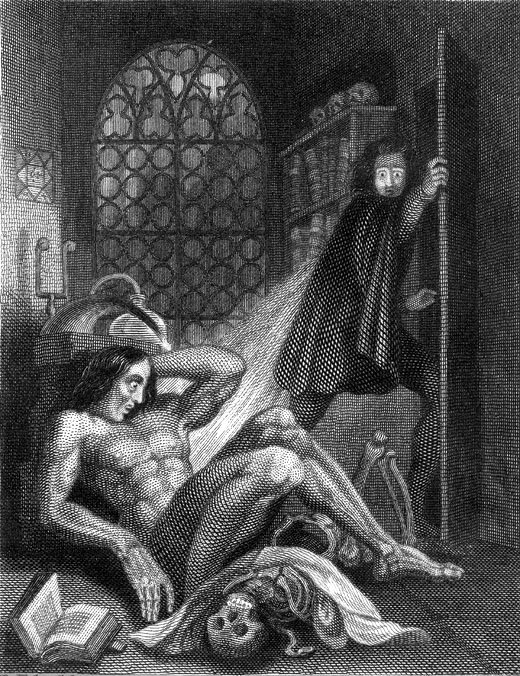 [Illustration by Theodor von Holst for the 1831 edition of Shelley’s book.]
“Remember that I am thy creature; I ought to be thy Adam, but I am rather the fallen angel, whom thou drivest from joy for no misdeed. Everywhere I see bliss, from which I alone am irrevocably excluded. I was benevolent and good; misery made me a fiend. Make me happy, and I shall again be virtuous.”
Mostly the creation is referred to as a “monster”–the word being used 35 times, mostly in reference to Victor’s animated man.
It is difficult to refer to the creation as a “monster” once you get to know him a little—he is exceptionally smart, teaching himself to read, and then reading difficult and complex works with deep understanding, which is hardly something that is expected from what Boris Karloff gave to us.