JF Ptak Science Books Post 2177
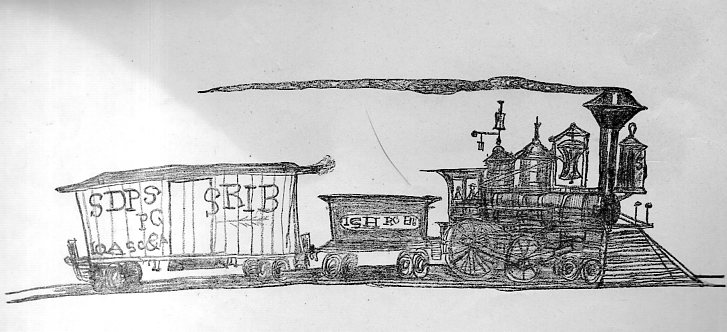
At first I though that this pamphlet was going to led us into a way-of-thinking, or sensibility, about aboriginal non-technical people thinking and relating mechanical and technical ideas. I also thought it might relate in some way to the absence of the advanced Chinese civilization in the 17-19th centuries (for example) of drawing technical ideas in a standardized fashion, in perspective, which I thought was so well done in the West and which helped lead to the great scientific and industrial revolutions to come.
It relates to neither, but it does in a way tell us the story of an American Indian artist from the 1880’s responding to outside influences in the Navajo world.
The paper is “A Navajo Artist and his Notions of Mechanical Drawing” by R.W. Shufeldt (1850-1934), which was published in the Annual Reports of the Smithsonian Institution for 1886 in 1889, and it tells the story of a remarkable artist who seems to have rendered great tech details from scant experience and deep memory. (Shufeldt, an Army surgeon ornithologist, and osteologist and some sort of highly questionable ethnologist, published this just before he was relseased from his Smithsonian duties for disgraceful behavior. He abandoned wives, was an Indian graverobber, and other unsavory things, even while being the curator of the U.S. Amry Medical Museum. He lost much of his vaguely-tempered appeal for what he regarded as “savage races” over the next decades, publishing The Negro, Menace to American Civilization in 1907 and America’s Greatest Problem, the Negro, in 1915. This in effect sums him up, and makes hm an early American version of Alfred Rosenberg-light, or at the very possibly least, a published racist of high order.1)
The paper–coming right at the end of the Plains Wars and just a few years before the Massacre of Wounded Knee–treats it subject with great distance and superiority. The artist’s name is “Choh”, the son of Esta-yeshi, who was the older sister of “one of the best-known sub-chiefs of the Navajo Indians”, Mariano, who lived in “crudely constructed habitations” on the hillsides near Fort Wingate. (The Fort was established near Gallup, New Mexico, in the early 1860’s to help control the Navajos to its north; from 1873-1886 it was used in actions to its south in the Apache Wars. At about the time the author of this pamphlet visited the Fort Douglas MacArthur was taking his first breaths.)
Choh’s face was disfigured by an incident when an infant, though as a young man of 22 or 23 in 1886 “he (was) by no means a stupid clown we would take him to be”.