JF Ptak Science Books LLC Post 2055
“My car gets forty rods to the hogshead, and that’s the way I likes it!” –Grandpa (Abe) Simpson, from The Simpsons (That’s about 500 gallons to the mile.)
A line, a connection of two points in space, is about as basic an imaginary thing as we have here on earth. Humans have used these creations to build all sorts of straight things, from roads to building to ships to literature to mathematics and on and on. What doesn’t happen very often, at least not in Western art in the last 500 years or so, is for people to be represented in art in a straight line that is not a processional (including military, religious, political venues), or that is not along a bench next to a table, or not supported by another artificial structure like a fortress wall (to give their waiting or standing a form to accommodate). That weakens the line field considerably–after all, what else is there to line up for? They’re not queuing up for a sale at Gimbels, and they’re not waiting patiently for a place on the bus. There’s just not that much to form a line for, evidently.
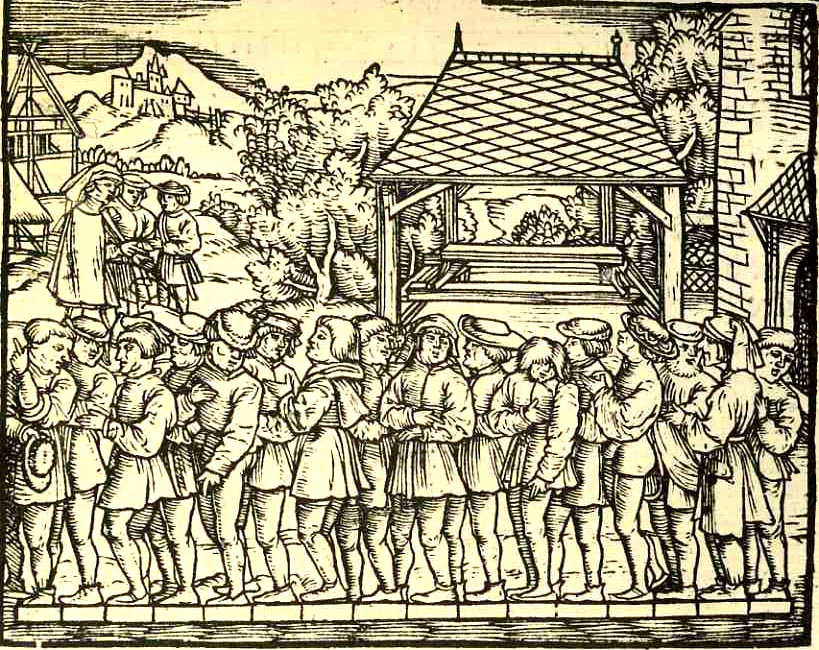
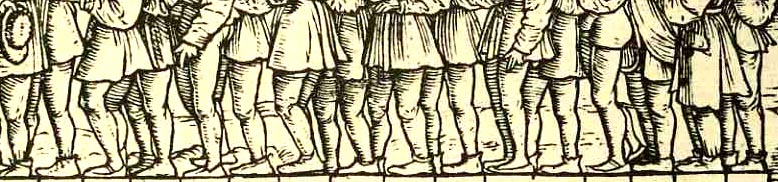
There is, on the other hand, this (above and below), what I take to be
rare representation of my odd requirements: a delightful woodcut from
Jacob Koebel’s 1522 Von Ursprung der Teilung, Mass und Messung dess Ertrichs, der Ecker, Wyngarten, Krautgarten und anderer Velder…,
an early surveying handbook (probably the first ever printed in
Germany) that could be used to measure and set out (as stated in its
title) herb gardens, vineyards, farms and the like.
I’m not 100% sure of this, but I think what is going oin in this image is the measruing of a rod (or “rute” in German), which is about 5.5 meters or 16 feet; and what we have in the picture is 16 men being positioned over a measuring device and beign overseen by the powers that be, at rear. On the other hand, maybe not: the English rod was 16.5 feet, while the rod measurement for Saxony, Rhineland, Bavaria and Baden were different as well; Sweden also came in at 16 feet to the rod. The other big question was: how long was a “foot”? Since that measure also chnaged (varing between 23.51 cm in Wesel and 40.83 cm in Trier and 31.387 cm up north in the RHineland) the measurement of anything with variable units of measure seems to have been problematic, or at least in a post-facto measure. [The whole issue of “absolute” units of measurement is another post for another time (and a much bigger and moire compelx story).] For right now I’m content to have found this pretty image, which in the end was probably the work of the author Koebel (1470-1533), who seems to have been a jack-of-all-trades; and while he was concerned with property and measurement, he also showed his flair with charm, as this group of men atest.