JF Ptak Science Books Post 2031
The story of the history of the story of firsts, of the first time something was noticed or acknowledged or invented or composed, is a problematic one. It isn’t so easy as it might seem to establish priorities–and once the major first of a particular field or interest is established, there may be a long line of minor firsts following the major one.
This is definitely true in photography and cinematography–even the first photograph is an item for discussion depending on how you define “photograph”. Absent this, there is a long line of other firsts that come into play–the first photograph of a human, the first portrait, the first night-time photograph, and so on, and the same sort of issue is applicable in the history of the cinema–and they fall into a long list of Wittgenstein/Tractatus1 enumeration.
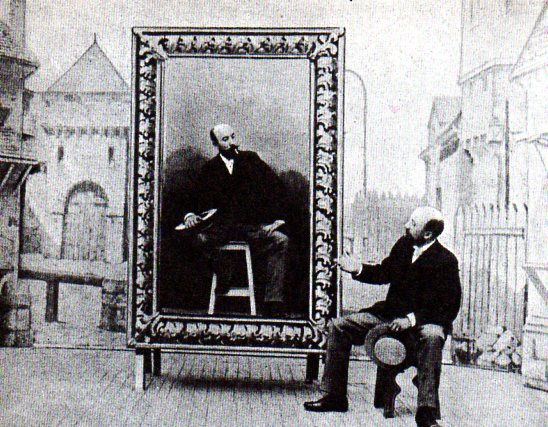
The subject of this post is an interesting “first” in the history of the cinema is this very interesting still of (the great) Georges Melies (1861-1938), who in 1888 opened his cinema in the Theatre Robert Houdin. He was extraordinary, and highly gifted, a man of vast creativity (see for example his early A Trip to the Moon, 1902, here) and energy. And it was here that in the long line of his own firsts that he produced the first cinematic experience of an a person appearing in a moving picture with themselves. There had been inventive photography that accomplished this minor miracle decades earlier, but this was indeed the first instance of this magic being worked in film. This must have been an enormous moment for the viewer, being able to see a person having a conversation with their duplicate–my guess is that it would have seemed other-worldy, brought to earth by (according to Louis Lumiere) a great cinematician.