JF Ptak Science Books Post 2014
Sacro Busto, or Sacrobosco (also called John or Johannes Halifax, Holyfax, Holywalde, Sacroboscus, Sacrobuschus, de Sacro Bosco, or de Sacro Busto) was a member of the Order of St. Augustine and a professor of mathematics and atronomy/astrology at Paris ca. 1230. (There are many places attributed to be his birthplace, but it seems fairly certain that he at least was educated at Oxford.) He became a celebrated member of the intelligensia, with his fame in the later centuries coming via three of his surviving works, each an elementary textbook on mathematics and astronomy: De algorismo, the De computo, and De sphaera.
[Source for this image and the third, fourth and fifth, below, come from a 1531 edition of the Tractatus viewable in full via Google Books, here.]
I think it is accurate to say that the Sphaera was the most famous of his works–it is a very long-lived fundamental textobok on astronomy (and the second astronomical text everprinted, in 1472) and went through 24 editions to 1500, and then another 40 editions from 1500 to 1547. The book was still in use in the mid-17th century but far less so, until it finally was superceded and fell away into the aniquarian dust. It was a short work–basically about 35 pages–and concisely written, even elementary, but it did receive some close attention by some of the great early thinkers in astronomy and mathematics who contributed commetaries, including Michael Scot (between 1230 and 1235), John Pecham (prior to 1279), and by Campanus of Novara between (1265 to 1292).
It may seem a little trifling after this to concentrate on the interesting aspect of the images in his Sphaera, but that is what brought me to Sacrobusto today. For example, this is the beautiful title page, showing (via an early metal engraving process utilizing little punches making those fine small dots) the structure of our existence:
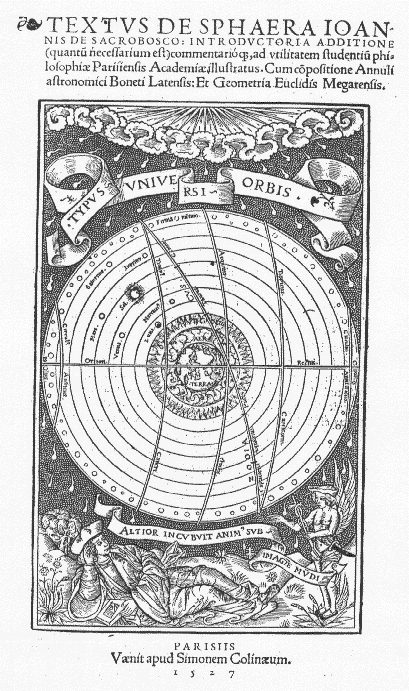 The work (29 cm tall and as I said 35 pages long) is called (in full) Textus de sphaera Ioannis de Sacrobosco. Introductoria additione (quantu necessarium est) commentario[que], ad vtilitatem studentiu philosophiae Parisiensis Academiae illustratus. Cum copositione Annuli astronomici Boneti Latensis: Et Geometria Euclidis Megarensis, which was printed in Paris (Parisiis) by Simonem Colinaeum in 1527, while Sacrobusto was a professor there.
[Source: Johannes de Sacrobosco – Editions of the Tractatusde Sphaera – home, Roberto de Andrade Martins http://www.ghtc.usp.br/server/Sacrobosco/Sacrobosco-ed1.htm.]
There are a number of beautiful and small woodcut illustrations throughout the book in its various editions, for example:
And:
And this:
And so:
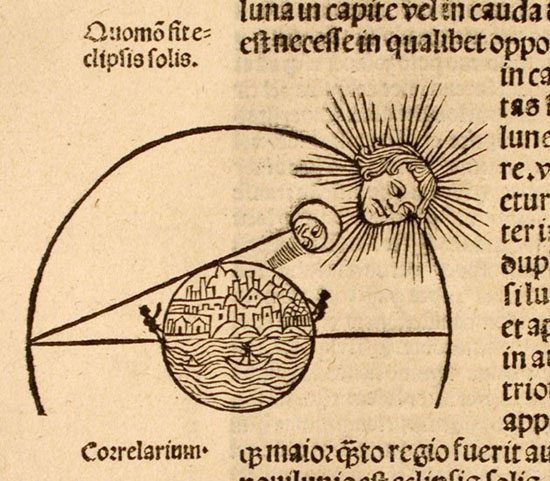
Meanwhile in Sacro Busto’s Vberrimum sphere mundi comētū intersertis etiā questionibus dñi
Petri de aliaco …[Paris, Guy Marchand for Jean Petit, February, 1498-99.] we find this beautiful illustration of a solar eclipse–finding again those curious stick-figure humans under a very Martin-Luther-like Sun:
[Source: Lilly Library, Indiana University, here.]