JF Ptak Science Books Post 1961
Looking through some of the books here at home today I found Thoughts on Prison Labor, etc etc…by a Student of the Inner Temple1, a book on prison and punishment, published anonymously in London in 1824. What struck me right away was the plan of the Cold Bath Fields Prison, and the unusual dark line that ran along the left side of the image, connecting a “regulating fly” to this:
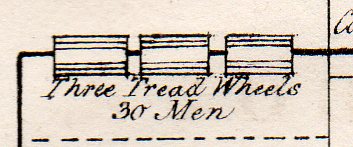
“tread wheels” are just what they sound like. They were used as a means of punishment and control, keeping the prison population busy and occupied. In general, the tread wheel was used in many prisons, and even though there were hundreds of people working on them int he course of a day employing thousands and thousands of steps to move the giant wheels, the large devices were connected to nothing. I guess they could have been connected to a grinder or something that would transmit the generated power into some purpose, but–at least in this case–the only thing the wheel was connected to was a fly wheel, which I assume helped govern the amount of force necessary to produce motion in the tread wheel.
Cold Field Baths was a prison of long standing and had been functioning for about 200 years at the time of publication of the book. For the most part the prison held low-level criminals, mostly with sentences of two years and under. People–men, women and children–served time there for vagrancy, some felonies, misdemeanors and unresolved debt (which is where most of the children come into the picture, as the debtor often found himself imprisoned with his family).
Each of the ganged three wheels would accommodate 30 people. There were six units of three tread wheels at work, meaning that there could be 360 people working the wheels at any given time. That’s a lot of energy produced in the pursuit of obedience. And punishment.
This is the detail from the frontispiece map, in full below:
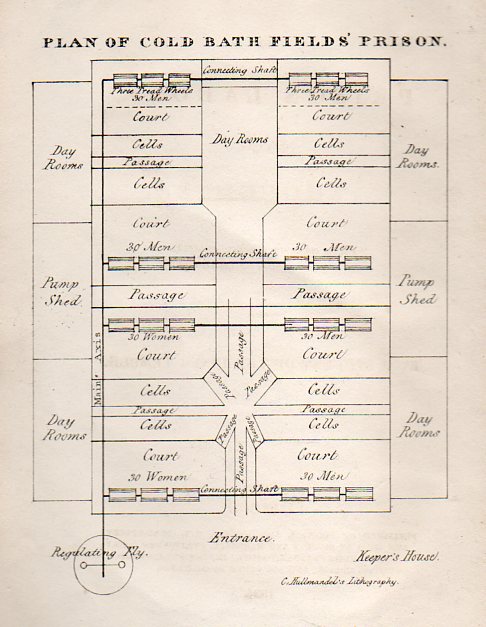
- (There were additions to the prison performed in 1850, which greatly expanded the place. The original prison though is still visible in the plans. See Note 2.)
Here’s a view of what those treadmills looked like, giving a prisoners’-eye view of the proceedings, this coming from 1864:
 Evidently people would work on the tread wheel for periods of 10-15 minutes, which would explain the lines of men walking to their turns, above. Standing and slow walking was the cool-down exercise.