JF Ptak Science Books Quick Post
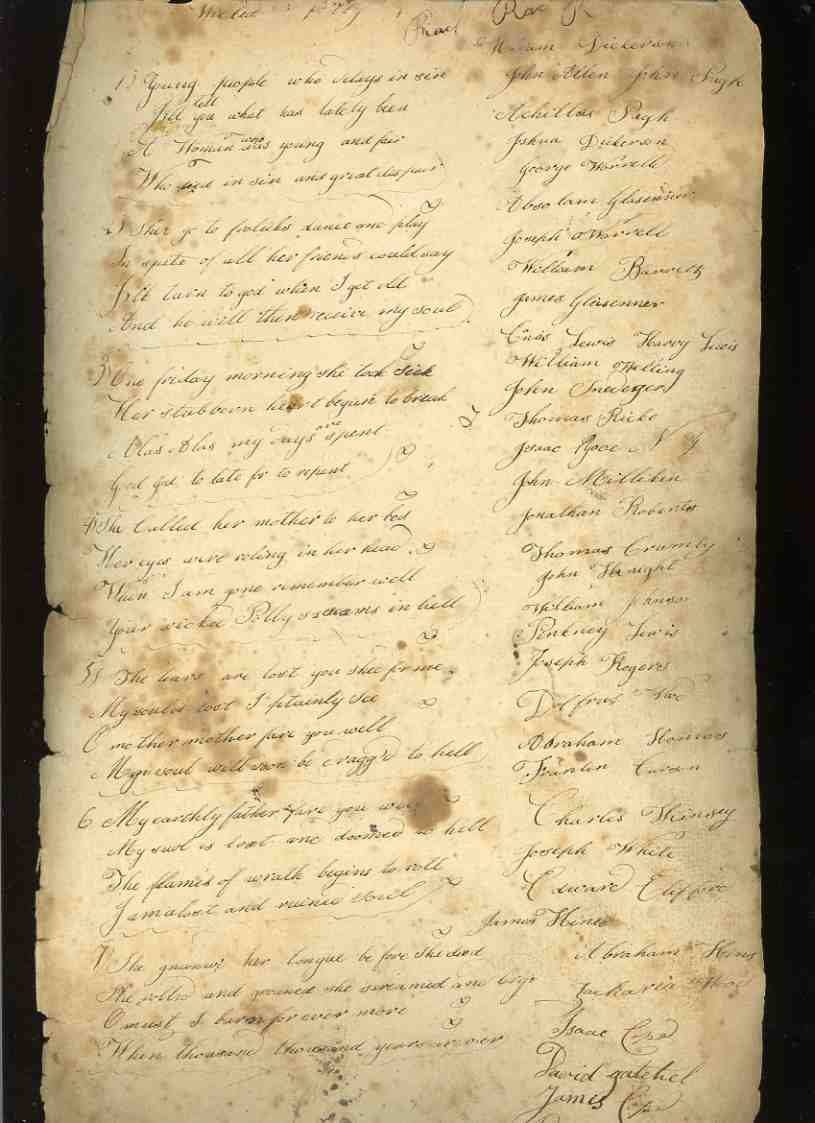 In my collecting of antique children’s art (that is, art produced by children from 1880 and earlier) I’ve stumbled across a number of interesting other associated, relateable, things. One such item is this manuscript copy–from 1827–of a much older children’s warning/lesson poem, called “The Lamentable Story of Wicked Polly”, a scare-the-kids-to-death kind of poem, instilling (and installing) a very healthy dosage of the wrath of god, a falling away from the just Jesus, and the regretably-late realization on the everlasting pain of sin. A rosey children’s lullaby it is not.
[The lyrics are below; click on the images for a more legible resolution.]
But the side interest here is literally at the side, a perhaps revealing bit of marginalia in which the copyist has recorded the names of 54 children (I imagine). Are these names the names of classmates, other children in school, kids in town? There are 26 girls and 28 boys; the girls, as it turns out, have 9 different names; the 28 boys have 18 different names. I wonder why? The girls have the following names (and with the number of holders): Ann (7), Ekiza (4), Mary (4), Hannah (3), Sarah (3), Mary (3), Jane (2) and then one each for Lydia, Sidney and Maria.
The boys have more imaginative names: most popular are William (4) and John (4); this is followed by Joseph (3), James (2), and Abraham (2). The rest of the names are single-uses, and include: Achilles, Joshua, George, Absolom, Enos, Thomas, Pinkney, Charles, Edward, Zachoria, Isaac, Dening and Reason. This is a small and unexpected sample, but it is interesting nonetheless–I don’t even have an explanation, just this observation.