JF Ptak Science Books Post 1937

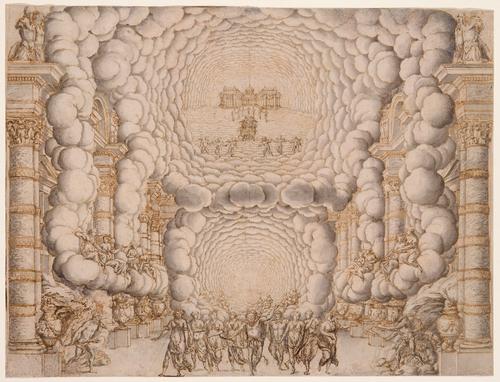
I am hardly an historian of the theatre (and having said that will give me a chance to make some mistakes in what I am about to say) but so many of the stage designs of Giacomo Torelli look to be concentrated at an infinite horizon that I wanted to collect a few of them in one place. Torelli (1608-1678) was an artist and artistic-technician who brought engineering skills to the stage, and was evidently a much-sought-after designer, given his very special
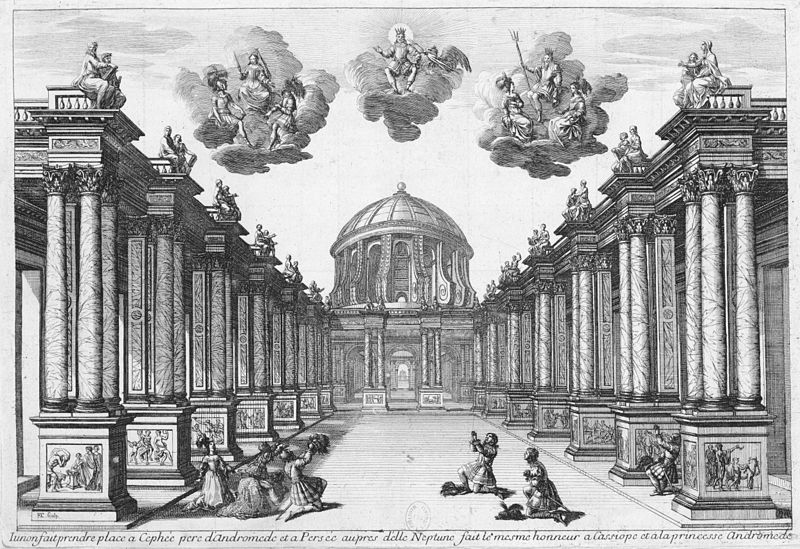
[Image source: WIki, here.] Set design for Act 5 of Pierre Corneille’s Andromède as first performed on 1 February 1650 by the Troupe Royale at the Petit-Bourbon in Paris.]
I do have to say that the Torelli puts me in mind of the perspective king of 17th c Continental architecture, Vriedman de Vries (1527 – c. 1607), especially with the columns (from his Architectura, 1633):
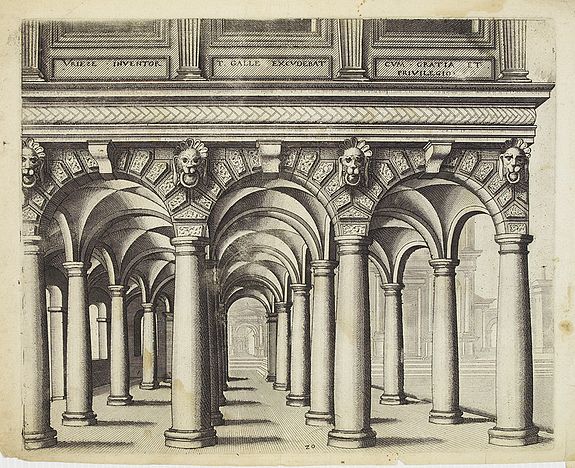 [Source: Swaen.com]
talents and innovations. He was absolutely interested in one-point perspective and the techniques used to gather the audience’s vision and suck it all into the low-center of the back of the stage, giving the production a fabulous quality of depth and distance. (He also provided the ingenuity and gearwork for quick changes of massive scenery by one stagehand, working under the stage with pulleys and winches, hauling large elements on and off stage during a performance. His work can be seen in the iconic Encyclopedie of Denis Diderot in a section for “Machines du theatre” in 1772.)
The other thing that strikes me immediately with these images is their absolute usefulness in toy paper theatre. By making eight copies of the first image (above) and by cutting out each seven layers of columns (the opening space between the two sides becoming progressively smaller), and then the last and eight level of the mansion in the background and then standing them up and placing them all-in-a-row with an inch between them (accordion style), one could make a lovely 3-dimensional miniature stage. (Scene changes would be an entirely different matter.)
[Source: see note #1, below]
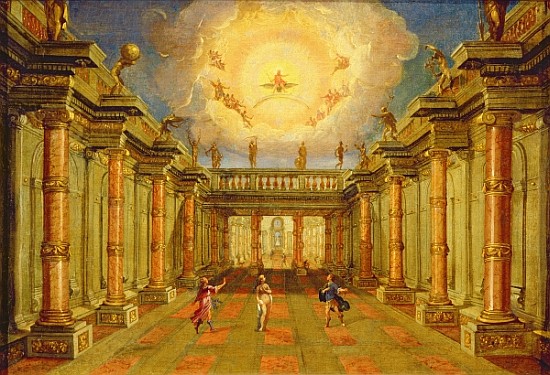
[Source: Copia-di-Arte.com, here.]
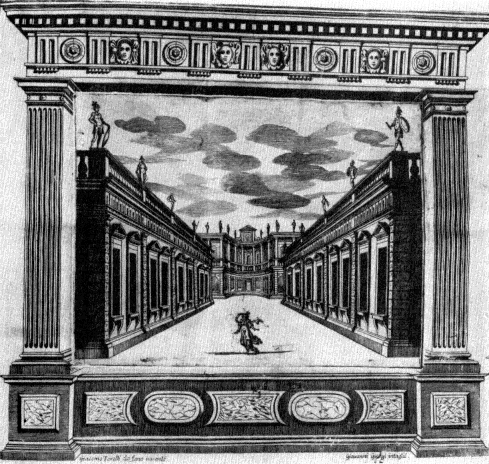
[Source: Publishing.cdlib.org, Operain Seventeenth Century Venice, the Creation of a Genre, by Ellen Rosand.]
[Francesco Buti/Isaac de Benserade, “Les Noces de Pelée et de Thetis”; Source: Oesterreichisches Theatre Museum, here]
Notes:
1. Bryan, Michael| (1889). Dictionary of Painters and Engravers, Biographical and Critical. Volume II : L-Z,
new edition, revised and enlarged, edited by Walter Armstrong &
Robert Edmund Graves. Covent Garden, London: George Bell and Sons