JF Ptak Science Books Post 1903 Part of the series on the History of Blank, Empty and Missing Things: Chinese Rail Workers, 1869.
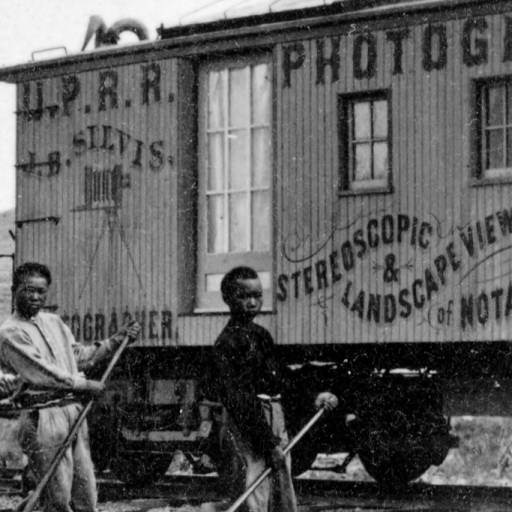
One thing that you seldom see so juxtaposed in the photographic history of the American West are the people who were so important to it placed in proximity to those who were no well disposed to recording their existence.
For example: this image by J.B. Silvis, “China Section Gang Promontory”, a photograph published as a stereocard between 1869 and 1870, shows a small group of Chinese workers setting two rails in Utah–they are the ubiquitously missing elements in historical images of transcontinental railroad construction. There were many thousands of these workers who were set to notoriously difficult tasks in bad situations and under time constraints with little liberty or pay (and not well-afforded much protection under the law), and in the history of documenting the expansion of the railroad across the West these workers are very seldom seen.
They are set incongruously in front of a photography car that so often saw through or around them. The car was labeled “U.P.R.R. Photograph J.B. Silvis Stereoscopic & Landscape Views of Notable Points on line of Pacific R.R. Always on Hand”, and I found it tempting to try to see in the photograph that it was made solely for the photographer’s advertisement, but the central placement of the workers makes a good argument against this. On the other hand, when you look at some of the other work of Silvis documenting his railway car (see here), there are a number of group images where he gathers cowboys or Indians or makes a photo with his car in an unusual place, he is definitely using those people and locales to establish the idea of remoteness and wildness of the places in which he was working. It seems to me that in the end, he was using the Chinese laborers as a piece of his advertising ensemble more than documenting them. Again, this is very speculative.
It is a very unusual image which I think is knee-deep in irony.
I should also like to point out that most of the workers have taken care to sew large leather patches on their breeches–that to help their thighs when pulling that heavy metal lever across their bodies while setting and moving track.
[All images via Denver Public Library, here.]