JF Ptak Science Books Post 1900
As I’ve written about on this blog before, Blank, Empty, Blank and Missing Things can be of great importance. For example, if human conversation wasn’t mostly filled with nothing, it would be difficult for us to process anything, everyone sounding like several mockingbirds calling away at once, all of the time. Music would be difficult if there were no silent interludes. And of course since existence is made up vastly of nothingness, to have it be filled would present a, um, problem. It also might be interesting to invent an 18th century board game based on the discovery of nothing through the ages…or maybe 16th century, when the idea of zero in mathematics was first coming into widespread use.
My interest in Nothing today comes along with design and epochal scientific publications–or at least highly significant appearances of great ideas. Sometimes the typography and design of the title pages of Great Works turn out to be very surprising–and sometimes that surprise in blankness is an unintentional result.
Also we’ll just discuss relatively recent works of the past 150 years or so. Design changes quite a bit from the 18th to the 19th century so far as scientific and technical title pages go–the earlier design (and particularly the illustrated versions) are another matter.
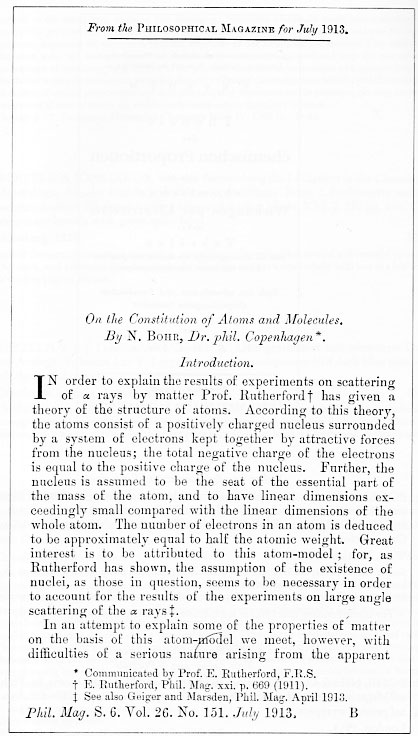
First, the intentional bits, like this fine example of Niels Bohr’s superb introduction to the rest of the world of modern atomic theory (based upon the Rutherford model and Planck’s quantum theory), “On the Constitution of Atoms and Molecules” (in the Philosophical Magazine for July 1913). In this case (which actually is a three-part paper), the offprint to the publication has an upper part that is blank because it excludes the closing paragraphs of the preceding article–offprints being the separately-published and bound author’s article that were meant to be distributed privately and prior to publication of the appearance of the contribtution in the journal.
Before I proceed though perhaps it would be interesting to see an attempt at anti-nothingness in design, which in many cases can be a work of high design art in themselves. For example, even though most of the white page is filled up,
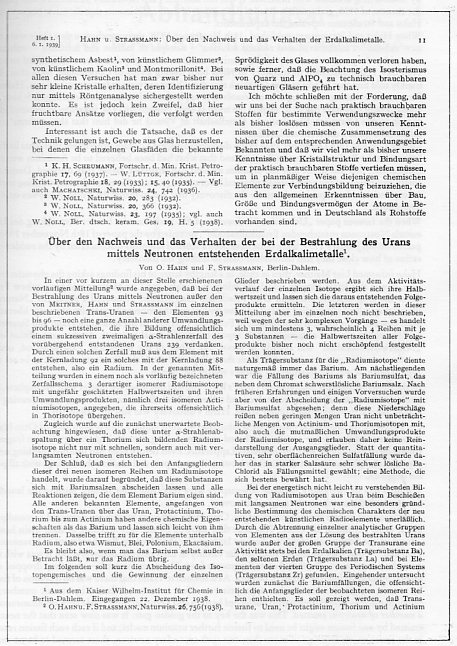
this is still somehow quite balanced and pleasing. (Otto Hahn and Fritz Strassmann delivered a series of eleven seminal papers from 1933 to 1939, this being one of the most important, signaling the discovery of nuclear fission, an event that started its own sort of chain reaction in physicists who awoke with the sudden realization of how very doable all of this was, and how close so many other scientists were to having discovered this themselves.)