JF Ptak Science Books Quick Post [Part of the History of Lines series]
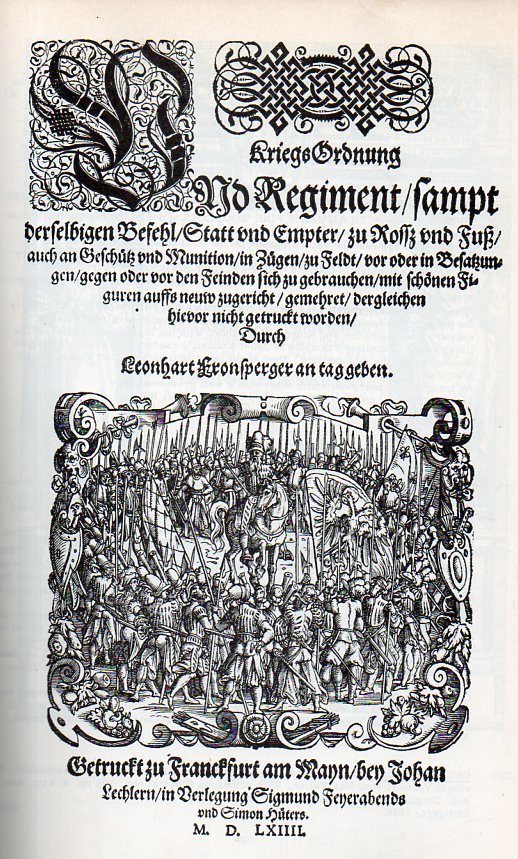
I was quickly struck by the use of lances to establish a depth and perspective in this small woodcut on the title page of Leonhart Fronsperger’s Kriegsordung und Regiment…(1564), and how I have seen this device used many times over he years. The artist here is the great Jobst Amman, and the book happens to be one of the most important works in military science published in the 16th century, addressing topics from troop movement to military economics to administration. (It is also one of the earliest books to address the subjects of pyrotechnics and rocketry, the later in the second chapter, “Vom Gescuetz und Feuerwerk”.)
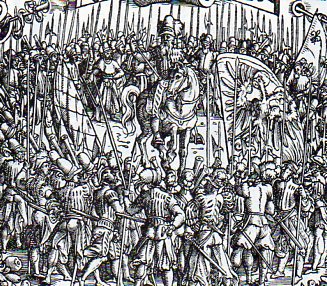
The above is a detail from the title page:
 All that said, I’m fixed on the lances, and how they remind me somewhat of Paolo Uccello (1397-1475)–who is one of the founders of perspective–and his triptych The Battle of San Romano, with the third part of the trio in particular.. The painting was intended to be viewed together, depicting the battle (more-or-less) at morning/noon/night, the parts of which are shown below in that order. The lances (especially in the “Counterattack”) are meant to heighten the sense of perspective–and the effect of the lances having basically no detail and being in brilliant color enhances that effect. (In the first part of the triptych Uccello uses the alignment of dead soldiers and dropped lances to the same effect–particularly the ones beneath the hooves and in the vicinity of Niccolo de Tolentino’s spectacularly white and “solid” horse. (The business of the lack of detail in Uccello has been famously addressed in William Gaddis’ The Recognitions. I’ve written about Uccello frequently here, particularly in this note.)
- Niccolò Mauruzi da Tolentino at the Battle of San Romano (probably about 1438-1440), egg tempera with walnut oil and linseed oil on poplar, 182 × 320 cm, National Gallery, London.

- Niccolò Mauruzi da Tolentino unseats Bernardino della Ciarda at the Battle of San Romano (dating uncertain, about 1435 to 1455), tempera on wood, 182 × 320 cm, Galleria degli Uffizi, Florence
