JF Ptak Science Books Post 1695
“That was mere foreplay; Where books are burned, human beings are destined to be burned too. ” (In German: “Das war Vorspiel nur. Dort, wo man Bücher verbrennt, verbrennt man am Ende auch Menschen.”)
– Heinrich Heine, Almansor (1821)
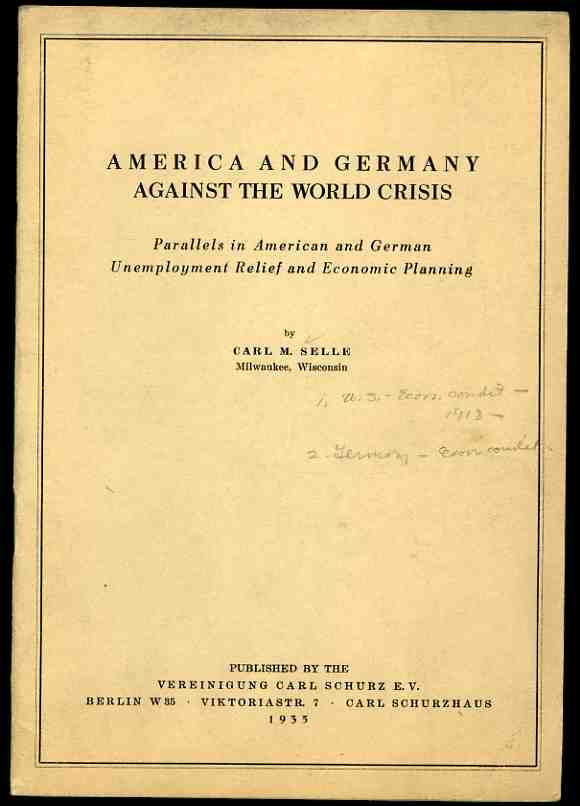
This sickly pamphlet America and Germany Against the World Crisis, 1935), written by Carl M. Selle, is a comparison of the “American and German New Deal”, and their joint effort in fighting the great depression as one of the “overwhelming catastrophe(s) of the Great War” by the “new governments” of the United States and Germany. It is a ludicrous, damaging, offalous piece of Berlin-published propaganda aimed at winning soft hearts and minds in the U.S. and other English-speaking countries.
“In Germany Hitler so augmented relief measures that a new note of hope as heard in that country”. These measures included—according to Selle, the Winterhilfswerk* which he equated with Roosevelt’s NRA, and the Deutsche Gesellschaft fier Offenliche Agbeiten (Oeffa) with the PWA (Public Works Administration).
What Selle didn’t mention is the story here, and not the seeming correspondences between the economic policies of the two countries.
Principal in Selle’s Corrupt Memory Timeline (and this just dealing with the Nazis up until 1935) are the Nuremberg Race Laws, which were the principal step in outlawing the right of “human being” for a segment of the German human society. “The Law for the Protection of German Blood and German Honor” (regarding Jewish marriage) and “The Reich Citizenship Law” (designating Jews as subjects) were the major components of these laws–there would be a dozen more which would classifying the Jewish people as subjects of the Reich and eventually, simply, disposable “things”.
On June 30, 1934, Hitler consolidated his power with The Night of the Long Knives, sealing his control of the Nazi army by ridding it of the “corrupt” influences of the SA, murdering the lice’s lice.
In May 1933 was the first great Nazi book burning, which was a continuation of a tradition that spread across the continents and back through the millennia (and that’s another story for another day), destroying the ideas held in physical form of the works of H.G. Wells, Jack London, Sigmund Freud, Albert Einstein, and other “non-patriotic” and “anti-German, anti-Aryan” “degenerate” works.* Book burning was the visual record of a much deeper destruction of the intellectual and cultural heritage of Germany, and was a very direct effort for thought and language control, autonomizing the creativity of an entire people (or at least those who were still considered to be “people”). It was also one of the early steps in eradicating ideas that were dangerous to a fragile and highly suspect intellectual foundation of a movement; that led inexorably to the destruction of the people who would have those ideas. It was also in this year that the Nazi Party was declared the only legitimate, political organization in Germany. So, when Hindenburg dies in 1934 and Hitler is made Fuhrer, it is not surprising that Hitler receives a 90% “yes” vote in the national referendum of August 19, 1934..
Earlier in the same year as the publication of this dirty little piece, January 26, 1935, was the passing of a law for forced abortions for people with hereditary diseases.
And on and on. The pamphlet was a meagre attempt to legitimize the cancerous growth of Nazism, equating it in whatever way possible with the efforts of the Roosevelt administration in order to give themselves some small washing of external friendly legitimacy. I don’t know anything about the author (though the name of the publisher related to a famous German American from the Civil War/Reconstruction period of U.S. history), but his efforts were soft, conservative, and embarrassing. And nothing new, or original.
But this sort of activity–hearts and minds campaigns–is still the coin of the realm of aspects of political /power relationship interactions.