A Daily History of Holes, Dots, Lines, Science, History, Math, Physics, Art, the Unintentional Absurd, Architecture, Maps, Data Visualization, Blank and Missing Things, and so on. |1.6 million words, 7500 images, 4.9 million hits| Press & appearances in The Times, Le Figaro, Mensa, The Economist, The Guardian, Discovery News, Slate, Le Monde, Sci American Blogs, Le Pont, and many other places… 5000+ total posts since 2008.

Extra-Earth Department #5–Primordial Pre-Cretaceous-Paleogene-Industrial Bubble-Earth

JF Ptak Science Books     Quick Post Addition to the Extra-Earth Series
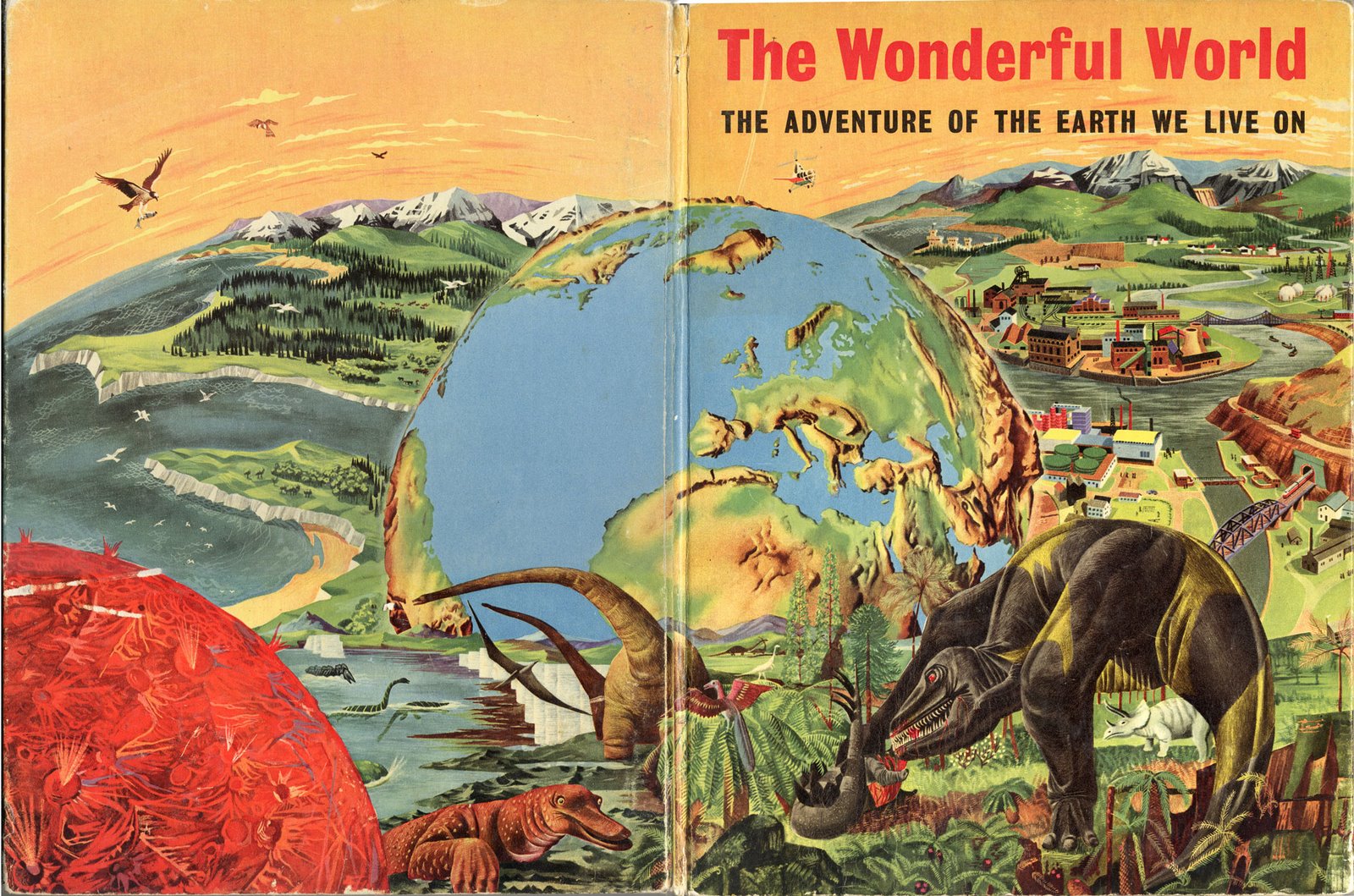
http://3.bp.blogspot.com/_ZaTCJM8RRD0/SHWWZuUV0VI/AAAAAAAAAZM/0BfSUS0FsrA/s1600/wonderful.world.cover.jpg

Today a reader of this blog forwarded a lovely image for the series on Extra-Earths that appears here–one installment of which (with links to the others) appeared just this morning. 

The Wonderful World–the Adventure of the Earth We Live On (by James Fisher, and with  art editor F.H.K. Henrion, and published by Hanover in 1954) is a clunky title even for expressing its idea to juvenile audiences. And speaking of which, if the intended reader was eight years old, the cover art might be a little confusing: what is that bubble-Earth doing there, and why is there a T-Rexy thing standing there on a mountaintop overlooking a city and observing the whole Earth-emergent process? 

But when we look inside the book (at the images provided by our reader, Kevin, from his own 2006 blog (“The Balloonist”) entry on this book, we can see the elements of the cover’s montage, and which would I guess alleviate a young reader’s consternation with the confusing image:

And we can see that it is actually an interesting book for what it is, and at least could give kids a sense of time and depth:
Needless to say my only interest here was the appearance of the miniature Earth bubbling up through the missing industrial-dinosaur goo.  The addition of an Earth on or within sight of the existing Earth seems a very odd way of making your point, even if that point was being made allegorically in a high-Renaissance work on scientific instruments–the use of Extra-earth imagery is to my experience very uncommon, and I don’t wonder why. 

·Posted by :

·in:

Recent Posts

Archives

Categories