JF Ptak Science Books Post 1560
I find a deep, semi-literary dreaminess in the imagination left open by the blankness of empty receipts, questionnaires, incomplete reports and untransmitted half-bits of undone documents. The missing qualities of these objects can be an open invitation to insight, sometimes allowing their reader to see more in the incompleteness than had the object been completed. (There are a number of posts in this blog about these qualities, one of which is “Empty Memory, Telephone Number Warsaw 20080, Nazi Occupied Poland, 1941″, with many of them appearing in the series A History of Blank, Empty and Missing Things.)
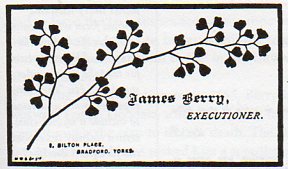
And so with this receipt for monies due to England’s executioner, James Berry, found on page 78 of Howard Engel’s very straightforward and intriguing work on execution in England, Lord High Executioner. James Berry served in this capacity, working for the state from 1883 to 1891, all through his thirties (31-39), hanging 130-odd criminals. It turns out that he was the third executioner in a row who had something to do with shoes–the preceding two executioners, William Calcraft and William Marwood, were both cobblers; Berry on the other hand was a shoe salesperson, whose replacement in 1891 was a “hairdresser”.
Calcraft was a man ill-suited for his job and was replaced by Marwood, who was–he was a deeper thinker when it came to executing people, and applied that too his craft. So too with Berry, who seemed to have the proper treatment of the condemned first in mind, which meant to have them suffer as little as possible during the execution. To that end he calculated the most efficient ways of noose construction and placement and the heights at which a person could be dropped to (hopefully) ensure an instant death.
He was a particular man, and intended for their to be as little left to chance in his job as could possibly be. As a matter of fact, to make an assignment function as smoothly as possible, Berry had printed a bill of services so that there would be no question as to what was being paid for with his services and for what. I can understand that the man needed as little confrontation in this job as possible.
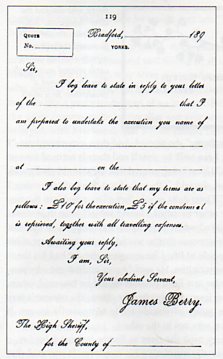
The man was a professional who sought to make his job make as much sense as possible, given the circumstances. While he was executioner, Berry felt as though to note execute someone for capital crimes was an affront to the Bible, which he felt demanded this blood retribution. Afterwards, after his career, he was less sure of this belief, ultimately becoming a true-enough evangelist who stood firmly against capital punishment.
 .
.- My Experiences as an Executioner, London : P. Lund, [1892] (via Internet Archive)