JF Ptak Scienc Books Post 1485
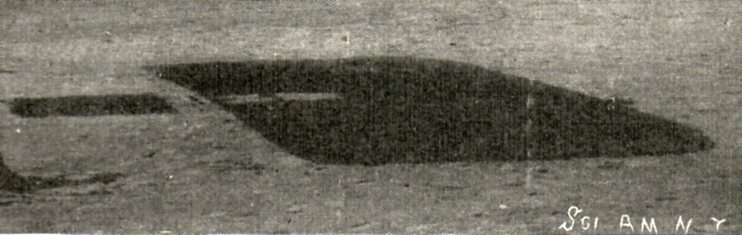
In this history of picturing shadows this might be one of the most significant for early 20th century technology. After all, shadows in images weren’t necessarily a desired effect, and certainly it was seldom required, but this one, captured as a result of capturing something else, has survived.
This is one of the first popular reports on the Wright brothers’ first publication describing their experiments in flight., and it is buried in the middle of The Scientific American issue for 22 February 1902, months after the original publication. That initial report, published as “Some aeronautical experiments” published in the even-then-obscure Journal of the Western Society of Engineers (6 (1901) 489-510) seems to be the only source for this article, the Wrights keeping information about their experiments closely held. (For example, the next publication of theirs, “Experiments and Observations in Soaring Flight” would be published in the Journal of the Western Society of Engineers ,VIII, 400-417, in 1903.)
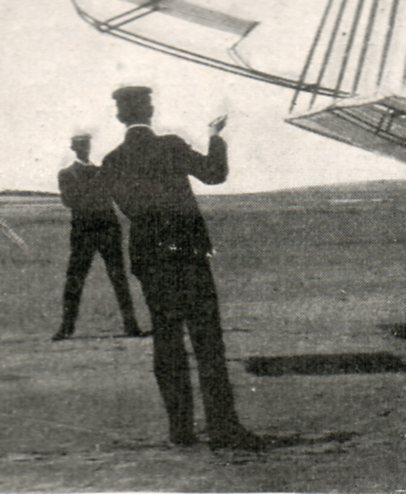
The editors of the Scientific American—and other magazines—were certainly skeptical when it came to claims of new sorts of flight, but the Wright case seems to have been thoroughly without question. Still the article on their article appeared in this issue of the magazine after stories on the reconstruction of the RedHeugh Bridge, reviving the Hudson River tunnel idea, steam boiler inspection, the Darien canal, variable speed gears for pumps, a new method of etching, “photographing by electric headlight”, mill flour in Sweden, domestic manufacture of Portland cement, improved rail joints, winter railroading in Alaska (and a few other bits), before we get to the article, which is just a half-page long.
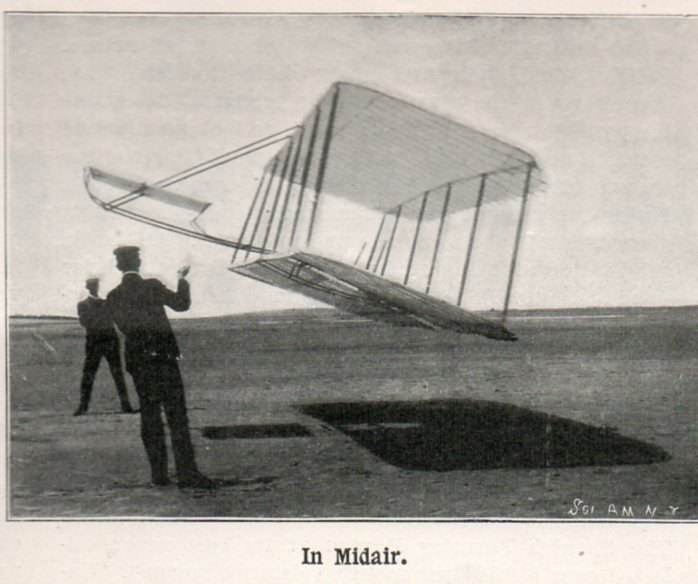
Bit it is an important half-page, which include five photos of the fliers as well as descriptions of the control apparatus, which includes an observation of an epochal improvement to their aircraft, one of the most important in the history of aviation (if I am not mistaken):
“…responding to the slightest motion of the rudder”
That is to say changes were made to the rudder which paved the way to their 1902 experiments on the vertical rudder, which gave it a critical importance of keeping the aircraft aligned when coming out of a banking maneuver or climb rather and so on than for changing the direction of the aircraft; so when using the rudder in this way and wing warping for altering direction, their aircraft would became a truly flyable thing.
Notes:
Since this is outside my area I quote liberally from the US Commission on the Centennial of Flight for a more exact description of the difference of the gliders between 1901 and 1902: