JF Ptak Science Books Post 1476 -part of the Blank, Missing and Empty Things series.
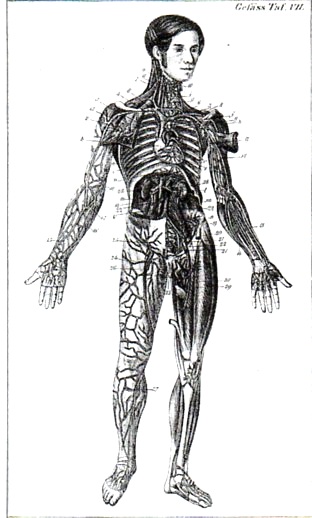
Carl Ernst Bock (1809-1874) was a physician and anatomist (and son of the anatomist August Carl Bock of Leipzig, 1782-1833), whose many publications include the very popular Hand-Atlas der Anatomie des Menschen nebst einem tabellarischen Handbuche der Anatomie.(first printed in 1841). This is a good example of his reaching out across the social strata to publish something that was accessible to the public-at-large, making him a pioneer in the distribution of medical information.
I’m sorry to say that in all of this man’s beautiful work I focused on this superior full-body anatomical–the odd thing here is that the only skin remaining on the body is on the head, where we see a face and full head of hair. To my experience this is a very highly unusual visualization.
In an almost-the-opposite approach (which is much more common) Albert Adamkiewwicz (in his Taflen zir Orientierung an der Gehirnoberflaeche des lebenden Menschen...(printed in 1894, in Vienna) offers the following:
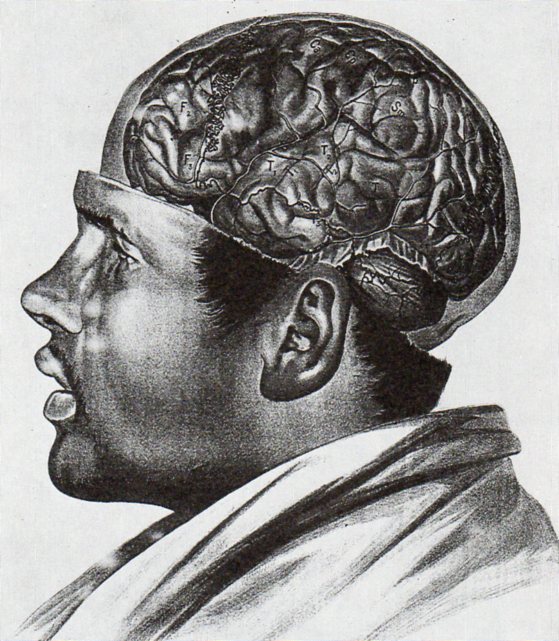
As with the other image above I only have a second generation image of this, and only in black and white–the color original is truly remarkable.
Another excellent example of an anatomical dissection leaving the face intact occurs several times in the massively interesting work of Jacques Gauthier Dagoty, whose work I remembered but whose name I forgot, making it fairly difficult to find the illustrations. But here they are, from Anatomie des parties de la generation de l’homme et de le femme, published in Paris, in 1773, with Dagoty (1717-1785) acting in multiple roles of author/designer/anatomist/painter, who produced these magnificent painterly dissection studies of great detail and warmth.

And this:
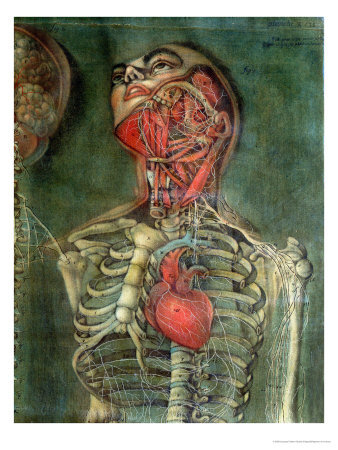
There are many other studies in the volume, but few retain the face.
Then there’s this, the other end of the spectrum, where we see the flayed anatomical specimen and its skin though not in contact with one another, which is a special category indeedy:
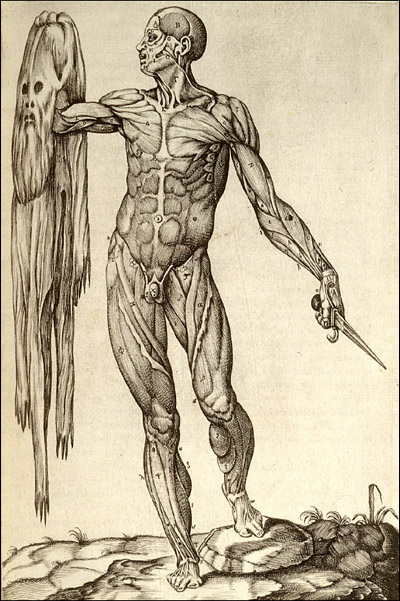
This copperplate engraving comes from Juan Valverde de Amusco (Valverde) (1525-1588 or thereabouts), Anatomia del corpo humano… (printed in Rome in 1559), and stands quite apart (though not alone) from the rest of the anatomical oeuvre of the 1550-1750 period.
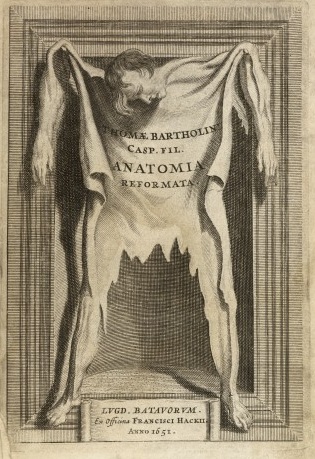
And let’s not forget Thomas Bartholin’s frontspiece for his Anatomoa, published by F. Hackis in Leyden in 1651, which is similar to the Valverde: