JF Ptak Science Books Quick Post
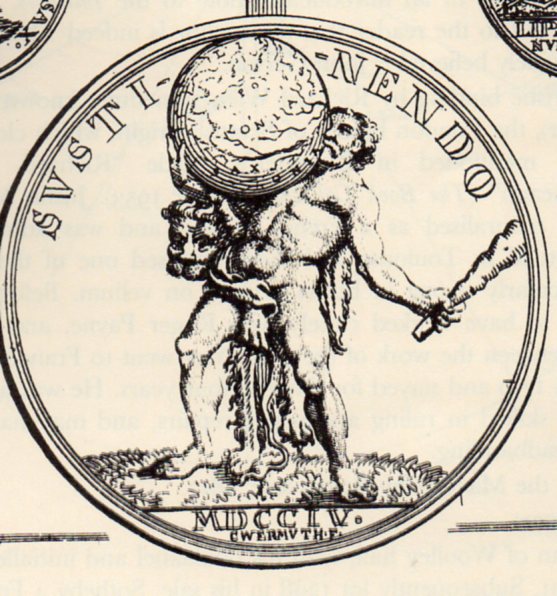
I found a rather unusual image in this sniffy but no doubt very useful book on heraldry. On the reverse side of a medal shown below (“Augustus II D.G. Rex Pol M. D Lit. D. Sax. I.C.M.A.”, or declouded it is August II, D.G., King of Poland, Grand Duke of Lithuania, Duke of Saxony, Julich, Cleves, Berg, Angria, and Westphalia) we see a compromised image of Hercules, the only time that I can remember seeing him balancing the sphere on his chest. It looks very uncomfortable.
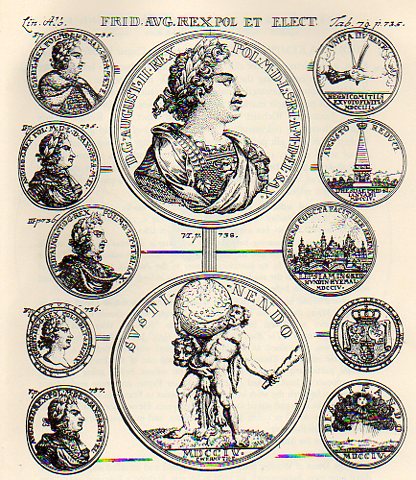
Originally Atlas was supporting a sphere representing the sky, a punishment that he stand on the Earth and support the Heavens so that the two did not meet. Over modern time Atlas has been given a new burden to bear, and generally it is that of the Earth rather than all creation.
Of course if we went looking a little further to see what else Atlas might be doing with his burden, there is the following:
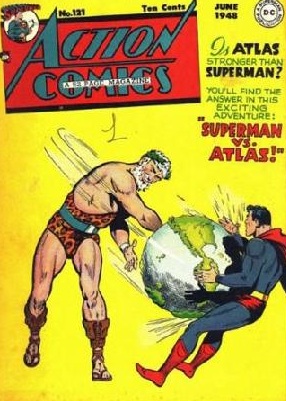
where for ten cents it would have been possible to see the outcome of this epic battle; but since I can’t spend the ten cents here, we’ll never know. It is interesting to see the representations of the mountains on the globe–given their bumpiness I’d say that their scale would relate to those peaks being 50 miles high.
And just for the sake of it “Atlas” became associated with a colletion of maps bound in a volume in Antonio Lafreri’s Tavole Moderne Di Geografia De La Maggior Parte Del Mondo Di Diversi Autori (1572) not because he employed the word first, but rather because he used an image of Atlas on the book’s title page–the first use of he word comes a little later in the work of Gerald Mercator.