JF Ptak Science Books Post 1457
There is a developing thread on this blog relating to strange things in the sky. Sometimes the images are extraordinary, impossible, beyond fiction: multiple/duplicate Earths, flying buildings, horses in balloons, extra-human missing souls downloaded to the Earth from extra-Moons, and so on. And at other times, the images are more subtle, questioning, ambiguous, as in the example of some 16th century prints that show the sky opening to reveal the Creator, who is in turn pictured against, say, a completely blank background, suggesting an enveloping nothingnesss of Heaven; or a field of beautiful stars filling a Renaissance sky of deepest red, at night. A gigantic foot shown floating in the sky in a 17th century image might be ambiguous, and it also wildly so; both it and the more subtle ambiguities–for example early representations of caves-over-mountains that give them an inside-out appearance–are welcomed sights.
Perhaps some of the most beautiful of the Strange Things in the Sky department might belong to the skies of Dante–they can be extraordinary, straightforwardly unusual and–when the narrative is presented pictorially–beautifully strange and with little ambiguity. They are presentations of ideas of time and space, fantastic adventures in imaginary environments, as much an internal journey as Milton’s Paradise Lost is an external one1.
Dante’s celestial exploration and the foundation that he provides have led to the possibility of an entire atlas of maps of paradise, hell and purgatory. Here’s an interesting map2 constructed by Michelangelo Caetani (1804-1882) showing the structure of the Comnedia:
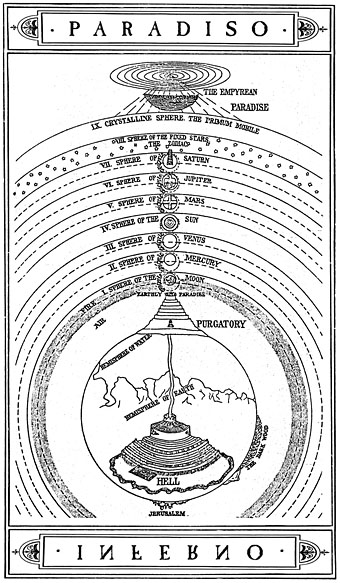
I’ve presented this map just to give a context for the placement of the following images, though I do like the Caetani because it presents a good overview of the entire placement of Dante’s work, though necessarily having to leave out almost all of the detail of what is actually going on in each level.
Nearly all of the images below are from La comedia di Dante Aligieri con la nova espostione di Alessandro Vettlutello, published in Venice in 1544 by Francesco Marcolini (or Marcolino)3. For the present collecting/browsing purposes I’m just going to go over the images lightly rather than try to launch into an ill-advised exegesis on a subject that I don’t know very well at all.
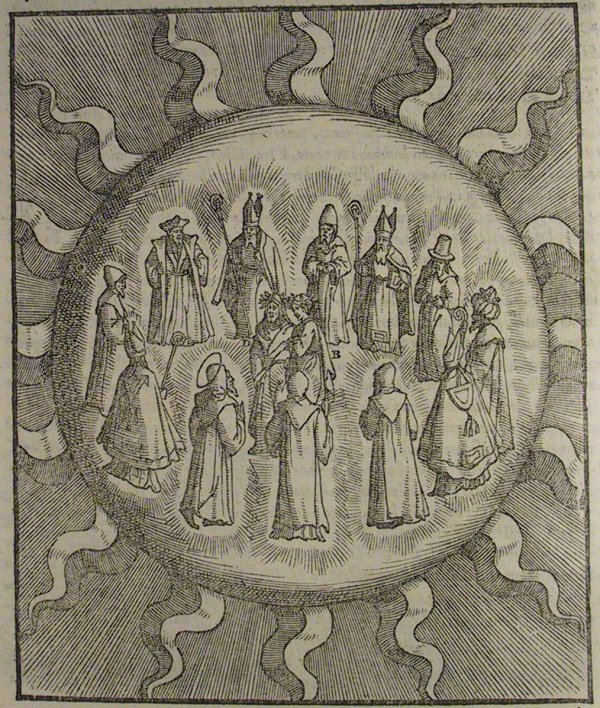
In the Sphere of the Sun Dante and Beatrice among the wise and the learned, hearing them all (eleven) named so by Thomas Aquinas. They include Albertus Magnus, Gratian, Peter Lombard, Solomon, Dionysius the Areopagite, Orosius, Boethius, Isidore of Seville, Bede, Richard of St. Victor, Siger of Brabant. Paradiso X
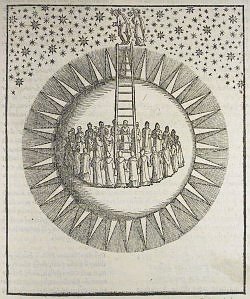
Dante and Beatrice entering the sphere of the fixed stars, using a ladder of contemplation, mythically suggesting stairs and in this case a stairway to god.
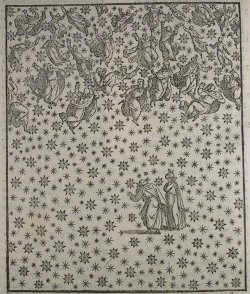
The souls ascent to the Empyrean, with Dante looking down to see the Earth (“the little patch that makes us so vicious”), and to trace the (“mad”) voyage of Ulysses, and to see perhaps how far he has traveled (Paradiso XXVII). Dante listens to St. Peter, and Beatrice, who describe the place, which is basically the mind of god and which is the envelope surrounding the final sphere:
- “The nature of the universe which holds
- The center still and whirls the spheres around it
- Takes from this region here its starting-point.
- “And here this heaven has no other where
- Than in God’s mind, where there flames up the love
- That spins it, and the power it pours down.
- “Light and love enclose it in one circle
- As it does all the rest, and this enclosing
- He alone who circles it can comprehend.
|
|

Beatrice and Dante together with Saint John and Saint James, Paradiso XXV.
- “My body is still earth within the earth
- And will remain there with the rest until
- Our number equals the eternal tally.
- “Only those two lights who have ascended
- Wear their two robes here in the blessed cloister,
- And this word you shall bring back to your world.”

I couldn’t resist straying a bit to show this fantastic 1491 woodcut (published in Venice by Petrus de Plasiis) illustrating Dante and Beatrice surveying and then entering the Moon. The scene is described in Paradiso II:
- “Turned toward me, as glad as she was lovely,
- And said, “Direct your mind with thanks to God
- Who here has made us one with the first star.” –-[the Moon is described and identified as a star.]
- I thought we were enveloped in a cloud,
- Shining, solid, dense, and highly polished
- As a diamond struck by the sun would be.
- The timeless pearl took us inside itself
- In the same way that water can receive
- A ray of light while it remains intact”
- Again, my apologies to those among you who know Dante–I really was just trying to get at the luxuriant strangeness of these images and display them–much more so than talk about them.
Notes
1. “The difference is that the visual phantasy bequeathed by Dante was mainly a congeries of intense and intricate symbolisms of his own personality,” Masson explains, “whereas that offered by Milton was mainly a sublime version of an independent objective tradition.” 12. David Masson, The Life ofJohn Milton: Narrated in Connexion with the Political, Ecclesiastical, and Literary History of His Time, vol. 6, 1660-1674 (1880; reprint, New York,
1946), p. 522.
2. Michelangelo Caetani, La Materia della Divina Commedia di Dante Aligherie (1855).
3.. Francesco Marcolini (or Marcolino), a typographer born in Forlì, also published the first book of cartomancy, or telling the telling of the future and fortune through the use of a deck of cards, in his 1540 Le sorti intitolate giardino d’i pensieri (“The oracle called garden of thoughts”).