JF Ptak Science Books Post 1357
Jean-Jacques Scheuchzer’s Physique Sacree (published 1732-1737) is an enormous, plumply illustrated thing, an extraordinarily diverse work on the Old Testament and the antique sacred and its relationship to the panoply of natural philosophy. Its 759 illustrations are usually given overly-encrusted decorated borders by a diverse and at times bizarre selection of themes from biology, geology, astronomy, physics, chemistry, and whatever else seemed to work. It is a production of the High Baroque and high imagination, working within the very definite confines of ecclesiastical squareness and scientific roundness–and somehow the pegs all seem to fit, for Scheuchzer.
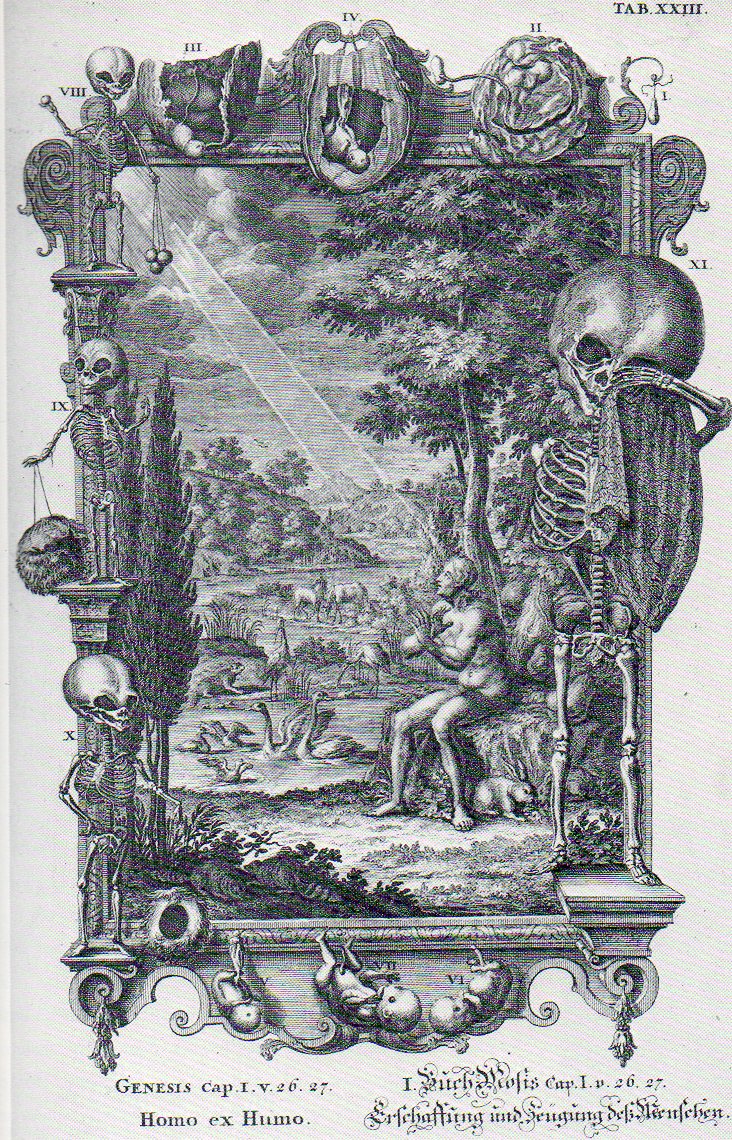
The image that I latched onto [and which is available at 200% if you click through it] illustrates Genesis I 26, 27:
“26: And God said, Let us make man in our image, after our likeness: and let them have dominion over the fish of the sea, and over the fowl of the air, and over the cattle, and over all the earth, and over every creeping thing that creepeth upon the earth.
27: So God created man in his own image, in the image of God created he him; male and female created he them.”
Indeed. We can see the pure holly light (appreciably wide as it gets to its subject than when it started, where it is also degraded) extending diagonally across the image to a surprised/fearful Adam, who is popped into a landscape of the newly-created. But it is the border illustration that is most extraordinary to me–it is an 11-segment depiction of the birth process, told almost exclusively in baby skeletons. The story begins at top-right corner, with perhaps a hint of conception, and then through developmental stages II (embryonic) and then III/IV (taking us through the third month) and then V through VII (showing perhaps through the seventh month or so), displayed in a top- and bottom-middle display, and not in order. I really don’t know enough of developmental anatomy to say what is depicted in images VIII through XI, except to note that–of course–they are all skeletons, and the last is weeping.
Spermatozoa seem to be missing in images I and II, or at least Scheuchzer didn’t make an attempt to show them at work, even though he must’ve been aware of their existence, discovered fifty years earlier (in 1677) by Leeuwenhoeck. But this discovery certainly didn’t get in the way of maintaining the theory and belief in the homonuclus–the tiny, preformed person carried completely within the sperm and implanted in the woman who served basically as an oven, a receptacle. Scheuzcher believed on the other hand that the homonuclus was located in the ovaries–still part of the preformationist camp, but getting closer to elevating the importance of woman in embryological development.
[All that said I don’t know the reason for the weeping skeleton; or, for that matter, what the things are that the two skeletons at upper left are holding.]
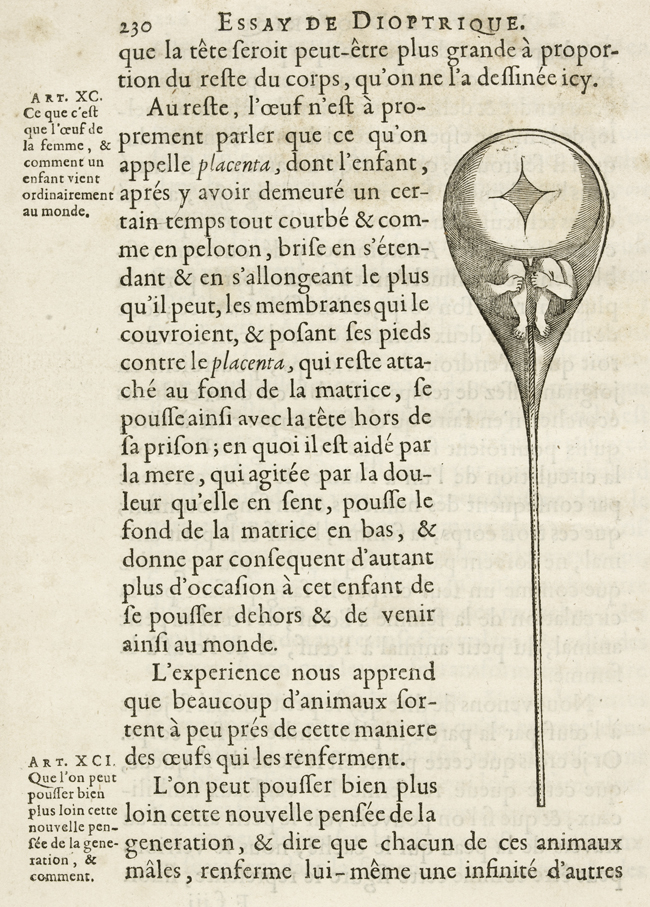
The homunuclus, famously illustrated in Nicolas Hartsoeker’s Essay de Dioptrique in 1694: