JF Ptak Science Books Post 1163
Being at the airport yesterday to watch the glorious EAA B-17f take off and land (and to see our 7- year-old climb through it and the Blackhawk that suddenly appeared) put me in mind of the extraordinary advances in flying in the earliest history of heavier-than-air flight. I picked up a volume of The Illustrated London News for 1909 to check out the popular reporting of the aeroplane and as usual got a very sharp reminder of how fast everything happened in the 1905-1915 period.
In the earliest stages of the development of heavier-than-air flight (powered and not, 1848-1906) there were major innovations and essential experiments from a dozen countries: England, the U.S., Poland, France, South Africa, Russia, Germany, New Zealand, Australia, Brazil, Romania, Sweden, Norway and Denmark. Even with all o f this directed work, the methods weren’t necessarily made public or when so were not well distributed, with many of the aviation/engineers working in obscurity and without contact with their peers. (Examples of the major players in the history of heavier-than-air early flight include John Stringfellow, England, 1848; George Cayley, England, 1853; Matias Perez, Cuba, 1856; Jean-Marie Le Bris, France, 1856; Jan Wnek, Poland, 1866; Goodman Household, South Africa, 1871; Félix du Temple de la Croix, France, 1874; Victor Tatin, France, 1874; John Joseph Montgomery, US, 1883; Alexander Feodorovich Mozhaiski, Russia, 1884; Clément Ader, France,1890; Otto Lilienthal, Germany, 1891; Lawrence Hargrave, Australia, 1894; Hiram Stevens Maxim, United Kingdom, 1894; Shivkar Bapuji Talpade, India, 1895; Samuel Pierpont Langley, US, 1896; Octave Chanute, US, 1896; Carl Rickard Nyberg, Sweden, 1897; Gustave Whitehead, US, 1899; Percy Pilcher, U.K. 1899; Augustus Moore Herring, US, 1899; Wilhelm Kress, 1901; Orville & Wilbur Wright, US, 1902; Richard Pearse, New Zealand, 1903; Karl Jatho, Germany, 1903; Orville & Wilbur Wright, US, December 17, 1903 (finally for the first recorded controlled, powered, sustained heavier than air flight); Orville & Wilbur Wright, US, 1904 (in the Wright II, making the first turn, and then later in September making the first circle); Horatio Phillips, UK, 1904; John Joseph Montgomery and Daniel Maloney, US 1905; Wilbur Wright, US, October 5, 1905 (circular flight of 24 miles in 39 minutes); Traian Vuia, Romania, 1906; Alberto Santos-Dumont, Brazil, 1906.)
By 1909 there were many dozens of different aircraft flying around, just about but not quite getting to the sophisticated stage. In just a few short years, by 1915, there would be an enormous increase in the capacity and numbers of airplanes –pushed along of course by the needs of war. Which is a little odd as some of te earliest fliers’ ideas and planes were rejected by the military establishment. The Wright fliers for example were not at first a welcomed idea to the U.S. Army (for numerous reasons, the Army saying “no” in 1905 but renewing their interest in 1907 and finally buying the plane in 1909) ; nor were the Brits interested in continuing funding for Samuel Cody (from Birdville, Texas) , pulling support for him just a few months after he had succeeded in flying the first British-built airplane in Great Britain (the British Army Aeroplane 1B). That of course would all change in just a few years with the guns of August.
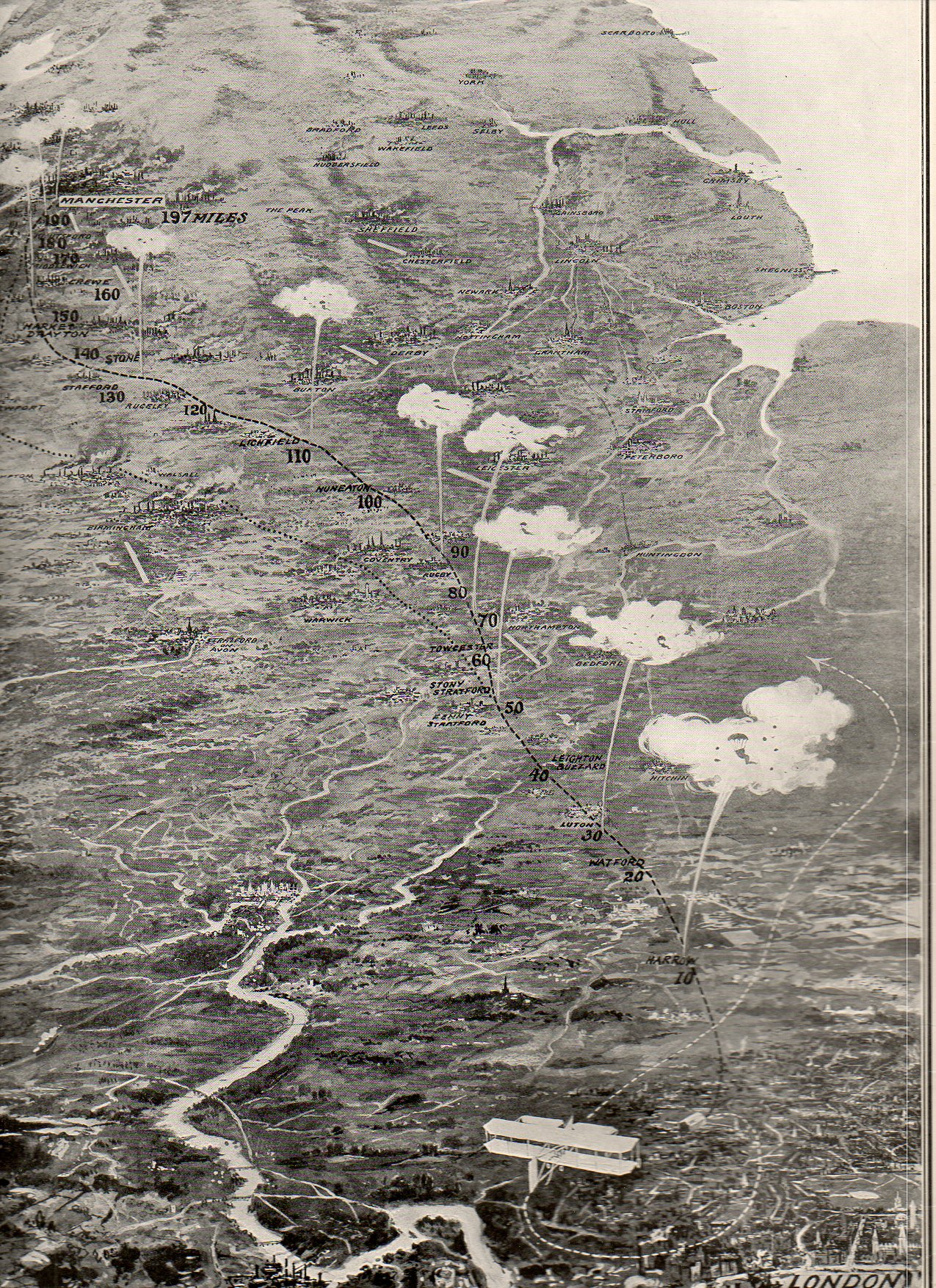
Seeing this plan (above) for Samuel Cody’s flight from London to Manchester would’ve been a breathtaking achievement, had he made it. The event had the trappings of An Enormous Situation, with smoke bombs and 450′-long white cloths to show him the way. As particularly thrilling as this event was in 1909 it would be overshadowed in short order. In perspective, it was only six years earlier that the Wrights engaged in the first powered heavier than air flight.
In 1903 the Wrights flew 121 feet; in just six years, Louis Bleriot would fly across the English Channel (on 25 July 1909); six years later Alcock and Brown would make the first transatlantic flight. In 1911 Cal Rodger (11 De3cember1911) made the first American transconteintal flight (completed over the course of 50 days, with 3 days 10 hours in actual flying time). 11 Years later Jimmy Doolittle flew from Florida to California in just 21 (with one stop for refueling); the next year would see the record for transcontinental flight broken with a nonstop effort of 26 hours; in 1930 the time would go down to 12 hours and by 1945 the time was an extraordinary 5 hours 17 minutes. (The retiring Blackbird flew the length of the country in 1990 in 64 minutes.)
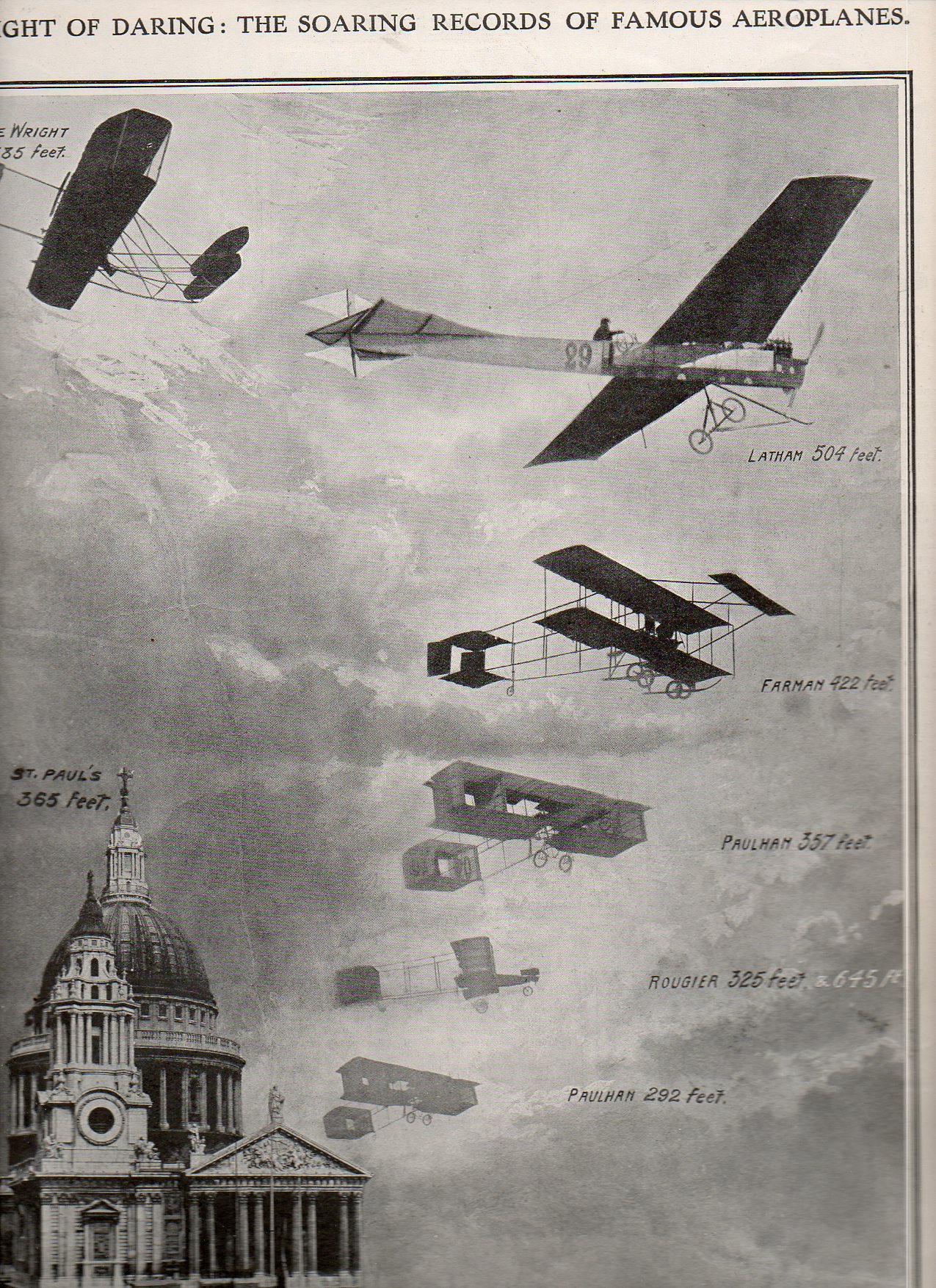
The next image showing the altitude records for aviation in 1909 is just as phenomenal. The record at this point still stood with the Wrights at 585 feet, less than double the height of St. Paul’s. It was a huge achievement, the other contenders coming to within hundreds of feet of their accomplishment but not quite doing enough to become the new world record holders,. Ion just the next year improvements in the quality of aircraft and engines and control made it possible fo r Louis Paulhan to achieve 3,018 feet in January 1910, Walter Brookins top climb to a record of 4,603 feet (7 July 1910), and Ralph Johnsonte to 8,471 on 20 October 1910. . It must have bene a shocking development to have seen aeronautics to advance so quickly, breaking the old altitude record by a more than an order of magnitude in one year. The speed record is a more difficult matter, but after recording speed records in the 30/40mp range in the 1903-1909 period, it broke to 66 mph 1910, 134 mph in 1914 and over 300 mph by 1928. The difference in aviation in those 25 years is similar to that between the computing now and that of 1985 (and certainly 1979).
I’m just saying that it is good to remember the enormity of change that took place in that early period of 1906-1919 or thereabouts–they were simply revolutionary developments that must’ve appeared to the folks of those times.
Notes:
Cody was one of the most colorful figures in the history of early aviation in the U.K. Born in 1867 and self-styled after Colonel William F. Cody, he was an inate adventurer and experiential bon vivant, who loved what he did and made sure that everyone else knew it, if nothing else. All that aside, he was a significant figure, important in the development of flight in England, and he died young for his pursuit. He appeared in the LA Times of 14 September 1907 (page 14) saying that the future of war would be in the air, and that the airship would “effect commerce as well as war”.