JF Ptak Science Books Post 1080
My favorite mid-century illustrator–G.H. Davis of the Illustrated London News–has provided yet another remarkably clear and well-designed series of images on a difficult topic for a main-line popular audience. This time (appearing as a two-page spread on 28 July 1945 in the ILN) showed the structure, strategy and deployment of one of the late war’s
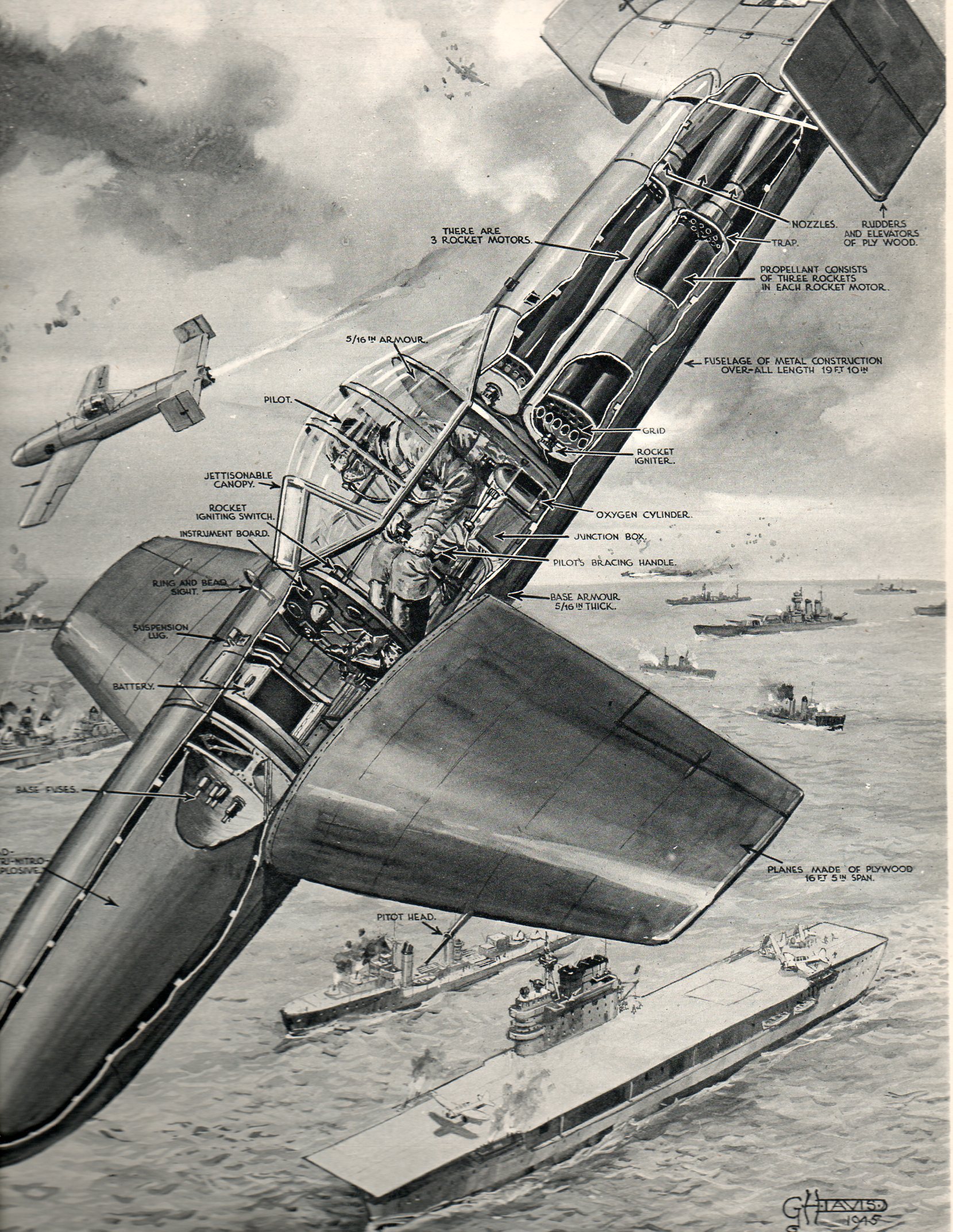
most feared weapons–the jet-powered human bomb of the Japanese naval air force. (In practice though the weapon didn’t produce that must damage though it did produce the fear: “the operational record includes three ships sunk or damaged beyond repair and three other ships with significant damage; seven US ships were damaged or sunk by Ohkas throughout the war”1). The Yokosuka MXY-7 Ohka was a purposefully designed and built rocket powered suicide rocket whose sole purpose was to attack and destroy ships. They were first produced in 1944 as unpowered glider aircraft, and then later in November 1944 the rocket propulsion system was added. All tolled, the Yokosuka and the Kasumigaura Naval Air Arsenal together built about 850 of them–fewer than 3 dozen survived.
It was a relatively simple construction and was easily deployed: dropped from a bomber it would glide until near it target and then the rockets would be ignited, powering the thing to a near-unstoppable 500+mph, sending it, its pilot and the 2,300 lb ammonal warhead (an explosive made up of ammonium nitrate, trinitrotoluene (TNT), and aluminum powder) into its target, detonating on impact.