JF Ptak Science Books Post 1075
The field of “photographic firsts” has always been interesting to me–the first photograph of the Moon, the first of a person the first portrait, the first color photo, the first engraving of a photographic image, and so on–and so I came to wonder about the first photograph of an airplane, or aircraft. What I found was this monster, built by Jean-Marie le Bris, evidently the first image ever made via photography of a fixed-wing aircraft:
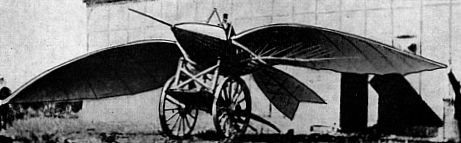
The photograph (made in 1857, 18 years after the invention of photography) looks very reworked and strains the imagination some, but it shows the glider of Jean-Marie le Bris, who actually achieved gliding flight in the aircraft. I am sure that the glider used those enormous wheels for land transportation and were not an integral part of the craft.
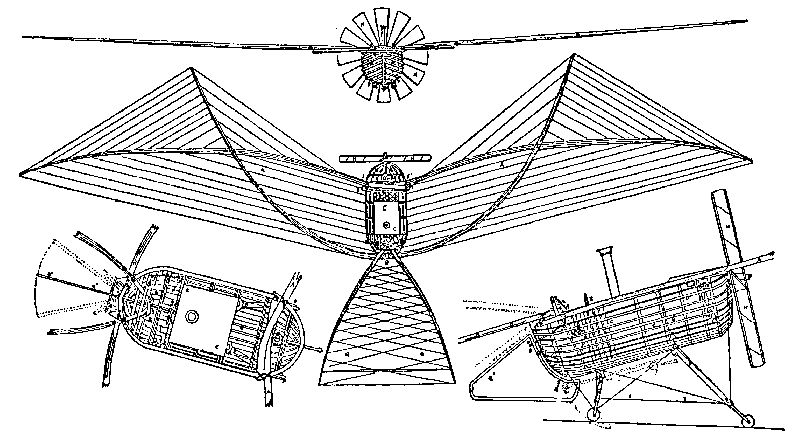
It was in that same year that Felix du Temple and his brother constructed and flew a small, steam-powered monoplane aircraft model (schematics above), which looked like a bird from the plan perspective and a beetle from the elevation. The view of the model head-on seems remarkable to me, showing very little in the way of profile.
Ferdinand d’Esterno produced a lovely design of a possible aircraft in his 1867 pamphlet, Du Vol de Oiseaux (“Onthe Flight of Birds”) , a glider that looked manageable and full of possibility, all based on his relentless study of the flight of birds. Esterno reasoned that all of the heavier birds excelled in soaring flight, and since this was the case, there was hope for man to fly as well.
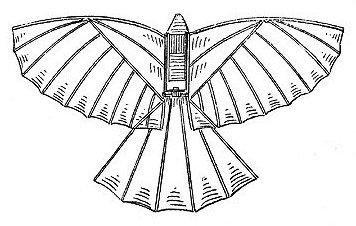
Esterno’s glider was interestingly outfitted with a movable seat for the pilot–something that would be able to change the center of gravity, the flier’s chair connected to the very broad tail section–controlling a rather elegant, rather light-for-its-era (330 pounds) craft with 215 square feet of wing surface. (See Flymachines.org for a nice description of this and other early aircraft.) I think what I like most about the Esterno machine–an idea that never progressed beyond the drawing stage–is its compactness and lovely lines, especially as we can see in the cross-section below:
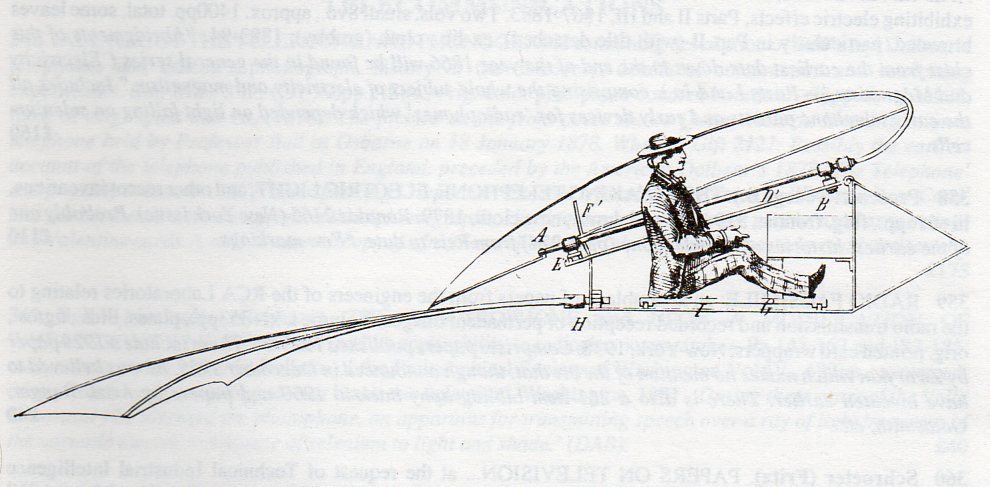
As the author(s) of Flymachine.org and other sites and books have pointed out, though Esterno’s plans never got out beyond the pages of his pamphlet, he did have an influence on other later fliers, most notably Gustave Whitehead (1874-1927) and the Wright Brothers. It was whitehead’s work which from my perspective most closely resembles Esterno’s as we can see below in this ca. 1901 photograph, the greatest difference of course being the two engine-driven propellers.
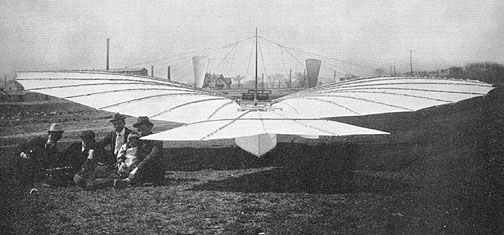
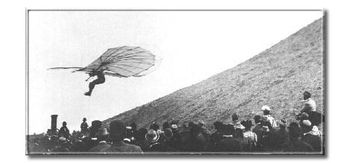
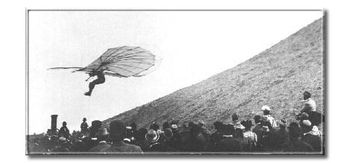
But it was Otto Lilienthal who was one of the most important figures in the development of
flight in the nineteenth century, making the first heavier than air
gliding flights in what looked quite a bit like bird wings. (Wilbur Wright said of him; “Of all the men who attacked the flying problem in
the 19th century, Otto Lilienthal was easily the most important. … It
is true that attempts at gliding had been made hundreds of years before
him, and that in the nineteenth century, Cayley, Spencer, Wenham,
Mouillard, and many others were reported to have made feeble attempts to
glide, but their failures were so complete that nothing of value
resulted” as found in The Aero Club of America Bulletin, September 1912, and
also in the article on Lilenthal in Wiki.) ) He would die in 1896 in
a gliding accident, falling to a crumpled death. We see him in a more successful moment in this fantastic photo:
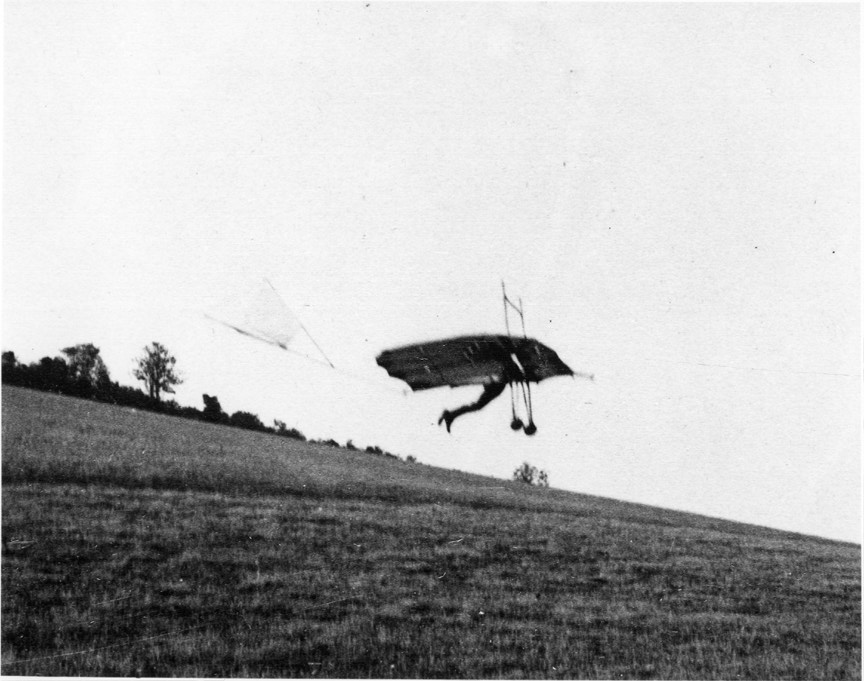
Lilienthal also influenced the English aviator Percy Pilcher (1866-1899) whose four interesting gliders ( named theBat,
the Beetle, the Gull, and the Hawk) led to his engine powered glider–a design left not completed due to Pilcher’s own fatal gliding accident in 1899.
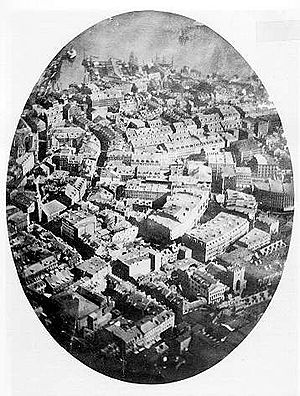
But getting back to photographic “firsts” and aviation, the earliest surviving aerial photograph was made by James Wallace Black (1825–1896) whose tethered balloon image of Boston (below) is a splendid 160-year-old image of the city; the first first in this category actually belongs to Gaspard-Félix Tournachon (more popularly known as “Nadar”) but that work hasn’t survived.