JF Ptak Science Books Post 1029
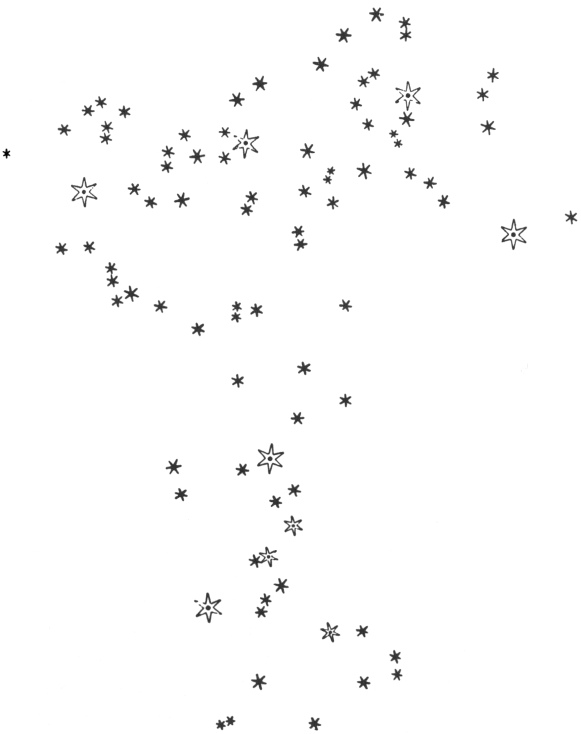
[History of Dots series]
I was wondering when it was that stars began to appear as dots in celestial atlases or astronomical works–dots rather than starry stars, decorated spheres with crusty circular fire rings about them.
I felt that at some near point in the history of astronomy that t he conventional antiquarian way of representing a star would fall away with magnification, or clarity, just as has been the opposite case with the magnification of simple dots to reveal complex structures, say with the amplification of the flea eye…even a graphite pencil’s period at the end of a sentence on a piece of paper will turn itself from a dot into something as complex as the coastline of England (given enough magnification).
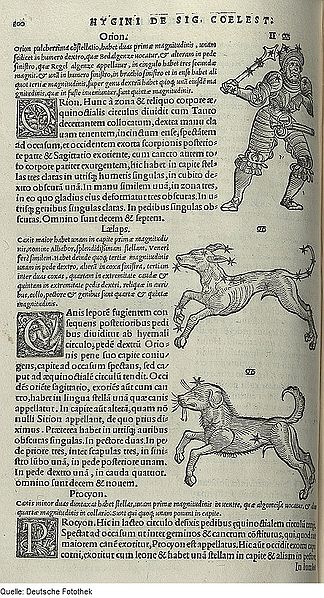
 The first star atlas published in 1482 after the work of the first century astronomer and philosopher Hyginius1 contains maps of the constellations composed of such beautiful light-encrusted bits. There wouldn’t be another work like this one, strangely, for another 75 years. Alessandro Piccolomini’s2 work of 1559 (which would be the first true star atlas), and again we see the familiar representation. I thought that this would change with the invention of the telescope, so I checked out Galileo’s3 beautiful account (pictured at left) of his discoveries in the Sidereus–again the same complicated, sawblade stars.
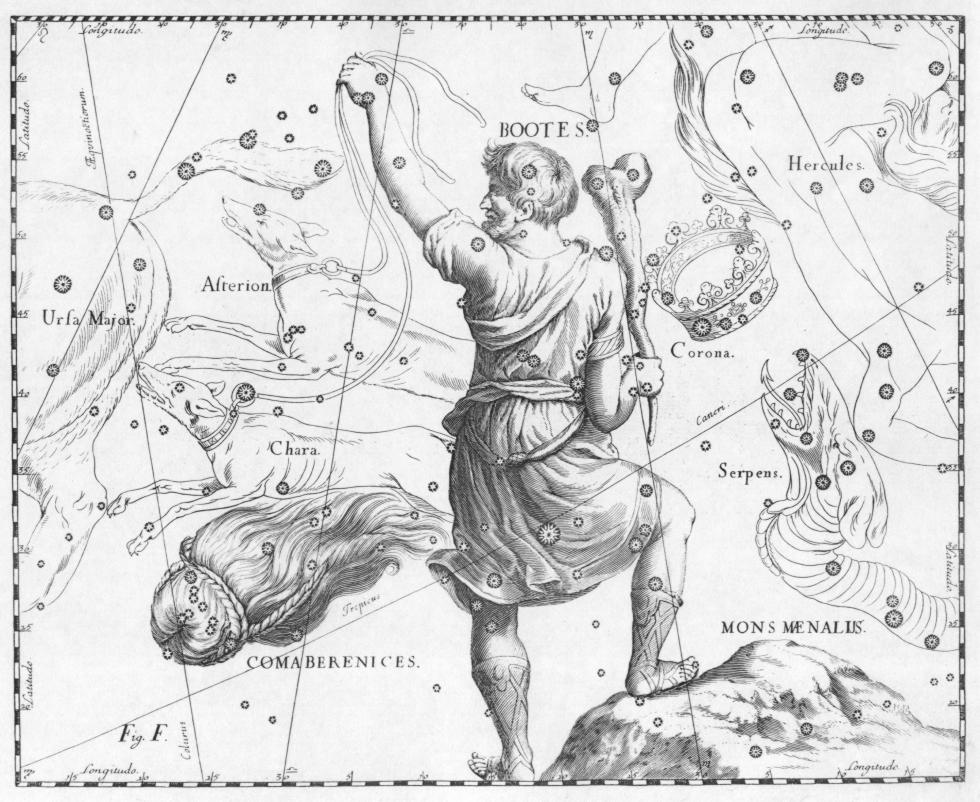
This has not been a very scientific search thus far, only checking handy notes and images that I’ve made. But the same result has been true for the star images in Bayer4, Cellarius5, Hevelius6(at right), Coronelli7, Flamseed8, Doppelmayr9 and Bode10. Even William Herschel’s fabulous map of the galaxy is a collection of these pointed stars. I think that I’ve just missed what is normally seen by regular folks as a conventional reassignment of star images to something more “modern”–and if that’s the case it has simply passed me by. (It seems though that among all of these that Hevelius comes closest–he inverts the familiar star pattern to the interior of a sphere.) And I continue to miss it. I’ve worked my incomplete survey now pretty close to the end of the 18th century, and I simply do not have a close answer..If anyone out there does have it, please let me know.
Notes:
1. Hyginius Mythographus (fl. 1st century A.D.). Poeticon astronomicon. Edited by Jacobus Sentinus and Johannes Lucilius Santritter. Venice: Erhard Ratdolt, 14th October 1482. The first star atlas per se, standing alone in its field for a century.
2. Piccolomini, Alessandro. De la Sfera del Mondo. 1559
3. Galilei, Galilei Sidereus Nuncius (known in English as Starry Messenger), published 1610
4. Bayer, Johann. (1572 – March 7, 1625) Uranometria 1603, which was the first atlas to cover the entire celestial sphere.
5. Cellarius, Andreas (c. 1596 – 1665): Harmonia Macrocosmica (1660, 1661, 1708).
6. Hevelius, Johannes (1611 – 1687): Firmamentum Sobiescianum, sive Uranographia (1690).
7. Coronelli, Vincenzo (1650 – 1718):
8. Flamsteed, John (1646 – 1719): Atlas Coelestis (1729, 1753).
9. Doppelmayr, John Gabriel (1677 – 1750): Atlas Coelestis (1742).
10. Bode, Johann Elert (1747 – 1826): Vorstellung der Gestirne auf XXXIV Tafeln (1782).