JF Ptak Science Books LLC Post 1014

many appearances in Western art prior to the 20th century–published images just don’t appear. Nor do the
originals–considering the ephemeral nature of the effort at art by children,
their work just don’t seem to survive. Some of that reason–particularly
in
the scarcity of materials for kids to produce art with: paper was not
inexpensive, and neither brushes and paints. Crayons, invented for chubby
and reachy fingers, were not invented for the mass market until 1903. (Crayola sold eight crayons in a box for
a nickel. The colors? Black, brown, blue, red, purple, orange,
yellow, and green.) Then of course the artwork would have to be
saved, somehow, for generations. As much as it would be fascinating to
find artwork done at age four by your great-great grandparents, it would have to
survive the cleansing tendencies of four generations of clean-up. End
result: there’s just not that much antiquarian chldrens’ art floating
around.
 It also doesn’t appear as art in artwork. It is possible to
find numerous examples of kids’ scratches in stone and such in ancient
graffiti, but it doesn’t appear as elements of fine artwork, or, for that
matter, in book illustration.
Also it seems to me that the artwork for pre-school age children looks about
the same—3-year-old kids drawing images of other people tend to look pretty
much identical, and so this way over many centuries. No doubt some group has studied this in depth
and in detail, though I don’t know about it—to me, by seat-of-the-pants
reckoning, the representations of people/animals/sun/sky and so on look like
they can be coming from the same classroom, even when the art is coming from
different centuries and from different parts of the globe. (At least for the 99% of them.) I find this remarkable. Then of course things happen, children
change, they get schooled, educated, informed, indoctrinated, and on and
on. But for that early period, the art
of children has a spectacular commonality.
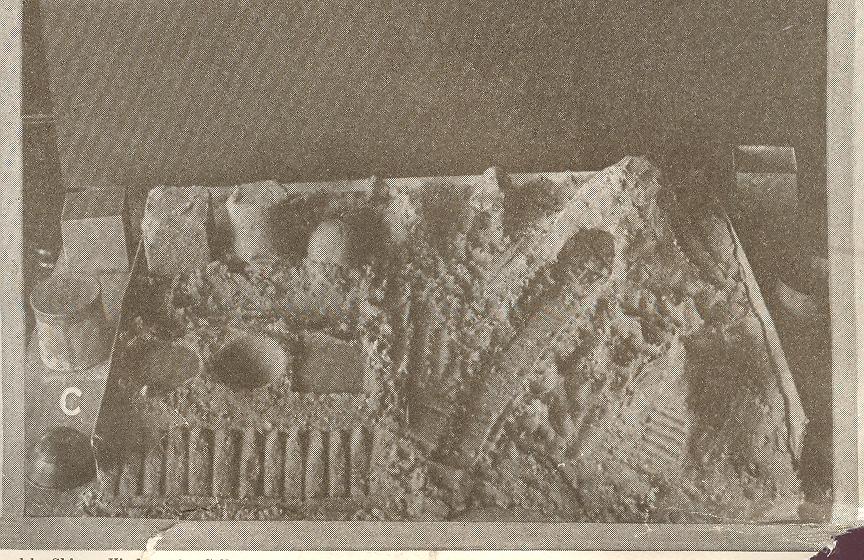
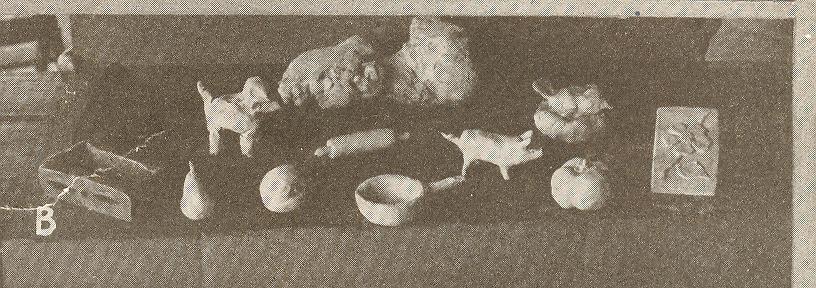
Reigning this in, the issue of childhood art was again rallied after finding
an illustration of children’s school art—there was a sort of diorama, but then
there was also an image of clay figures made by kids…and then there was the
sand castle. I honestly cannot recollect
ever seeing a hundred-year-old image of a child’s sand castle. Some woodcut must appear in Harper’s Weekly or some such magazine,
showing play at the beach, perhaps the castle making an incidental appearance
at the edge of the scene. I was struck
by the picture, and by its (perhaps) rarity.
I have no doubt that kids having been building things in sand and mud
forever; whether there are many published pictures of the results, I really don’t
know.
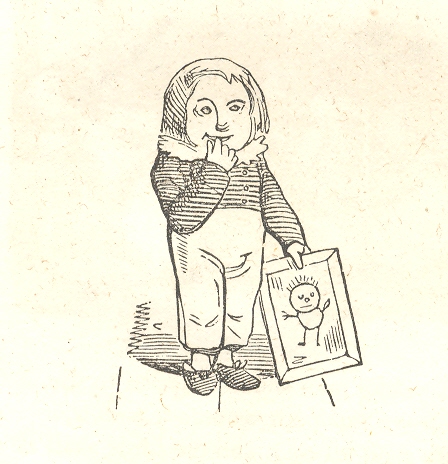
a New Collection of Nursery Rhymes, published in
in 1847. The book is filled with unusual illustrations and fantastic
ornamental borders, all used in support of some odd, scary, mean and
occasionally pretty mid-century posies meant as night-time entertainment for
the young ones. Our prize is found on the very last page, the final slug
of an illustration to a more-finely illustrated book: a coy, small boy, holding
an example of his art, seemingly drawn on a framed slate. He looks happy,
pleased, proud to me–on the one hand he is interested in sharing his
achievement and on the other is really too shy to share, an emotion I’ve seen
from time to time with my girls. As a matter of semi-fact, this is a rare
emotion to see displayed in art, the too-shy-to-share routine saved more for
fluttery self-conscious Victorian grown-ups more so than for children..
Believe me, after having dealt with books and prints as an antiquarian for
almost 30 years, and also having a collection of sorts of antiquarian
childrens’ arts, pictures like this just don’t surface very often at all.
Over the years I’ve made some annoying phone calls and emails to librarians at
art galleries (especially at the National Gallery in DC where I was a pester)
explaining my interest and trying to find out if this struck any bit of memory
in their brains–I never once had a positive answer. (I expected at some point that
someone would say, “Oh yes, of course–there’s a census of that that Mr.
Kemp of Yale did in 1977”. Or something, some sort of memory for this kind of
image.) This is hardly an academic pursuit, but my occasionally ritualistic
clawing seems to bear out that these things are just not available.
All I have to go with here is the sheer emotion of seeing some of these pictures–they strike such an utterly deep chord, and are so astonishing, and personal,and so completely resonating, that I know they are important.. In a way I think that whatever is in the picture in that little boy’s hand from 1847 is what everyone is looking for