During the Exodus Moses and the Israelites were often in deep, mortal danger—perhaps none more
dangerous as when they ran out of water.
Moses’ leadership (and safety) came under question (Exodus 17:4), with
Moses crying out to the Creator that he needed help, and that his people were
about ready to stone him. The answer
came quickly, with Moses directed to strike a rock with his staff, the
resulting action bringing water/a stream from the rock (Exodus 17:5-6).
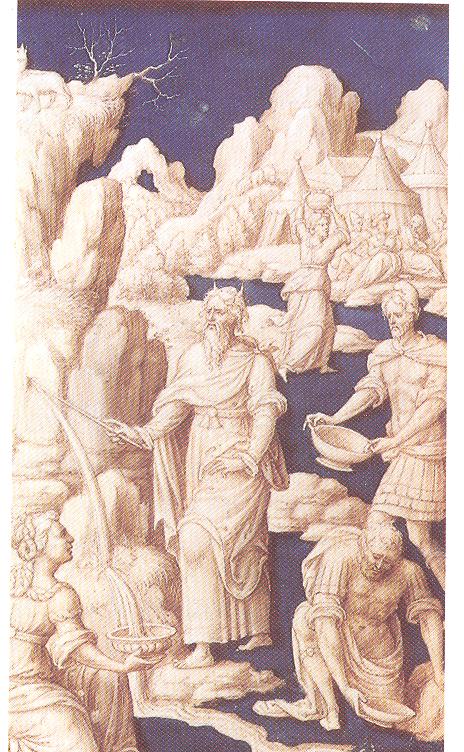
And that’s what is going on here in this little scene from a
15th century (unfortunately unspecified) French Bible. The rare use
of almost all white set against a blue background gives the whole a
marble-like, lifeless effect—which seems to mirror the sense of nothingness in
the Israelites reactions to the great miracle.
Their prayers were answered, but their anticipation of fulfillment and the
act itself goes emotionally unregistered.
Moses also looks removed, gently touching the rock with a
rod which s very lightly controlled by a mostly-open hand—his bearing is one of
great lightness.
This scene is often repeated and represented throughout the
history of art, though usually with more (or actually, “some”) emotional
quality. When the scene is depicted with
little emotion it seems usually to be a small piece of art, a touchstone,
showing just the head of Moses/the rock/the staff, a bit of simple visual
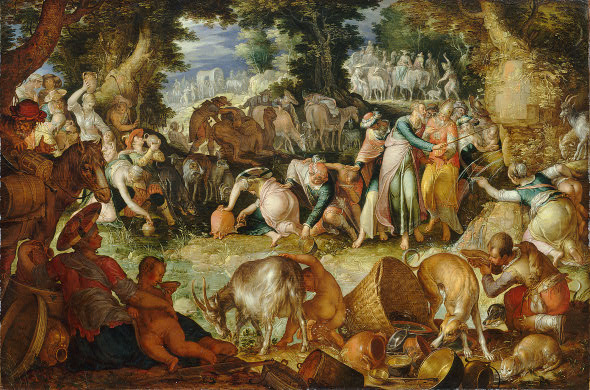
shorthand to remind eh viewer of the story (as in the work by Giotto in 1305). Generally though the scene is shown in high
drama, as with the work of Joachim Anthonisz Wtewael (1664), Abraham Blaemaert
(1596), Nicolas Poussin (1649), and many others. Sometimes in some very early
work the woodcutters show Moses wielding his staff over his head, getting ready
it seems to crack the rock open. Bu not here, not in this image—the emotion of
the scene has been literally whitewashed away…it is beautiful, but it is a cold
beauty of nothing.
(Wtewael, below).