JF Ptak Science Books LLC Post 913
What
if our eyes worked in the “opposite” way?
What if we somehow broadcast the lines of reality from our eyes1 rather
than receive photonic emissions from the physical world, that we didn’t specify
the wavelength and frequency of light, and that somehow electromagnetic rumblings
in the “visual range” didn’t apply to our sense of sight?
This
would certainly make for an interesting existence
if somehow the elements around us weren’t necessarily so. Perhaps this is sort of replacement reality
is just what has been going on in the entire history of humans, altering the
landscape to make it more suitable for our existence, a long history of
painting the physical landscape with something more “suitable”, an
individualized creation.
This
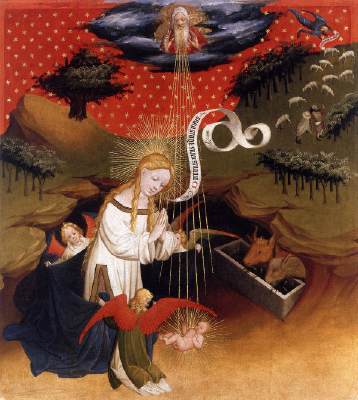
all came up wondering about this fantastic sky, produced 475 years before
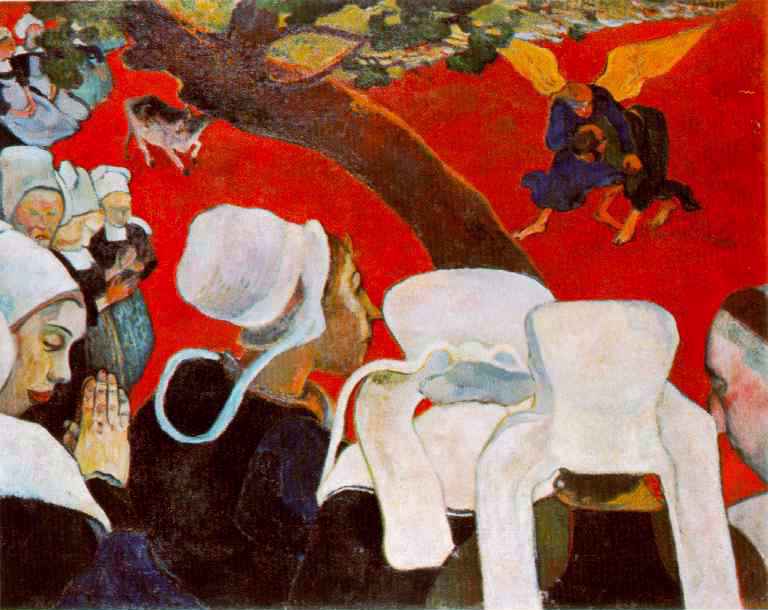
non-representational art and 455 years before Gauguin started applying big blankets of red2 : it seems to me
in a distant impression that it is a representation of vision that is more a projector
than a camera.. The end result of this
emission and wayward thought is the fabulous red sky in the painting Nativity by Master Francke3 (ca.
1424-1436) is a fantastic red sky with lustrous stars.
The
painting is otherwise filled with the common reliables of Renaissance iconography
concerning the nativity: the place of “birth”
(a stable or barn-like building, also sometimes appearing as a classical ruin
or cave), a flock of sheep, a stand of trees, and the watch sensate gazes of the near by
beasts. Mary is ecstatic in the same ways
that Joseph is usually not—to me, he usually seems pretty detached from the
whole deal, lost in another space. The
baby Christ is again just a little man (and not a baby) laying there on the barren
ground. [I’ve wondered about Joseph’s
detachment: perhaps the whole scene is
nothing but mysterious, a complexity far removed from his reach and
understanding, a notion of an act that is so phenomenal that there is no
retrievable reaction for it, and so he looks away. Later on in the history of Mary and Joseph,
and deep into the 19th century when the Immaculate Conception—that is,
the sexless conception of Mary the mother of Christ which she would later accomplish
for her own baby—the issue of Joseph’s own virginity comes up, mounting the
confusion no doubt in Joseph’s already-full head.]
But
back to the sky: certainly skies and
backgrounds of pure gold and blue painted by the masters in
and
abound during this time, but red is quite unusual. The sky is accented by the terrific red of
the wings of the angels and more softly so in the hair of the (long-fingered) Madonna.
There
is also the issue of the hole in the sky, revealing the large-handed Creator with glimpses
of the alternate, higher, existence visible in the background, a taste of the
alpha (or omega?) part of the long arch of Earth-borne humanity.
Notes
1.The discussion of optics and vision is one of the most spectacular conversations ever held in the history of science and philosophy (along with “time”, “motion” and “the void”. I think that Leonardo would’ve come closest in relatively-modern times to understanding vision if he had the real capacity of dissecting the eye (which in spite of many approaches to experiment) would always go flat, leaving him with an unsatisfying mess.
In Aristotle’s Physics (Book II, Part II) we find the following fascinating thought:
“Similar evidence is supplied by the more physical of the branches of mathematics, such
as optics, harmonics, and astronomy. These are in a way the reverse of geometry. While
geometry investigates physical lines but not qua physical, optics investigates
mathematical lines, but qua physical not qua mathematical”
A classical position of the emission theory of optics is stated by Hero in his Definitions:
“Optics does not deal with physical questions and does not study whether given rays
flowing out from the eyes go forth to the boundaries of objects or whether images that are
detached go forth from corporeal objects [and] enter the eye along a rectilinear path or
whether the intervening air is stretched or contracted by the ray-like pneuma from the
eye. It is only concerned whether, at each reception (of an image) the right direction of
movement or tension is maintained as well as the requirement that the convergence to a
point occurs at an angle when objects are seen that are larger or smaller than the eye.”
(My thanks to Dr. Kim Veltman for these quotes from her Continuity and Discovery in Optics and Astronomy, Studies on Leonardo da Vinci http://www.sumscorp.com/books/contin/title.html)
2. I had Gauguin’s 1888 “After the Sermon/Jacob Wrestling the Angel” in mind for an example of this.
3. Master Francke active (c. 1424 –
36 ), Nativity, in the Kunsthalle,
39×35 inches.
Opened, the altarpiece showed scenes from the Passion of Christ. Francke was a leader of the northern German version of International
Gothic. He had close links with French book illumination (he may
have worked in
paintings of the
of Conrad van Soest
, though it is not known where he received his training.”
Other Nativity scenes as follows: