JF Ptak Science Books LLC Post 836 Blog Bookstore
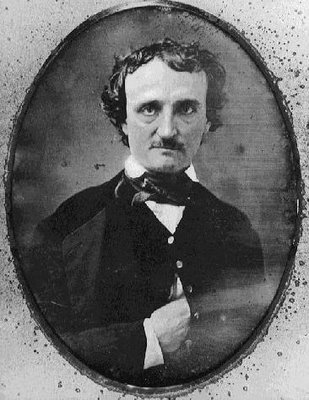 I was paging through the literary criticism and review volume
of my Collected Works of Edgar Allan Poe
and came to an unassociated wondering about what those “curious volumes of forgotten lore” from “The Raven” might’ve
been. First let me state that Poe was a
critical eviscerator, writing in advanced-smart
hyper-bitch mode, capable of crushing anyone. It was here, doing book reviews and general
literary bric-a-brac commentary that he made his first real way into national
consciousness (working for Graham’s
and Southern Literary Messenger and others). When he set his mind to it the man could build
a quick and modest edifice in which to flash-burn an author’s work. And he made short effort of it, too. (An example of this rides below.1) He liked people, too, don’t get me wrong; but more often than not he was comparing others to his own very high standards, and most suffered from a lack of O2 in the end.
According to the little I’ve read about the man, Poe didn’t dip deep into the past for his reading, and wasn’t known for
keeping a library per se, though he did have books–books which he sold from time to time when
the money got short and his ambitions high.
My first guess for the first book in the “forgotten lore2”
category of this young student pining away over his lost love was Robert Burton’s
Anatomy of Melancholy. Seldom have there been such great and
difficult-to-read books—and the first and only book of its author—so filled
with somewhat chance swaths of advanced learning and understanding that have
long survived the effects of its wrist-snapping weight on its reader. The book is filled, jam-packed with
polymathic geegaws that it makes the book both irresistible and forgettable. But it seems that Mr. Burton was not known—or
at least not mentioned—by Mr. Poe, so far as I can tell.
And so I wonder what else might fill this category? Poe knew his
Clarissa (1747) or Laurence Sterne’s Tristram Shandy (1759)?
Perhaps Poe meant for the volumes to be forgotten and forgettable? I just don’t know, but I bet some of you
might have some ideas.
1. a great example of Poe’s criticism is seen in his work on
Twice-Told Tales (1842):
“A skilful literary artist has constructed a tale. If wise,
he has not fashioned his thoughts to accommodate his incidents; but having
conceived, with deliberate care, a certain unique or single effect to be
wrought out, he then invents such incidents—he then combines such events as may
best aid him in establishing this preconceived effect. If his very initial
sentence tend not to the outbringing of this effect, then he has failed in his
first step. In the whole composition there should be no word written, of which
the tendency, direct or indirect, is not to the one pre-established design. And
by such means, with such care and skill, a picture is at length painted which
leaves in the mind of him who contemplates it with a kindred art, a sense of
the fullest satisfaction. The idea of the tale has been presented unblemished,
because undisturbed; and this is an end unattainable by the novel.”
2. Just in case, here it is:
Once upon a midnight dreary, while I pondered weak and weary,
Over many a quaint and curious volume of forgotten lore,
While I nodded, nearly napping, suddenly there came a tapping,
As of some one gently rapping, rapping at my chamber door.
`’Tis some visitor,’ I muttered, `tapping at my chamber door –
Only this, and nothing more.’